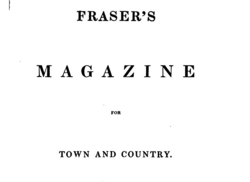
Fraser's Magazine
~ the eulogy ~
On 3 August 1836 a Member of Parliament walked into a bookshop at 215 Regent Street with his brother and a gold-headed hunting whip. The brother stood at the door. The MP, Grantley Berkeley, asked the publisher James Fraser to name the writer who had taken his novel apart in that month's number, and when Fraser refused he beat him with the whip. Three days later the man who had written the review fought Berkeley with pistols near the Harrow Road. That was the sort of magazine this was.
Fraser's Magazine for Town and Country began in February 1830 as a Tory monthly in the Blackwood's mold, planned by a barrister named Hugh Fraser and an Irish journalist named William Maginn. The magazine takes its name from Hugh, not from James Fraser the publisher, who was no relation and never claimed to have founded it. Maginn ran the editorial side for its first decade under the pen name Oliver Yorke, a fictional presiding gentleman who introduced the pieces and argued with the contributors, and whom readers understood to be nobody at all.
A surviving title page reads Fraser's Magazine for Town and Country, Vol. VIII, July to December 1833, London: James Fraser, 215, Regent Street, and sold by all booksellers and newsmen in town and country. Two bound volumes a year from that point puts the numbering at 106 in the second half of 1882, which is exactly the volume libraries hold for the final year. The run checks itself without needing a source to confirm the end date.
~ the dossier ~
| Born | February 1830, two shillings and sixpence a number |
|---|---|
| Peak | the 1830s, when Carlyle and Thackeray were both regulars |
| Killed | October 1882, replaced the next month by Longman's Magazine |
| Lifespan | 52 years, 106 volumes |
| Made by | Hugh Fraser and William Maginn, published by James Fraser of 215 Regent Street |
| Killed by | Longmans deciding a sixpenny magazine would sell better |
~ the whip and the pistols ~
The August 1836 review of Grantley Berkeley's Berkeley Castle went past the book and into Berkeley's family, which is what brought him to Regent Street. Both men sued. The cross-actions were tried together on 3 December 1836, with damages laid at six thousand pounds in each. Fraser was awarded a hundred pounds for the assault and Berkeley forty shillings for the libel.
The duel with Maginn ran to three exchanges of fire. One account has Maginn slightly hit on the last; the others say nobody was touched. James Fraser never fully recovered from the beating, and when he died at Argyll Street on 2 October 1841 after a long illness, the newspapers of the day laid the blame on Berkeley's whip. That is press attribution rather than a cause of death, but it is the version that stuck.
~ what came out of it ~
Thomas Carlyle serialized Sartor Resartus here from November 1833 to August 1834, and it landed badly enough that Fraser had to tell him so. Carlyle's own view of the magazine that printed his most famous book was that James Fraser was infatuated with it, and he called the thing a dog's-meat tart. It took two years and an American edition before anyone would publish Sartor Resartus as a book in England.
The rest of the list is long. John Stuart Mill's Utilitarianism first appeared as three articles in volume 64 in 1861. Ruskin began Munera Pulveris in 1862 and was cut off partway through for attacking the economists. Charles Kingsley ran Hypatia from January 1852 to April 1853. Thackeray wrote for it under Yellowplush and Michael Angelo Titmarsh, and Daniel Maclise drew eighty one caricature portraits for the Gallery of Illustrious Literary Characters between 1830 and 1838, which is still the main reason anyone can picture what the London literary world of that decade looked like.
~ the handover ~
Ownership passed from James Fraser to George Nickisson in 1842 and from Nickisson to John William Parker in 1847. The Longman brothers bought Parker's whole business in November 1863. The editors after Maginn were a procession: Francis Mahony, Nickisson himself, Parker's son, then James Anthony Froude from November 1860 to August 1874, William Allingham to June 1879, John Tulloch, and finally Charles James Longman from February 1881. A new series restarted the volume numbers in January 1870, though the libraries went on counting straight through to 106.
The circulation figures that survive come from the Waterloo Directory and they do not hold together: the same 8,700 is printed for 1831 and for 1879, with 8,000 in 1860 and 6,000 in 1870 between them, and a figure of 500 for September 1879. Whatever the real curve was, Longmans concluded in 1882 that a magazine at half a crown had no future and one at sixpence might. Fraser's printed its last number in October. Longman's Magazine, cheaper and aimed at a wider room, started in November, and the catalogs have listed the two as separate titles ever since.
~ leave a rose ~
an anonymous tribute. one rose per visitor per day.
@}-->-- ... roses left here
~ leave a wreath ~
a rose fades by morning. a wreath stays on this grave for good, with your name on it.
paid once through stripe. payments are handled by OÜ Lakeview, the small company that keeps rip.so running. the money pays for the hosting and the nightly digging. adopt it and the headstone reads "maintained in memory by" you. the groundskeeper plants new wreaths at the next tending, usually within a day.
» one email a week: new graves and the anniversaries of the dead. subscribe
other news: YiGG, Votes for Women, Dr. Dobb's Journal, HuffPost Arabi
also died in the pre-1980s: Votes for Women, Radio Londres, Berliner Illustrirte Zeitung
~ leave a note ~
visitors before you have left these graveside notes. anonymous welcome.