Votes for Women
~ the obituary ~
Emmeline and Frederick Pethick-Lawrence founded the paper in October 1907 and paid for it themselves. They edited it jointly, St Clement's Press printed it, and the Women's Social and Political Union adopted it as its official organ almost at once. It started as a monthly costing 3d with weekly supplements bolted on to keep it current, which is a clumsy arrangement that lasted about six months. In April 1908 it went weekly, and the month after that the price was cut to a penny.
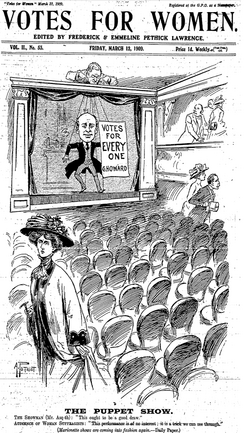
A copy from 12 March 1909 shows how fast that worked. It is volume two, number 55, priced one penny, weekly, with both Pethick-Lawrences named across the top. Count it back: roughly six monthly issues from October 1907, then a weekly from April 1908, and you land on number 55 in the second week of March 1909 almost exactly. The front page that week is a cartoon called The Puppet Show, with Asquith as the showman running a screen that promises votes for everyone, and an audience of suffragists telling him the performance is of no interest because it is a trick they can see through.
Circulation peaked at 33,000 a week in early 1910, after a redesign onto a bigger page and a poster campaign that put Helen Craggs and others on an omnibus going around London. Elizabeth Crawford's figure is the one usually quoted; Evelyn Sharp's biographer puts the height nearer forty or fifty thousand. Either way it was a paper that a few thousand women physically sold to each other, week after week, with no distribution network behind it worth the name.
~ the case file ~
| Born | October 1907, monthly at 3d, founded and paid for by the Pethick-Lawrences |
|---|---|
| Peak | 33,000 copies a week in early 1910 |
| Killed | March 1918, when the United Suffragists wound themselves up |
| Lifespan | 10 years and 5 months |
| Made by | Emmeline and Frederick Pethick-Lawrence, later the United Suffragists |
| Killed by | winning, and the loss of a campaign to report |
~ selling it in the gutter ~
WSPU members sold it on the street, and the police treated a woman standing on the pavement with a stack of newspapers as an obstruction. So the sellers stepped off the curb and stood in the road, where there was no offense to charge them with, and sold from there. Passers-by harassed them anyway. The union urged members going to the seaside each summer to come back with new subscribers, and supplied posters for the purpose, including a 1909 design by Hilda Dallas of the Suffrage Atelier.
The advertising pages are the part that has aged most interestingly, because the movement was effectively running its own small economy in them. Ethel Ayres Purdie took space for her accountancy practice, urging women to go and reclaim a portion of their income tax, and Sime Seruya used it to announce the opening of the International Suffrage Shop. Emmeline Pankhurst's secretary found the chauffeur Aileen Preston through an advertisement in it. Women who could not get served elsewhere advertised to each other here.
~ the split that took the WSPU away ~
In 1912 both Pethick-Lawrences were arrested and Evelyn Sharp took the editor's chair for a while. When the couple came out they were expelled from the WSPU over tactics, and the union started its own paper, The Suffragette. Votes for Women did not go with it. The founders owned it, so they kept printing it independently, with their readers reorganized into something called the Votes for Women Fellowship that was open to militants and constitutionalists alike.
That turned out to matter. Fellowship branches around the country spent their time on education rather than windows, some of them concluded they wanted to campaign again, and in February 1914 the paper announced the formation of the United Suffragists. In August the Pethick-Lawrences handed the title over to the new group and Sharp became sole editor.
~ the war paper for women ~
War cut the circulation badly and the finances never recovered. Sharp relaunched the pitch at middle-class readers under the slogan The War Paper for Women, and by October 1915 money was tight enough that it dropped back to monthly. She had come to oppose the war personally and kept the paper neutral on it regardless, which cannot have been comfortable to maintain issue after issue for the rest of the war.
The Representation of the People Act received royal assent on 6 February 1918 and gave the vote to women over thirty. In March the United Suffragists dissolved themselves, and the paper stopped with them. No open source records the date or the contents of the final number, which is an odd gap for a title this well documented. What is recorded is that the members gave Evelyn Sharp a book with all their signatures in it.
The domain votesforwomen.org today serves a blank GoDaddy template headed Your Business. The British suffrage movement's best-known slogan now resolves to a page that has never had anything on it.
~ leave a rose ~
an anonymous tribute. one rose per visitor per day.
@}-->-- ... roses left here
~ leave a wreath ~
a rose fades by morning. a wreath stays on this grave for good, with your name on it.
paid once through stripe. payments are handled by OÜ Lakeview, the small company that keeps rip.so running. the money pays for the hosting and the nightly digging. adopt it and the headstone reads "maintained in memory by" you. the groundskeeper plants new wreaths at the next tending, usually within a day.
» one email a week: new graves and the anniversaries of the dead. subscribe
other news: HuffPost Arabi, Dr. Dobb's Journal, Russkiy Kurier, Koduj24.pl
also died in the pre-1980s: Fraser's Magazine, Radio Londres, Berliner Illustrirte Zeitung
~ leave a note ~
visitors before you have left these graveside notes. anonymous welcome.