La Fronde
~ the eulogy ~
In April 1896 Le Figaro sent one of its columnists to the International Feminist Congress at the Sociétés savantes in Paris, on the understanding that she would come back with something amusing about it. Marguerite Durand was thirty-two, a former Comédie-Française actress who had left the stage in 1888, the year she married a Boulangist deputy, and had divorced him in 1895. She sat through the sessions and refused to write the piece. Her own account, given almost forty years later, says what changed her mind was the logic of the speeches and the way the chairwoman, Maria Pognon, kept control of a hall full of hecklers.
What she decided she wanted was not a magazine about women's questions. It was a general daily newspaper, covering parliament and the stock exchange, produced start to finish by women, so that the capability argument would be settled by the object itself rather than by anybody's essay about it. La Fronde went on sale on Thursday 9 December 1897 out of offices at 14 rue Saint-Georges in the ninth arrondissement, five centimes a copy, twenty francs a year in Paris.
The name means the sling, and behind it the seventeenth-century revolt. The first issue declared that the paper was making war not on men but on prejudice and obsolete law codes. It sought no triumph for woman over man, it said, only a place in society for a free creature. French Wikipedia, citing the standard history, calls it the first daily anywhere in the world made entirely by women, and the second women's paper of any kind, after Josephine St. Pierre Ruffin's monthly The Woman's Era in Boston, which had stopped eleven months before La Fronde started.
~ the dossier ~
| Born | 9 December 1897 in Paris, five centimes a copy, twenty francs a year |
|---|---|
| Peak | about 50,000 readers in 1898, against a steady subscription list near 12,000 |
| Killed | March 1905, at issue 2,110 |
| Lifespan | 7 years and 3 months, of which 5 years and 9 months as a daily |
| Made by | Marguerite Durand, who had left the Comédie-Française for journalism |
| Killed by | a luxury operation funded by an intellectual readership too small to carry it |
~ composé par des femmes ~
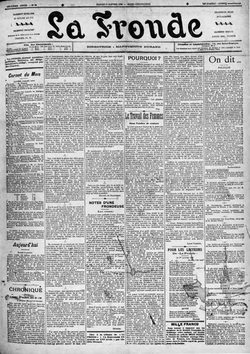
The standing line across the front page said what the paper was: La Fronde, a daily political and literary newspaper, is directed, administered, written and typeset by women. The verb that mattered was the last one. Journalists were one thing; a composing room was a closed trade with a union attached, and Durand staffed hers with women and had the paper printed by them. Every account agrees that the only man allowed on the premises worked nights as the watchman.
This collided immediately with a protective labor law that barred women from night work, which for a morning paper is the whole job. Durand's answer was to build the institutions the law assumed could not exist. Her Union of Women Printers was admitted to the Paris Labor Exchange on 3 February 1900 and her Women Printers' Cooperative Society followed on 22 November, the first women's cooperative in France. In 1901 she let eight of her own typesetters offer themselves as replacements during a printers' strike at Berger-Levrault in Nancy. The book workers' federation retaliated, and the union she had built was expelled from the Labor Exchange on 7 January 1902. She won it back in court in 1905, by which time the paper was finished.
~ 1 january 1898 ~
The New Year issue is the best single object the paper left behind. The nameplate reads DEUXIÈME ANNÉE, N° 24, and 9 December to 1 January inclusive is exactly twenty-four days, which means the paper had not missed a single one, Sundays and Christmas included. Underneath sits DIRECTRICE: MARGUERITE DURAND, and beside the price, LE NUMÉRO: CINQ centimes.
Flanking the nameplate are four date lines instead of one. The French Republican calendar is there, abolished almost a century earlier. Beside it sit the Protestant calendar and the Jewish one, which gives the year as 5658, in Tébeth. The fourth is Russian and reads 20 December, which is correct: the Julian calendar then ran twelve days behind, so 20 December 1897 in Petersburg was 1 January 1898 on the rue Saint-Georges. A paper that had to argue every working day that women could set type ran four religious and civil calendars across its masthead to make a point about whose year anybody was living in.
~ twelve thousand subscribers ~
The launch was enormous and the base was not. Durand had two hundred thousand copies printed for the first issue and sold something over forty thousand of them. Readership peaked near fifty thousand during 1898, but the subscription list that actually paid the bills settled at about twelve thousand, and she admitted those subscribers were mostly women with degrees. Against that she was running a general daily out of a townhouse with a telephone number and a stock-market correspondent.
English Wikipedia says the paper was financed by a seven-million-franc gift from Gustave de Rothschild. No French source supports that, and Durand spent years denying she had any backer at all, writing to Jane Misme that she had funded it herself by selling her pearls one at a time. The rumor about a Jewish syndicate bankrolling her was a Dreyfus-era smear, and the paper had earned it by being loudly and consistently dreyfusard from the beginning, which is one of the things that cost it readers.
By 1903 it was finished as a daily. The last everyday issue came out around 1 September, after 2,091 of them, and from that month La Fronde survived as a monthly supplement attached to a different failing paper called L'Action. Nineteen monthly numbers later it stopped, in March 1905, at number 2,110. Durand's own account of why, looking back, was that the socialists had found the paper too bourgeois and the provinces had found it too Parisian.
~ what durand kept ~
The masthead came back twice and neither return took. There was a weekly through the summer of 1914 that began before the war did and stopped on 3 September, and a six-days-a-week revival from May 1926 that put out 172 numbers before the end of that December and kept going into 1928. The Bibliothèque nationale carries the whole thing as one title with one ISSN, published 1897 to 1930, and prints a question mark where the final date should be.
What survived properly was the library. The paper's own reference collection at rue Saint-Georges, which La Fronde used to ask its readers to donate books to, grew into the documentation office Durand ran without salary for the rest of her life. Paris accepted the donation at a council session on 31 December 1931 and housed it beside the Panthéon. A heart attack took her on 16 March 1936, alone in the building, at work on the collection. The Bibliothèque Marguerite Durand is open today at 79 rue Nationale and holds the run of the newspaper that started it.
~ leave a rose ~
an anonymous tribute. one rose per visitor per day.
@}-->-- ... roses left here
~ leave a wreath ~
a rose fades by morning. a wreath stays on this grave for good, with your name on it.
paid once through stripe. payments are handled by OÜ Lakeview, the small company that keeps rip.so running. the money pays for the hosting and the nightly digging. adopt it and the headstone reads "maintained in memory by" you. the groundskeeper plants new wreaths at the next tending, usually within a day.
» one email a week: new graves and the anniversaries of the dead. subscribe
other news: Crime Library, CNN Airport, Sega Visions, The Brunei Times
also died in the pre-1980s: Nutting Associates, Clairtone, The Delineator
~ leave a note ~
visitors before you have left these graveside notes. anonymous welcome.