Partisan Review
» see partisanreview.org as it lived, on the wayback machine
~ the obituary ~
Partisan Review was started in 1934 by the John Reed Club of New York, a mass organization of the Communist Party USA, and edited from the first issue by Philip Rahv and William Phillips. The editors of New Masses helped launch it, Joseph Freeman among them. The early numbers mixed proletarian literature with cultural criticism, and Rahv and Phillips were already impatient with the first half of that mixture.
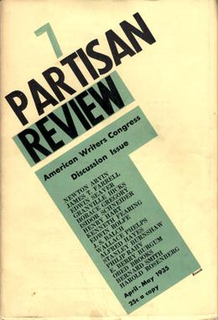
It was a little magazine in the literal sense, small circulation and large opinions, and the April-May 1935 cover is a fair picture of what that meant. A two-color block print, the words "American Writers Congress" and "Discussion Issue" set under the masthead, a column of contributor names running down the front, 25 cents a copy.
Then the party abandoned the John Reed Clubs in 1936 for the Popular Front, and interest fell away far enough that publication was suspended with the October 1936 issue. When Rahv and Phillips brought it back in December 1937 they brought Dwight Macdonald and F. W. Dupee with them, printed Trotskyist-adjacent writers, and were accused by the party press of stealing an asset. That was not a change of editorial line so much as a change of side.
~ the case file ~
| Born | 1934, in Greenwich Village, as a journal of the John Reed Club of New York |
|---|---|
| Peak | circulation of 8,150 in 1989, down to roughly 3,200 at the end |
| Killed | April 2003 |
| Lifespan | 69 years, with publication suspended from October 1936 to December 1937 |
| Made by | Philip Rahv and William Phillips |
| Killed by | Boston University ending its support after Phillips died |
~ the second founding ~
The 1937 relaunch is the version of the magazine everybody means. The Moscow trials and Soviet conduct in Spain had done most of the work, and the Nazi-Soviet Pact of 1939 finished it: the magazine broke with the communist movement entirely, including its Trotskyist wing. Rahv and Phillips backed American rearmament with reservations, Macdonald and Clement Greenberg did not, and Macdonald left in 1943 to start his own magazine, politics. By the early 1950s the anti-Stalinism had become difficult to tell apart from straightforward support for American values.
~ who it printed ~
Greenberg's "Avant-Garde and Kitsch" ran in 1939. Susan Sontag's "Notes on 'Camp'" ran in 1964. Saul Bellow's first published piece, "9 a.m., without Work," ran in 1941, James Baldwin's "Everybody's Protest Novel" in 1949 and "Sonny's Blues" in 1957, Hannah Arendt on Kafka in 1944 and on the concentration camps in 1948. George Orwell was the magazine's London correspondent during the war, and "Such, Such Were the Joys" appeared here posthumously in 1952. Borges, Delmore Schwartz, two of Eliot's Four Quartets and, as late as 1986, Philip Roth.
Circulation in 1989 was 8,150. That number is the whole argument about little magazines in one line.
~ the money nobody admitted to ~
In 1953, when the divorce of its main private backer Allan D. Dowling cut off the funding, the magazine took a $2,500 grant from the American Committee for Cultural Freedom, and later half of what that committee had left when it dissolved. Henry Luce gave $10,000 and appears to have introduced Phillips to Walter Bedell Smith, then Director of Central Intelligence. In the early 1960s the Congress for Cultural Freedom sent $3,000 a year for three years, booked as foreign subscriptions. Phillips denied the CIA connection. The details surfaced after the Soviet collapse.
~ going out with a bang ~
The magazine moved to Rutgers in 1963 for free office space and salaries, and on to Boston University in 1978, when Phillips reached the Rutgers mandatory retirement age of seventy and no exception was offered. Rutgers, which had put more than a million dollars into it since 1963, physically blocked the transfer of the archive, and the matter went to lawyers. Phillips won by arguing the records had been a deposit rather than a gift.
Phillips died in September 2002 at ninety-four. His widow Edith Kurzweil had been running the magazine, and she and the advisory board decided to stop. Chancellor John Silber canvassed about a dozen literary and intellectual figures before settling what Boston University would do, and reported that "the general attitude was that Partisan Review was a reliquary." He was blunter than the obituaries were: it "was magnificent when it was the left's response to Stalinism," and once the Soviet Union went, the magazine lost its purpose. Circulation was down to roughly 3,200.
Kurzweil turned the last number into a tribute to her husband. "We thought we should go out with a bang rather than whatever we had on hand," she said. It is volume 70, number 2, dated Spring 2003, and it reached subscribers that April. Boston University kept the rights to the name and the archive, and Silber said at the time that he still hoped somebody would revive it.
~ leave a rose ~
an anonymous tribute. one rose per visitor per day.
@}-->-- ... roses left here
~ leave a wreath ~
a rose fades by morning. a wreath stays on this grave for good, with your name on it.
paid once through stripe. payments are handled by OÜ Lakeview, the small company that keeps rip.so running. the money pays for the hosting and the nightly digging. adopt it and the headstone reads "maintained in memory by" you. the groundskeeper plants new wreaths at the next tending, usually within a day.
» one email a week: new graves and the anniversaries of the dead. subscribe
other news: DIY Life, EveryBlock, Sky Text, Worldchanging
also died in the 2000s: Yahoo Clubs, Grokster, Papyrus Design Group
~ leave a note ~
visitors before you have left these graveside notes. anonymous welcome.