National Lampoon
~ the eulogy ~
Three Harvard Lampoon alumni licensed the Lampoon name in 1969 for a monthly national publication: Douglas Kenney as editor and Henry Beard as executive editor, with Robert Hoffman taking the legal and business end as managing editor. Issue one carried an April 1970 cover date and reached newsstands on 19 March. The Boston Globe had trailed it a week earlier: "The first issue, which is devoted entirely to sex, will go on sale Mar. 19." The money and the company behind it were Twenty First Century Communications of New York, chaired by Matty Simmons. By the sixth issue, September 1970, Disney was threatening to sue over a cover drawing of Minnie Mouse topless in pasties.
The best sales years were 1973 to 1975. The single-issue peak was 1,000,096 copies of the October 1974 "Pubescence" issue, against a 1974 monthly average of 830,000. A 1984 New York Times piece reported a fall from "a high of 638,000" to around 450,000, with publishing revenue down to $9 million in 1983 from $12.5 million in 1981. That 638,000 cannot be squared with the million, and nobody has squared it since. The same window produced the stage and radio work that carried the magazine's people outward. There was a weekly Radio Hour across 1973 and 1974, and Lemmings in 1973, an off-Broadway Woodstock parody written by Tony Hendra with Sean Kelly. It ran for a year at the Village Gate and put John Belushi and Chevy Chase into their first major roles, alongside Christopher Guest.
In 1978 Animal House, from a script Kenney co-wrote with Harold Ramis and Chris Miller, became the highest-grossing comedy made to that point, and the company turned away from the magazine toward films. Hendra, who had edited there, put it flatly: "The significance of the choice that was made in 1978 cannot be underestimated." Late the following year Twenty First Century Communications renamed itself National Lampoon, Inc. Five more films came out between 1982 and 1985.
~ the dossier ~
| Born | on sale 19 March 1970, cover-dated April |
|---|---|
| Peak | 1,000,096 copies of the October 1974 'Pubescence' issue |
| Killed | November 1998, issue 246 |
| Lifespan | 28 years |
| Made by | Twenty First Century Communications, under Matty Simmons |
| Killed by | a renegotiated contract that barred its owner from publishing |
~ cheeseface ~
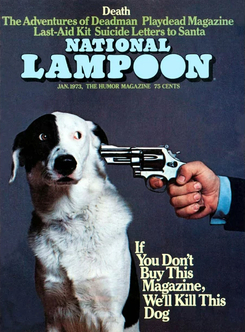
The January 1973 "Death" issue, number 34, put a photograph of a dog on the cover under the line "If You Don't Buy This Magazine, We'll Kill This Dog." The dog is looking sideways at the muzzle of a revolver held against its head. It was called Cheeseface, and the idea belonged to a writer, Ed Bluestone. The cover bills the magazine as THE HUMOR MAGAZINE at 75 cents, and the other lines on it are Death, The Adventures of Deadman, Playdead Magazine, Last-Aid Kit and Suicide Letters to Santa.
Ronald G. Harris took the picture and could not at first make the situation read as funny instead of pitiful. The solution was mechanical. Cocking the revolver produced a click, and the click moved the dog's eyes into the position printed on the cover. Michael C. Gross art-directed it, having taken over the look of the magazine from its eighth issue and kept it until 1974.
The American Society of Magazine Editors later put it seventh in a ranking of the previous forty years of magazine covers. The magazine's own account of how it happened credits "skillful art direction and minimal interference from asshole editors." The gag was still in service in 2007, when a DVD-ROM collection reissued the cover with the line altered to "If You Don't Buy This DVD-ROM, We'll Kill This Dog," and Simmons had already borrowed it for the title of his 1994 memoir.
~ the buyout clause ~
The founders' contracts contained a buyout clause and in 1975 all three used it, leaving with a shared total of $7.5 million. The record gives no breakdown per person and no month. Kenney stayed on the masthead as a senior editor until about 1976. At roughly the same moment Michael O'Donoghue and Anne Beatts went to write for Saturday Night Live; Belushi and Chase went too, and so did Gilda Radner, out of the magazine's touring company and into the first cast of the Not Ready For Prime Time Players.
P. J. O'Rourke was editor-in-chief in 1978, having started the True Facts section in August 1977. The job rotated, so the magazine's editorials were written by whoever was editing that particular issue. In 1985 Simmons took the chair himself. He fired the whole editorial staff and installed his two sons as editors. Peter Kleinman returned as creative director and left four years later. What came after that is described in the record as a period of precipitous decline.
~ one issue a year ~
By the end, J2 Communications was publishing one issue a year. One issue a year is not something anybody outside the United States comes across by accident, and I did not. What reached me was the name, stamped above the titles of video cassettes and later VCDs for films the magazine had no hand in beyond a licensing fee. National Lampoon was a label on comedies of declining quality for a decade before I found out it had ever been a magazine.
Daniel Grodnik and Tim Matheson had taken control of the company in 1989 and sold it, with the rights to the name, to J2 Communications in 1990. J2 was run by James P. Jimirro, until then known for marketing Tim Conway's Dorf videos, and he described what he had bought as "a moribund company that had been losing money since the early 1980s." It was treated from that point as a brand to license out. Film rights started going in 1991, producing Loaded Weapon 1 in 1993, Senior Trip in 1995, Golf Punks in 1998 and Van Wilder in 2002. Heavy Metal, which the same company had launched with an April 1977 issue, was sold to Kevin Eastman in May 1992.
The publication frequency tells the rest of it. Monthly through the seventies and into the early eighties, then bimonthly from 1986, announced that July for the year following. An attempted return to monthly in 1991 produced nine issues. After that came two issues in 1992, one in 1993, five in 1994 and three in 1995. For the final three years it appeared annually, because one new issue a year was the minimum J2 was contractually obliged to publish in order to hold on to the Lampoon name. In 1998 the contract was renegotiated and the clause turned around: J2 was prohibited from publishing any more, and kept the name anyway. Issue 246, November 1998, was the last, a count the 2007 collection of the entire run on PDF bears out. nationallampoon.com answers today as a live comedy collective. The archive's first capture of that address is dated 28 November 1999, a year after the magazine had already stopped, so this grave carries no address at all.
~ leave a rose ~
an anonymous tribute. one rose per visitor per day.
@}-->-- ... roses left here
~ leave a wreath ~
a rose fades by morning. a wreath stays on this grave for good, with your name on it.
paid once through stripe. payments are handled by OÜ Lakeview, the small company that keeps rip.so running. the money pays for the hosting and the nightly digging. adopt it and the headstone reads "maintained in memory by" you. the groundskeeper plants new wreaths at the next tending, usually within a day.
» one email a week: new graves and the anniversaries of the dead. subscribe
other news: Cink, ABCnews.com.co, Window Media, Fametracker
also died in the 1990s: Sega 32X, Windows Reversi, Line Mode Browser
~ leave a note ~
visitors before you have left these graveside notes. anonymous welcome.