Line Mode Browser
» see www.w3.org/LineMode as it lived, on the wayback machine
~ the last words ~
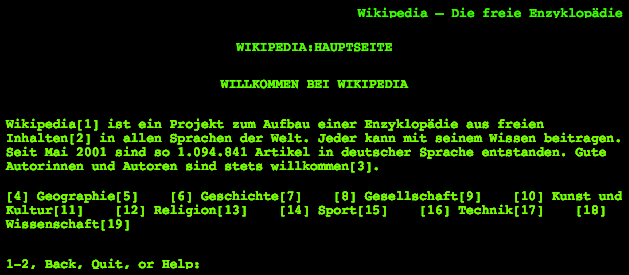
The web I met in 1998 already had pictures in it. That is such a basic assumption that it takes real effort to imagine the alternative, but for the first two years of the web's life the alternative was the normal case. Tim Berners-Lee's own browser ran only on a NeXT machine, of which there were perhaps a few thousand in the world. Everyone else got the Line Mode Browser.
Nicola Pellow wrote it as a student intern at CERN, starting in November 1990 and demonstrating it the following month. The design constraint was brutal and clarifying: it had to run on anything. It could assume no mouse and no graphics, and nothing about the terminal beyond its ability to print a line of text and read one back. Version 0.7 came out on 14 May 1991 and the public announcement followed that August.
The move that mattered was putting a copy on a public machine. You could telnet to info.cern.ch from anywhere and land inside a working browser without installing a thing, which for a couple of years was how most people on earth had their first look at the web. It was ported to more platforms than any browser since has bothered with, down to MS-DOS and to IBM mainframes running VM/CMS, because the entire point was that no machine was too dull to be a client.
~ the record ~
| Born | 14 may 1991, version 0.7, written at cern from november 1990 |
|---|---|
| Peak | 1991 to 1993, when telnet to info.cern.ch was the front door to the web |
| Killed | 1995, the last release as a browser in its own right |
| Lifespan | four years standalone, then absorbed into libwww |
| Made by | nicola pellow at cern, under tim berners-lee |
| Killed by | mosaic, and everything that came after it |
~ what it actually did ~
Reading with it was a numbered exercise. Links in the page came out as bracketed numbers in the running text, and you followed one by typing its number and pressing return. Return on its own scrolled down and u went back up. Typing g with an address took you somewhere new. There was no back button in the modern sense, because there was no sense in which you were anywhere.
It spoke more protocols than a modern browser does. FTP and Gopher and NNTP and WAIS were all in there beside HTTP, which tells you exactly what the internet looked like in 1991. HTTP was one option among several and not yet obviously the winner. The Line Mode Browser was less a web client than a general reader for whatever a remote machine was willing to hand over.
~ what replaced it ~
From version 1.2l in October 1992 it started sharing a common code library with CERN's other web software, and that library became libwww, the reference implementation that everybody else read while writing their own browser. By January 1994 only two percent of web users were still on it, Mosaic having arrived and taken the argument elsewhere. The last release as a program in its own right came in 1995, after which it survived as a component inside libwww, which is why version numbers carrying 2017 dates still turn up attached to its name.
CERN brought it back for an afternoon in 2013. A dozen developers were flown in for the twentieth anniversary of the web software being released into the public domain, and they built a simulator that renders the world's first website the way it looked from a terminal. It has been sitting at line-mode.cern.ch ever since. It is a re-creation in a browser rather than the original C, which is the usual shape of a restoration: the artifact is a performance of the thing, put on for people who were not there.
~ leave a rose ~
an anonymous tribute. one rose per visitor per day.
@}-->-- ... roses left here
~ leave a wreath ~
a rose fades by morning. a wreath stays on this grave for good, with your name on it.
from $1, paid once through stripe. it keeps the graveyard running: the hosting and the nightly digging. adopt it and the headstone reads "maintained in memory by" you. the groundskeeper plants new wreaths at the next tending, usually within a day.
» one email a week: new graves and the anniversaries of the dead. subscribe
outlived by Lynx, still breathing
other browsers: HotJava, Mozilla Application Suite, Arora, Internet Explorer
also died in the 1990s: Windows Reversi, Sega 32X, Elastic Reality
~ leave a note ~
visitors before you have left these graveside notes. anonymous welcome.