New Masses
~ the obit ~
New Masses launched in New York in May 1926, out of the Workers (Communist) Party of America, to fill a hole the Party had made itself. The Workers Monthly had drifted into theory and there was no longer anywhere on that side of American publishing for the art. The name pointed backward on purpose, to The Masses, which the Post Office had finished off in 1917, and to The Liberator that followed it.
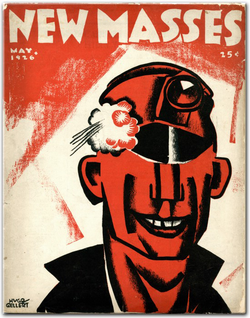
The first masthead was looser than the sponsorship suggests. Max Eastman, Hugo Gellert, Mike Gold and John Sloan came across from the older magazine, with Walt Carmon and Joseph Freeman, and Whittaker Chambers passed through early. Freeman later counted the people connected to those first issues and reported that of fifty six writers and artists, two were members of the Communist Party and fewer than a dozen were fellow travelers. The cover of the May 1926 number is a Gellert face in red and black, grinning, and the price in the corner is fifteen cents.
The Depression is what turned a small monthly into a force. Americans who had never read a left magazine in their lives were suddenly willing to, and circulation followed. The September 1933 issue printed six thousand copies. On 2 January 1934 it switched to a weekly, and the first weekly number of January 1935 was printed in twenty five thousand. Over twenty two years it printed most of the American literary left: John Dos Passos, Theodore Dreiser, Upton Sinclair, Richard Wright, Ralph Ellison, Dorothy Parker, Dorothy Day, James Agee, Langston Hughes, Rex Stout and Ernest Hemingway, with Aaron Copland on music and drawings by William Gropper and Reginald Marsh.
The 1940s pulled it apart from several directions at once. The Moscow Trials and then the Nazi-Soviet Pact of 1939 cost it readers who had been willing to overlook a great deal, the war brought censorship and a hardening anti-communism at home, and Partisan Review had already taken the literary half of its audience. The final issue is dated 13 January 1948, volume 66, number 3.
~ the rap sheet ~
| Born | May 1926, from the Workers (Communist) Party, at fifteen cents |
|---|---|
| Peak | 25,000 printed for the first weekly issue of January 1935 |
| Killed | 13 January 1948, volume 66 number 3 |
| Lifespan | 21 years and 8 months |
| Made by | the Workers (Communist) Party of America, New York |
| Killed by | the Nazi-Soviet Pact, then the postwar anti-communist turn |
~ go left, young writers ~
At the end of 1928 Mike Gold and Joseph Freeman took full editorial control and the loose left magazine began hardening into one with a line. Gold's column in the January 1929 issue carried the headline "Go Left, Young Writers!" and it started the proletarian literature movement. The early editors had been impressed by Upton Sinclair's Mammonart, which argued that most of history's great writers had worked as propagandists for the rich and powerful, and the conclusion they drew was that the answer was literature written by actual workers rather than about them.
It was not a demand for flat documentary prose. Gold and the people around him argued for stylistic experiment while insisting on genuine working class authorship, and what that policy produced was Richard Wright and Jack Conroy. By the middle of the thirties a Marxist test was being applied to every contribution and the less ideological writers drifted away. David Peck dates the turn to 1934 and puts it plainly: a monthly magazine of art and literature turned into a weekly political one. In 1935 John L. Spivak ran two long pieces alleging a conspiracy among Wall Street financiers to take over the country, built from a redacted version of congressional hearings, and named the businessmen he thought were in it.
~ 23 december 1938 ~
John Hammond wanted to stage a concert at Carnegie Hall that would run American black music from spirituals forward into swing, and he could not find anyone to pay for it. The person who said yes was Eric Bernay, the business manager of New Masses, and the magazine's name went onto the program. From Spirituals to Swing happened on 23 December 1938, with a second concert the following Christmas Eve. The recordings have been in print, in one edition or another, ever since.
The magazine also carried Abel Meeropol's anti-lynching poem, written under the title Bitter Fruit and first printed in a teachers' union paper in 1937, a couple of years before Billie Holiday recorded it as Strange Fruit. In one of the last issues, dated 30 December 1947, the editor Betty Millard published Woman Against Myth, an essay tracing the fight for women's equality across the United States and the wider socialist movement.
~ all twenty two years of it are online ~
Every issue of New Masses is scanned and free on the Marxists Internet Archive, from May 1926 to the last number, in partnership with the Riazanov Library. I can open a Communist weekly from 1934 in Ankara in 2026, complete, in less time than it takes me to find a Turkish forum thread I wrote myself in 2006. Magazines that existed because somebody held a political conviction tend to get archived by people who still hold it. Most of the commercial web I actually grew up on has nobody like that.
~ 13 january 1948 ~
Joseph North edited from 1939 to the end. After the last issue the magazine merged with Mainstream, a Communist cultural quarterly founded the year before, and came back in March 1948 as Masses & Mainstream, which ran until 1963.
Whittaker Chambers arrived as a contributor in 1931 with four short stories, was a contributing editor by the end of that year and managing editor for the first half of 1932, at which point he received orders to join the Soviet underground. His name stayed on the masthead for months afterward, which has generally been read as cover. Granville Hicks, who became literary editor with the same January 1934 issue that made the magazine a weekly, resigned from the Party in public in 1939 and made sure everyone heard about it.
In 2016 the Party of Communists USA began publishing under the name New Masses, sixty eight years after the last one stopped.
~ leave a rose ~
an anonymous tribute. one rose per visitor per day.
@}-->-- ... roses left here
~ leave a wreath ~
a rose fades by morning. a wreath stays on this grave for good, with your name on it.
paid once through stripe. payments are handled by OÜ Lakeview, the small company that keeps rip.so running. the money pays for the hosting and the nightly digging. adopt it and the headstone reads "maintained in memory by" you. the groundskeeper plants new wreaths at the next tending, usually within a day.
» one email a week: new graves and the anniversaries of the dead. subscribe
other news: PlayPower, Electron User, Dengeki Comic Gao!, Commodore Format
also died in the pre-1980s: Busicom, Blue Book, The Masses
~ leave a note ~
visitors before you have left these graveside notes. anonymous welcome.