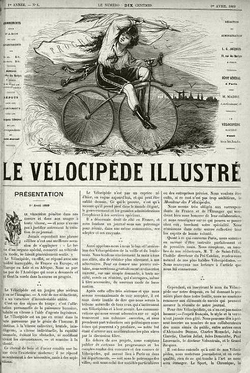
Le Vélocipède Illustré
~ the last words ~
The front page of number one says everything about the scale of the thing. Across the top: 1re ANNÉE, N° 1, LE NUMÉRO: DIX CENTIMES, 1er AVRIL 1869. Under that, an engraving of a woman riding a velocipede along a riverbank at speed, and then four pages of large-format newsprint about a machine that had existed in recognizable form for about a year.
It was not the first cycling paper. That was Le Vélocipède, started at Voiron on 1 March 1869 by A. Favre, who made velocipedes, and managed by one L. Fillet. It lasted until 15 May. Richard Lesclide's paper came out one month behind it and was still going three and a half years after it folded. Favre built velocipedes and started a paper to sell them. Lesclide was a writer who had noticed a subject.
Lesclide signed himself Le Grand Jacques and is now mostly remembered for a later job: he became Victor Hugo's secretary. In 1869 he was inventing sports journalism as a trade. The paper covered racing, touring, road conditions and the patents being filed that year, and it tracked the machine's physical evolution closely enough to be useful now, from the 1868 velocipede on wooden wheels hooped with iron to the lighter véloce of 1870 running tensioned metal spokes and rubber tires. It carried theater notes and occasional science pieces with no connection to cycling at all, including one on electric motors. The back page was advertising from the makers: wheels, rubber tires, cyclometers and lanterns.
Lesclide also serialized his own travel novel in it, Le Tour du monde en vélocipède, a wholly imaginary journey signed Le Grand Jacques and illustrated by Félix Régamey, which carries its characters from Paris to Siberia and on to Kamchatka. Jules Verne's Around the World in Eighty Days was serialized two years later, in Le Temps. Lesclide got there first, on a machine that could barely manage a French departmental road.
~ the record ~
| Born | 1 April 1869 in Paris, number one at ten centimes, four pages |
|---|---|
| Peak | 7 November 1869: 202 entries, 120 starters, thousands of spectators at the place de l'Étoile |
| Killed | 24 October 1872 |
| Lifespan | 3 years and 206 days from number one to the last, roughly 24 months of it actually printing |
| Made by | Richard Lesclide, writing as Le Grand Jacques |
| Killed by | the Franco-Prussian War, which took the subscribers and the bicycle makers together |
~ paris to rouen ~
On 30 September 1869 the paper announced a race. The rules went into the issue of 20 October and read like an open invitation to anyone with a machine: all the velocemen of France and abroad were asked to take part, and every man-powered device was admitted, monocycles and bicycles and tricycles and quadricycles alike. The stated purpose was an argument rather than a sport, that the bicycle allowed a rider to cover considerable distances with incomparably less fatigue than walking produced.
It ran on Sunday 7 November 1869, organized with the Compagnie parisienne. Of 202 entries, 120 riders started from the place de l'Étoile at half past seven in the morning in front of several thousand people. Four women started. Checkpoints sat at Saint-Germain-en-Laye, Mantes-la-Jolie, Vernon and Louviers, and the first five home took prizes, a thousand francs for the win. Thirty-four riders were classified as finishing inside twenty-four hours. Two of the women rode as far as Vernon and stopped. The one who finished rode under the name Miss America, came in twenty-ninth and collected a prize set aside for any woman who completed the course in the day.
James Moore won it, an Englishman who had already taken the first organized races at Saint-Cloud the year before, covering the 123 kilometers in ten hours forty-five. His machine came from Jules-Pierre Suriray and carried the most advanced hardware available. Suriray then did something nobody had done: he bought advertising in Le Vélocipède Illustré off the back of the result. That is the first time a race win was used to sell the bike underneath it, and the paper that staged the race took the money for the ad.
~ number 68 ~
The Suriray advertisement ran in number 68, dated 6 January 1870, on page four. That number is worth holding onto, because the French article describing the paper calls it a bimensuel, a twice-monthly. Twice monthly from 1 April 1869 would have reached about number 19 by that January. Sixty-eight numbers in forty weeks is a weekly that went twice weekly, which is what the publication history says happened on 3 June 1869, with a handful of numbers missed along the way.
That cadence holds until 4 September 1870. The paper's first run ends on the day the Second Empire did: Napoleon III had surrendered at Sedan two days earlier and the Republic was proclaimed in Paris that Sunday. A cycling paper was not going to be printed through the siege.
~ what the war took ~
It came back twice and never properly. From 16 July to 27 August 1871, after the Commune had been put down, it appeared under a different title, La Vitesse. Then from 2 May 1872 it ran again under the original nameplate, and that run ended on 24 October 1872.
The French account is specific about why. By 1871 the paper had lost its foreign correspondents and a share of its subscribers, some killed in the fighting and others simply finished with bicycles for the time being. The makers who had filled the back page went under in the same stretch, and the advertising went with them. A specialist paper needs an audience and an industry willing to pay to reach that audience, and the war took both inside a year.
~ what replaced it ~
The name came back on 6 April 1890 with Lesclide himself behind it, his wife Juana running the editorial side under the pen name Jean de Champeaux. He was 64 by then, not the 67 the French article on the paper gives him: the same encyclopedia's article on Lesclide puts his birth at Bordeaux on 1 December 1825. Juana took the paper over when he died in 1892, and Paul Faussier, who had organized the first race for horseless carriages between Neuilly and Versailles in 1887, took the editor's chair. That version ran to about 1901. The French encyclopedia files both the 1890 paper and a 1901 one as successeurs homonymes, successors sharing a name, which is the correct reading and the reason this grave is dated 1872.
Paris-Rouen did better. After 1869 it was not held again for twenty-five years, came back in 1895, and then ran on and off until its final edition on 10 May 2009. The 2010 race was canceled. In 2019 somebody organized a re-enactment of the 1869 course for its hundred and fiftieth anniversary. A paper that lasted three and a half years started a bicycle race that lasted a hundred and forty.
~ leave a rose ~
an anonymous tribute. one rose per visitor per day.
@}-->-- ... roses left here
~ leave a wreath ~
a rose fades by morning. a wreath stays on this grave for good, with your name on it.
paid once through stripe. payments are handled by OÜ Lakeview, the small company that keeps rip.so running. the money pays for the hosting and the nightly digging. adopt it and the headstone reads "maintained in memory by" you. the groundskeeper plants new wreaths at the next tending, usually within a day.
» one email a week: new graves and the anniversaries of the dead. subscribe
other news: MacUser, Sega Force, Reader's Digest UK, Project Eyeball
also died in the pre-1980s: Berliner Illustrirte Zeitung, Ramparts, Victor Talking Machine Company
~ leave a note ~
visitors before you have left these graveside notes. anonymous welcome.