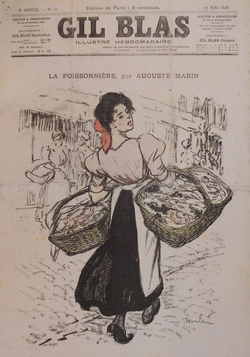
Gil Blas
~ the last words ~
The first number of Gil Blas went on sale in Paris on 19 November 1879: four pages, fifteen centimes, an office at 19 boulevard des Capucines. Auguste Dumont had spent enough years in newspapers to know what he was building, and he explained the title in his opening prospectus. It had seemed simple and logical, he wrote, to take the hero of Lesage's 1715 picaresque novel for a paper that meant to be cheerful without being trivial and truthful without being cynical. The motto underneath, lifted from the critic Jules Janin, was franker about the commercial idea: "Amuse the people going past, please them today and begin again tomorrow."
It sold badly at first. Zola, who was watching from inside the Paris press, remembered asking the editors of rival papers what they thought of the newcomer and getting shrugs and contemptuous smiles, because it was not selling and they had nothing to fear from it. Then, he wrote, he saw their faces lengthen. Gil Blas had found a specialty in light chronicles and with it a large readership, a good part of it women who had no objection to agreeable indecency, and the respectable half of the press went into a fury that did the paper nothing but good.
What it was running underneath the gossip was the naturalist school at full strength. Zola serialized Au Bonheur des Dames across 1882 and 1883, then Germinal in 1884, then L'Œuvre, with L'Argent and La Joie de vivre as well. A great many of Guy de Maupassant's stories appeared in it before they appeared anywhere else. Théophile Steinlen and Albert Guillaume drew for it. In 1880 Gustave Caillebotte painted his friend Richard Gallo walking in the parc Monceau with a copy of it folded in his hand, which is close to how the paper described itself.
Dumont died in May 1885. The printer Éloi Dubuisson took the title over, and six years later made the decision that turned a Paris daily into an object people still collect.
~ the record ~
| Born | 19 November 1879, four pages at fifteen centimes |
|---|---|
| Peak | over 260,000 copies by July 1893 |
| Killed | March 1940, in its 61st year |
| Lifespan | 60 years, with a six year gap for the first war |
| Made by | Auguste Dumont, at 19 boulevard des Capucines, Paris |
| Killed by | August 1914, then a second life that never became a daily again |
~ five centimes, in color, every week ~
On 30 May 1891 Dubuisson started a weekly supplement, named Gil Blas illustré a month after it appeared. It cost five centimes, it carried original illustrations in color, and subscribers to the daily received it as a premium. The circulation moved immediately. The print run had started at a hundred and sixty thousand copies; by July 1893 it was past two hundred and sixty thousand. In 1892 the stockbroker Victor Antoine Desfossés came in as principal administrator, by which point the finance side of Paris had noticed the title was profitable.
The supplement is where the strange material went. It printed songs by Aristide Bruant and Yvette Guilbert, so a subscriber in the provinces got the Montmartre cabaret repertoire for five centimes without going to Montmartre. It printed poems, including Arthur Rimbaud's Première Soirée in the issue of Sunday 29 November 1891, a few weeks after Rimbaud died in Marseille. And in 1896 a German publisher named Albert Langen, living in Paris and taking advice from Steinlen, decided Germany needed its own version of the thing. He called it Simplicissimus.
~ donatello among the wild beasts ~
On 17 October 1905 the paper printed Louis Vauxcelles on the Salon d'Automne. Vauxcelles had walked into a room where a quattrocento-style sculpture was standing among canvases by Henri Matisse and the painters around him, and he described what he saw as Donatello chez les fauves, Donatello among the wild beasts. The phrase escaped the review and went into general circulation within weeks, and the painters took the insult for a name. Fauvism is called Fauvism because of one line in a newspaper notice, and this is the newspaper.
~ the day after 4 august 1914 ~
Paul Ollendorff and Antonin Périvier owned and ran it between 1903 and 1911. Pierre Mortier arrived in 1911, took the paper to six pages and dropped the price to ten centimes. Then it stopped the way most of the Paris press stopped. The national library's run statement gives the last daily number precisely: 36th year, number 18625, dated 4 August 1914. The following morning there was nothing, because France had gone to war and Gil Blas was a paper built on amusing people on their way past.
Mortier brought it back on 20 January 1921 and stayed with it for another nineteen years, though it never became a daily again. It appeared episodically, whenever it appeared, until March 1940. The Bibliothèque nationale holds the run through its sixty first year and stops there, two months before the German army came through the Ardennes. English Wikipedia gives the end as 1938 and files the paper under 1914; the French article and the national library both say March 1940, and that is the date to use.
~ leave a rose ~
an anonymous tribute. one rose per visitor per day.
@}-->-- ... roses left here
~ leave a wreath ~
a rose fades by morning. a wreath stays on this grave for good, with your name on it.
paid once through stripe. payments are handled by OÜ Lakeview, the small company that keeps rip.so running. the money pays for the hosting and the nightly digging. adopt it and the headstone reads "maintained in memory by" you. the groundskeeper plants new wreaths at the next tending, usually within a day.
» one email a week: new graves and the anniversaries of the dead. subscribe
other news: Far Eastern Economic Review, Linux Format, More, Newsmill
also died in the pre-1980s: Architectural Forum, Picture Post, Shockley Semiconductor Laboratory
~ leave a note ~
visitors before you have left these graveside notes. anonymous welcome.