Far Eastern Economic Review
» see feer.com as it lived, on the wayback machine
~ the eulogy ~
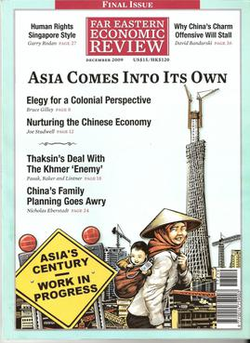
The last cover is dated December 2009 and has the words FINAL ISSUE printed above the logo. The main line reads Asia Comes Into Its Own, over a photograph of cranes and half-built towers with a yellow roadworks sign pasted across it saying Asia's Century, Work in Progress. Top left, in the list of inside stories, sits a piece called Human Rights Singapore Style. The cover price was US$11.
Eric Halpern founded the Review in Hong Kong and published the first issue on 16 October 1946. He was a Jewish immigrant from Vienna who had settled in Shanghai and worked at a business biweekly that shut down in December 1941 when the Japanese army took the city. His bet was that postwar Asia would settle down and that English would be the language its merchants and bankers did business in. HSBC and Jardines put up seed capital, along with the Kadoorie family.
Under Derek Davies, the Welsh editor who held the chair from 1964 to 1989, it became the magazine you read if your job touched Asia. Circulation reached nearly 90,000, which sounds small until you notice that almost a hundred journalists in fifteen bureaus were producing it, the largest editorial operation any regional weekly on earth was running. The South China Morning Post took majority ownership in 1972 and sold its 51 percent to Dow Jones in 1987.
What followed was not a closure so much as a long subtraction. Dow Jones merged the Review's editorial operation into the Asian Wall Street Journal in November 2001 to save money. In December 2004 the weekly became a monthly, about 80 jobs went, and the magazine switched to commissioned essays written by economists and policymakers rather than reporting done by staff. Todd Larsen of the Dow Jones Consumer Media Group announced the end in September 2009, calling the decision a difficult one taken after careful study of the magazine's prospects in a challenging business climate.
~ the dossier ~
| Born | 16 October 1946 in Hong Kong, founded by Eric Halpern with seed capital from HSBC and Jardines |
|---|---|
| Peak | nearly 90,000 circulation, with close to 100 journalists across 15 bureaus |
| Killed | December 2009 |
| Lifespan | 63 years |
| Made by | Dow Jones, in full control from 1987 |
| Killed by | advertising losses, after a decade of being cut down to a skeleton |
~ the courts ~
The Review spent decades being sued and banned by the governments it covered. Its Singapore correspondent Ho Kwon Ping was held for two months in solitary confinement under the Internal Security Act in the late 1970s and gave a televised confession. In 1987 Lee Kuan Yew restricted its sale in Singapore over an article about detained Catholic church workers, which took its circulation there from 9,000 copies to 500. Mahathir Mohamad sued in 1987 over a story claiming Malaysia planned to sell Limbang to Brunei, settled out of court in March 1991 for an apology notice and fifty thousand ringgit. Bangladesh banned the issue of 4 April 2002 for a cover story on militant groups.
The one that outlasted the magazine started with an October 2006 interview with the opposition politician Chee Soon Juan. Lee Kuan Yew and his son, Prime Minister Lee Hsien Loong, sued for defamation. On 24 September 2008 Justice Woo Bih Li granted summary judgment against the Review and its editor Hugo Restall, and in October 2009 the Court of Appeal upheld it. While the appeal was still live, Restall told Reuters that if they lost there was a question of whether Singapore would try to enforce the judgment in Hong Kong.
Dow Jones announced the closure the month before that appeal was decided. The magazine lost the case in October and shut in December, and the cover of the issue it shut with advertised an essay titled Human Rights Singapore Style.
~ what the cuts took ~
David Plott was editing the Review when the 2004 cuts came, and he described what went out the door as one of the greatest concentrations of knowledge and expertise about the region assembled anywhere. Philip Bowring, who had edited it until resigning in 1992 over editorial direction, blamed the decline on editors being changed too quickly and on efforts to make the thing easier to read.
Restall's own verdict at the end was about the region rather than the magazine: Asia keeps growing in importance and there are fewer and fewer publications producing quality coverage of it. Two of the Review's journalists had walked out in 1975 to start Asiaweek, which did the same job faster and died in December 2001. The Review outlived its rival by eight years and was running on a fraction of its old staff when it did.
~ what happens to feer.com ~
The domain does not resolve. A 63-year archive of Asian business reporting sits behind a hostname that no longer answers, and the Wikipedia entry's website field links to a Wayback Machine query instead of a site, which is the modern way of saying the address is gone.
~ leave a rose ~
an anonymous tribute. one rose per visitor per day.
@}-->-- ... roses left here
~ leave a wreath ~
a rose fades by morning. a wreath stays on this grave for good, with your name on it.
paid once through stripe. payments are handled by OÜ Lakeview, the small company that keeps rip.so running. the money pays for the hosting and the nightly digging. adopt it and the headstone reads "maintained in memory by" you. the groundskeeper plants new wreaths at the next tending, usually within a day.
» one email a week: new graves and the anniversaries of the dead. subscribe
other news: Linux Format, More, Protocol, Newsmill
also died in the 2000s: StarSight Telecast, Google Page Creator, Olé
~ leave a note ~
visitors before you have left these graveside notes. anonymous welcome.