Sega Force
~ the obituary ~
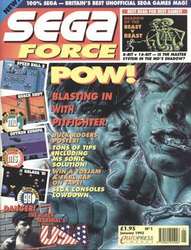
Newsfield announced two magazines in mid-1991, Sega Force and Nintendo Force, and then went into liquidation. The titles survived the publisher. Europress Impact picked them up and pushed Sega Force onto shelves in December 1991 with a January 1992 cover date, months behind the original plan, at £1.95 for a magazine that covered every Sega machine then on sale, from the Mega Drive down to the Game Gear.
Issue one carries two claims along its top edge: "100% Sega", then "Britain's best unofficial Sega games mag". The boast was accurate: EMAP held the official Sega relationship, so Impact took the thing it did not have and sold it back as independence.
The artwork is what survived. Oliver Frey drew the covers and the interiors in a style borrowed from Akira, and he kept smuggling horror into them. His Lemmings cover replaced the rodents with human beings and painted their faces on the way down. Stuart Wynne edited it, with Phil King and Matt Yeo among the writers filling the pages around the pictures.
Issue 19, dated July 1993, was the last one called Sega Force.
~ the case file ~
| Born | issue 1 cover-dated January 1992, on sale December 1991, £1.95 |
|---|---|
| Peak | nineteen monthly issues, plus game novellas written by its own staff |
| Killed | July 1993, issue 19, split into two titles |
| Lifespan | nineteen issues over eighteen months |
| Made by | Europress Impact, renamed Impact Magazines during 1993 |
| Killed by | a publisher who thought two magazines would sell better than one |
~ the novellas ~
Matt Yeo wrote prose fiction based on video games and the magazine printed it. The one that stuck was a novella built on Super Smash TV, produced with Acclaim's cooperation, following the game's plot and ending each chapter with hints on how to get past the bit you had just read about. The debt to Stephen King's The Running Man was not subtle. Prose fiction with walkthrough hints at the chapter breaks, stapled into a magazine for teenagers with a Master System, is not a format anybody has tried since.
The fiction was a response to Sega Power, which had already sold books off the back of games. Impact's version was cheaper and came stapled inside something you were buying anyway.
~ the split ~
In 1993 Impact Magazines decided one Sega title was leaving money on the table. Sega Force became Sega Force Mega, 100 pages for the Mega Drive and Mega-CD owner who wanted to be treated as an adult, and Sega Master Force, 68 pages aimed at younger readers with a Master System. Both carried a G-Force section for the Game Gear. Both launched in August 1993. Nick Roberts edited Master Force, Mark Smith edited Force Mega, and Steve Shields managed both.
Sega Master Force ran six issues and stopped in December 1993. Sega Force Mega ran six plus a seventh special made of recycled reviews and news. The Mega title was pushed out to a contractor in Newton Abbot partway through while the Impact staff moved onto another new launch called Mega Machines. The people who ordered the split had already stopped watching it. One magazine with nineteen issues behind it became two magazines with six each.
~ the rest of the Force ~
Impact kept using the brand. Amiga Force was a budget Amiga monthly in the same stable, and Commodore Force was Zzap!64 renamed so an advertising agency could buy the whole shelf in one conversation. Europress Impact became Impact Magazines during 1993 and went under in March 1994, which took the surviving Force titles with it.
Everything about this magazine assumes a British newsagent. Five rival Sega monthlies on one rack, and £1.95 in cash from a reader who could stand there comparing them before picking. The shelf is the product. Sega's console war reached Turkey through importers and secondhand trade, with no rack like it anywhere, so a title whose entire pitch was being the unlicensed option on a crowded shelf had nothing here to be unlicensed against.
~ leave a rose ~
an anonymous tribute. one rose per visitor per day.
@}-->-- ... roses left here
~ leave a wreath ~
a rose fades by morning. a wreath stays on this grave for good, with your name on it.
paid once through stripe. payments are handled by OÜ Lakeview, the small company that keeps rip.so running. the money pays for the hosting and the nightly digging. adopt it and the headstone reads "maintained in memory by" you. the groundskeeper plants new wreaths at the next tending, usually within a day.
» one email a week: new graves and the anniversaries of the dead. subscribe
other news: Reader's Digest UK, ReadWriteWeb, MacUser, ComicsAlliance
also died in the 1990s: Central Point Software, Alliant Computer Systems, Distinctive Software
~ leave a note ~
visitors before you have left these graveside notes. anonymous welcome.