Berliner Tageblatt
» see berlinertageblatt.de as it lived, on the wayback machine
~ the goodbye ~
On 1 January 1872 it was pages of classified advertising with no journalism in it at all. Rudolf Mosse ran an advertising agency and worked out that owning the paper the ads sat in was better business than renting space in somebody else's. Editorial copy was added later, to hold the reader long enough to see the ads. The full name on the masthead stayed Berliner Tageblatt und Handelszeitung for the whole run.
By 1914 it was selling 245,000 copies and was the largest daily in the German Empire. That number is the high-water mark, and it arrived before the fame did. English accounts tend to attach 245,000 to 1920, which gets the paper exactly backwards: the Reich statistical office recorded 160,000 in 1919, and the slide had already started in 1916.
What the paper is remembered for happened on the way down. Theodor Wolff, Mosse's cousin, became editor in chief in 1906 and held the job for twenty seven years. On 14 November 1918 he ran a guest article by Hugo Preuss on the revolutionary government's legitimacy problem, and the next day Friedrich Ebert read it and made Preuss state secretary with the job of drafting a republican constitution. Two days after that, on 16 November, Wolff's own front-page appeal founded the German Democratic Party, signed by sixty other people including Rudolf Mosse himself, who had spent decades keeping his papers off any party's side. A newspaper got a constitution written and a party started inside three days.
The party then lost almost all of its voters, and the paper went with it. Advertising income was 2.1 million marks in 1913, 705,000 in 1928 and 304,000 in 1930. Lachmann-Mosse blamed Wolff's lecturing tone and Wolff blamed Lachmann-Mosse's property speculation, and they were both partly right. Bankruptcy proceedings opened on 13 September 1932 with roughly 8,000 creditors. Circulation that year was 25,000.
~ the chronicle ~
| Born | 1 January 1872, as a Berlin advertising sheet with no newsroom |
|---|---|
| Peak | 245,000 copies in 1914, the largest paper in imperial Germany |
| Killed | 31 January 1939, the same day as the Kreuzzeitung |
| Lifespan | 67 years |
| Made by | Rudolf Mosse, and after 1920 his son-in-law Hans Lachmann-Mosse |
| Killed by | bankruptcy in 1932, then the Propaganda Ministry's paper rationing |
~ what mosse was selling ~
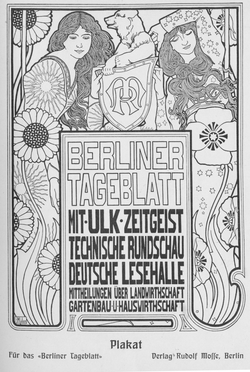
The surviving advertising poster for the paper is a Jugendstil panel with two women holding a shield bearing Mosse's monogram and the Berlin bear perched above them. The text under the title is a list rather than a slogan: mit Ulk, Zeitgeist, Technische Rundschau, Deutsche Lesehalle, Mittheilungen über Landwirthschaft, Gartenbau u. Hauswirthschaft. The old spellings with the extra h date the sheet before the 1901 orthography reform.
That is what a subscription actually bought. The paper came twelve times a week, Monday evening only, two editions a day from Tuesday to Saturday, one on Sunday morning, sixteen pages on weekdays and thirty two on Sundays, and it arrived wrapped in a stack of supplements that included a satirical weekly and a technology review. The type was set in Fraktur until 21 March 1927 and in Antiqua afterwards.
~ fired by his own publisher ~
On 31 January 1933, the morning after Hitler took office, Wolff ran a single-column leader headed Es ist erreicht, listing the names of the new cabinet with guarded remarks about their chances. Victor Klemperer wrote in his diary that same day that even the Berliner Tageblatt had gone tame. Wolff was by then writing almost nothing, and the paper covered the Reichstag fire four weeks later in flat official language, on a direct instruction from Goebbels that nothing but the government statements could be printed.
Wolff himself had left Berlin by night train for Munich while the building was still burning. He came back on 3 March, walked into the Mossehaus on Jerusalemer Strasse and was handed his dismissal on arrival. The order did not come from the new government. Lachmann-Mosse was closing out a fight he had been having with his editor since 1928, and the timing simply made it cheap.
What happened afterward is the part nobody plans for. Wolff's actual last leading article, drafted in Munich before the firing, ran two days after it. His name stayed in the imprint until 21 March. He voted in the 5 March election at a polling station near his house on the Hohenzollerndamm, took the evening train back to Munich, and on 9 March left for exile.
~ the winding-up editor ~
Goebbels kept the title alive on purpose. He complained in public about the monotony of the German press and wanted one German paper that foreign readers would still take seriously, so in April 1934 the Reich Press Chamber installed Paul Scheffer, the first foreign journalist ever refused a re-entry permit into the Soviet Union, in 1929, for reporting on the five-year plan and predicting famine in Ukraine, and promised him a free hand. Scheffer stabilized the circulation, sent Margret Boveri across North Africa to interview Haile Selassie, and in his own articles referred to Hitler as "Herr Hitler" rather than by any title. At a 1935 ministry press conference a Goebbels spokesman screamed at him about Rosenberg's Mythus des 20. Jahrhunderts, and Scheffer replied that he noted Germany now had a religion whose first volume had already been published.
He gave up at the end of 1936, when the Four Year Plan turned paper into a rationed raw material and the number of German newspapers started falling toward the 977 that would be left in 1944. Goebbels replaced him with a committed Nazi, Erich Schwarzer, and most of the newsroom either resigned or stopped trying. The last editor, Eugen Mündler, was appointed in May 1938 with liquidation as the actual job description. He was simultaneously editing the Kreuzzeitung, so the Berliner Tageblatt spent its final months appearing under its own masthead with the Kreuzzeitung's text inside it. Both papers were delivered for the last time on 31 January 1939.
~ what carries the name ~
Wolff was stripped of his citizenship on 26 October 1937 while living in Nice, in an apartment the German Foreign Office had helpfully furnished by shipping his Berlin library and private archive to him in a sealed railway wagon. On 23 May 1943 civilian officials of the Italian occupation arrested him and handed him to the Gestapo. He went through a Marseille prison and the camp at Drancy to Moabit, fell ill, was moved to the Jewish Hospital in Berlin on 20 September and died there three days later. Since 1973 the top prize in German journalism has been the Theodor Wolff Prize, handed out by the federation of newspaper publishers.
The domain is a different story. berlinertageblatt.de answers today with 170 KB of rolling world news in six languages, published by a company registered as Scandic Trust Group LLC with a chief editor reachable in Dubai. It stuffs "Rudolf Mosse" into its meta keywords and then says nothing about him anywhere a reader can see. There is no 1872 on it, no 1939, no Wolff. Its own imprint concedes the point in legal German: a newspaper title and a German-language edition do not by themselves establish anything.
The paper itself is fully scanned, 1872 to 1939, at the Berlin State Library. I can open the issue of 16 November 1918 from Ankara and read the appeal that started the DDP, which is more access to its own back numbers than any of its subscribers ever had.
~ leave a rose ~
an anonymous tribute. one rose per visitor per day.
@}-->-- ... roses left here
~ leave a wreath ~
a rose fades by morning. a wreath stays on this grave for good, with your name on it.
paid once through stripe. payments are handled by OÜ Lakeview, the small company that keeps rip.so running. the money pays for the hosting and the nightly digging. adopt it and the headstone reads "maintained in memory by" you. the groundskeeper plants new wreaths at the next tending, usually within a day.
» one email a week: new graves and the anniversaries of the dead. subscribe
other news: Inkstone News, Mr. Showbiz, Galge.com, Official U.S. PlayStation Magazine
also died in the pre-1980s: Neue Rheinische Zeitung, Liberty, Four Color
~ leave a note ~
visitors before you have left these graveside notes. anonymous welcome.