Bentley's Miscellany
~ the obit ~
Richard Bentley and Henry Colburn had been partners and the partnership ended badly. Bentley's answer was a monthly aimed straight at Colburn's New Monthly Magazine, with more jokes in it, and the working title was the Wits' Miscellany. He swapped that for his own name before launch. Richard Harris Barham, who had been at St Paul's with him and went on to write the Ingoldsby Legends for the magazine, is the one the Dictionary of National Biography credits with asking why he had to go to the other extreme. The joke has been reassigned to other people since, Douglas Jerrold most often, and the DNB says flatly that those attributions are wrong.
The first number is dated January 1837 and some catalogs file the magazine under 1836, because a monthly dated January was on the streets before January arrived. Bentley's brother Samuel printed it out of Bangor House on Shoe Lane. The address on the title page was 8 New Burlington Street for every volume the magazine ever issued except the stretch in the 1860s when Chapman and Hall handled it. The editor was Charles Dickens, 24 years old with Pickwick still running in parts, and the cover said so: EDITED BY BOZ, in capitals, in the position where a magazine normally puts its own name.
The opening Prologue was split between William Maginn of Fraser's and Dickens, and it spends two pages defending the title change in a tone the magazine never quite dropped. Having advertised themselves as the Wits' Miscellany, they wrote, they recoiled at the sound they had made, and then: we massacred the title as ruthlessly as ever were massacred its namesakes in Holland. The namesakes are the De Witt brothers, torn apart by a mob in 1672. That is the register of a magazine introducing itself. Dickens's own piece in the first number was a satire on the public life of Mr Tulrumble, once mayor of Mudfog.
Oliver Twist started in the second number with George Cruikshank drawing it, and ran in 25 installments to April 1839, skipping June 1837 after Mary Hogarth's death and skipping October 1837 as well. Sales ran at roughly ten thousand copies a month while it was going, a figure that comes down to us through one essay rather than through any surviving account book. Bentley had signed Dickens in August 1836 for two novels at a thousand pounds, then paid five hundred for this one and later made it seven hundred and fifty. The editorship was a separate twenty pounds a month from October 1836, raised to thirty the following March.
~ the rap sheet ~
| Born | January 1837, edited by Charles Dickens at 24 for twenty pounds a month |
|---|---|
| Peak | about ten thousand copies a month while Oliver Twist was running |
| Killed | December 1868, the 384th number, absorbed into Temple Bar |
| Lifespan | 31 years, 64 volumes, 384 monthly numbers |
| Made by | Richard Bentley, 8 New Burlington Street, London |
| Killed by | the founder's son, who bought it back for 250 pounds in order to retire it |
~ two years and two months ~
Bentley advertised the second number in every morning, evening and weekly paper in London, and then printed a squib about having done it. The Extraordinary Gazette is a mock royal proclamation under a Cruikshank plate, and its text reads: on Wednesday, the first of February, the House of Bentley met for the despatch of business, in pursuance of the Proclamation inserted by authority in all the Morning, Evening, and Weekly Papers, appointing that day for the publication of the Second Number of the Miscellany, edited by Boz. The first of February 1837 did fall on a Wednesday. Accounts that call that number the magazine's first are reading the novel's start as the magazine's.
Dickens withdrew in January 1839 and his last issue was February. He had asked for a six-month postponement on Barnaby Rudge, Bentley had refused, and by then Dickens was writing that his books were enriching everybody connected with them except himself. He bought the copyright and remaining stock of Oliver Twist off Bentley for 2,250 pounds on the way out.
Then he wrote his own exit notice and put it in the magazine. Pages 219 and 220 of volume five carry a piece headed FAMILIAR EPISTLE FROM A PARENT TO A CHILD, AGED TWO YEARS AND TWO MONTHS, which is the age of the magazine to the number. In fact, then, my child, you have changed hands. Henceforth I resign you to the guardianship and protection of one of my most intimate and valued friends, Mr AINSWORTH. I reap no gain or profit by parting from you. Nor will any conveyance of your property be required, for, in this respect, you have always been literally Bentley's Miscellany, and never mine. He signs it BOZ. Page 221 opens the March number with Jack Sheppard.
~ sold in secret, bought back at a loss ~
William Harrison Ainsworth edited it until December 1841 and then had the same fight. He came back in 1854, as the owner. His letter to James Crossley of 19 October that year says he has just concluded the purchase, that it cost a long price at 1,700 pounds for the copyright, and asks Crossley not to mention it in any literary circle, because he did not intend to have any ostensible connection with a magazine that would go on being published under Bentley's name. He already owned the New Monthly. Having acquired a second magazine he shut down his own, Ainsworth's Magazine, at the close of that year, after a run of nearly thirteen years.
In 1867 Richard Bentley was hurt in a railway accident at Chepstow station and handed the firm to his son George. In 1868 Ainsworth sold the Miscellany back for 250 pounds, taking a loss of 1,450 on what he had paid fourteen years earlier. The last six numbers came out of New Burlington Street again, and at the close of the year George Bentley put the magazine inside Temple Bar, which the firm had started in 1860 under George Augustus Sala to compete with the Cornhill. Temple Bar itself ran to 1906, and Ainsworth went off to the weekly Bow Bells. Richard Bentley died at Ramsgate in September 1871, aged 77, having watched the whole transaction.
~ the column it vanished from ~
There is no farewell. Volume 64 closes on page 628 at the end of an article about Nuremberg under Napoleon, with THE END set beneath the last line of it, and nowhere in the volume is there a mention of Temple Bar or a word addressed to subscribers. Temple Bar's own December 1868 and January 1869 issues never print a line about having absorbed anything. The run works out at 64 volumes of six numbers, 384 months from January 1837 to December 1868 with none spare and none missing, and the last of them went out like any other.
The clearest evidence of the ending is an advertising column. On 31 October 1868 Bentley took space in the Athenaeum for the New Monthly and the Miscellany side by side, listing the November contents of both. By the issues of 26 December and 2 January the New Monthly is still there, advertising its January number and promising a new Ainsworth serial for February, and the Miscellany has simply gone from the column. Bentley's own full-page list on 5 December pushes Temple Bar and five editions of the Ingoldsby Legends, and does not mention the magazine those Legends were written for.
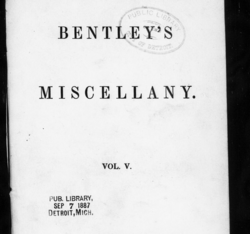
The copy of volume 64 that got scanned belonged to the Detroit Public Library, which stamped it on 7 September 1887. That is the object that reaches me: an English monthly from the 1830s, bound in America, stamped in Michigan, photographed by a nonprofit in the 2000s, opened on a laptop in Ankara. The distance here is not the regional kind I usually have to account for. It is a hundred and ninety years. Somebody in Detroit was still buying bound volumes of a London magazine nineteen years after it had stopped coming out.
~ leave a rose ~
an anonymous tribute. one rose per visitor per day.
@}-->-- ... roses left here
~ leave a wreath ~
a rose fades by morning. a wreath stays on this grave for good, with your name on it.
paid once through stripe. payments are handled by OÜ Lakeview, the small company that keeps rip.so running. the money pays for the hosting and the nightly digging. adopt it and the headstone reads "maintained in memory by" you. the groundskeeper plants new wreaths at the next tending, usually within a day.
» one email a week: new graves and the anniversaries of the dead. subscribe
other news: The Sunday Correspondent, The Electrical Experimenter, Google Bulletin, Backfence
also died in the pre-1980s: The Electrical Experimenter, Heimin Shinbun, Longitudinal Video Recording
~ leave a note ~
visitors before you have left these graveside notes. anonymous welcome.