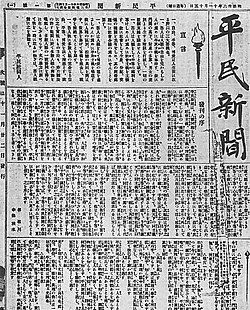
Heimin Shinbun
~ the obit ~
In 1903 the Japanese press was turning over to the war party. Yorozu Choho had been arguing against a war with Russia, and when the pro-war societies and the professors' manifesto shifted public opinion, the paper shifted with it. Two of its reporters would not go along. Kotoku Shusui and Sakai Toshihiko resigned, and on 27 October 1903 they set up the Heiminsha to keep making the anti-war case.
About a month later they had a newspaper. Issue 1 of the weekly Heimin Shinbun, the Commoner's News, came out on 15 November 1903, funded by a handful of backers including Kojima Ryutaro and Kato Tokijiro. The operation ran out of Kotoku's rented house near what is now the north exit of Otsuka station in Tokyo, which served as both the residence and the newspaper office.
Issue 1 carried a signed declaration from the Heiminsha members and a preface signed by Sakai and Kotoku, committing the paper to socialism and pacifism, under the banner of commonerism that gave it its name. By early 1904 it was the leading socialist publication in Tokyo, and eighty-two people would eventually declare their allegiance to socialism in its pages. In July 1904 it had 1,400 direct subscribers, and it never had more.
Japan in 1904 is not a place I have any personal line to, and the thing that makes this paper worth a file here is how small and how well-documented it is. Fourteen months, sixty-four issues, 1,400 subscribers at the peak, and a complete record of every government ban it collected.
~ the rap sheet ~
| Born | issue 1 on 15 November 1903, published by the Heiminsha in Tokyo |
|---|---|
| Peak | 1,400 direct subscribers in July 1904 |
| Killed | 29 January 1905, issue 64 |
| Lifespan | 1 year, 2 months |
| Made by | Kotoku Shusui and Sakai Toshihiko |
| Killed by | Meiji press law, and the cost of being banned every few weeks |
~ the english column on page one ~
Page one of the weekly carried a column in English. It was not there for readers in Tokyo. The paper was trying to reach socialists in Russia and the English-speaking countries directly, at a moment when Japan and Russia were at war and their socialists were being asked to line up behind their own governments.
It worked once, visibly. At the Sixth Congress of the Second International in Amsterdam in August 1904, with the war still running, Katayama Sen of Japan and Plekhanov of Russia were elected joint vice-chairs and shook hands in front of the hall. Heimin Shinbun reported it, and so did the socialist press in a dozen other countries.
~ what the anniversary number carried ~
Issue 53, dated 13 November 1904, marked the paper's first year. Sakai and Kotoku used it to publish the first Japanese translation of the Communist Manifesto, which they had made together from Samuel Moore's English version rather than from the German. That is the document the issue is remembered for.
The bans had started well before it. An editorial on 13 March 1904 addressed the Russian socialist party directly and proposed a joint fight against militarism in both countries. One on 27 March, titled something close to "alas, the tax increase", argued for changing the military and class systems outright; it was prohibited, with judgment handed down on 5 April 1904. Issues were banned repeatedly, and editors were fined and jailed. Kotoku went to prison for five months from February 1905 over his part in the paper.
~ the date in two languages ~
English Wikipedia calls Heimin Shinbun a daily and dates its last issue to 18 January 1905. Both are wrong. The 1903 paper was a weekly, and the Japanese article records the run precisely: issue 1 on 15 November 1903 through issue 64 on 29 January 1905. The arithmetic confirms it, because sixty-three weeks after 15 November 1903 lands exactly on 29 January 1905, and 18 January was a Wednesday.
The daily came later and was a different paper with the same name. Check which one a source means before you quote a date from it.
~ Chokugen, and then nothing ~
After issue 64 the group kept publishing weekly under a different masthead, Chokugen, as the effective continuation. According to Arahata Kanson's memoir they had to do it that way because the authorities would not license a newly founded successor to a banned paper. Chokugen ended at issue 32. On 9 October 1905 the Heiminsha dissolved, under two years old, broke and split internally between the idealists and the materialists.
On 15 January 1907 the name came back as the daily Heimin Shinbun, the organ of the Japan Socialist Party, and the state crushed it inside three months: last issue 14 April 1907, after the parliamentary reformers and the direct-action faction stopped being able to share a paper. Each side went off with its own title. A third attempt dissolved in March 1910. Osugi Sakae and Arahata Kanson tried again in 1914 and were banned issue by issue until they gave up in March 1915, and the Japanese Anarchist Federation revived the name once more in June 1946 before that group collapsed in 1950.
Kotoku did not see most of that. He and Uchiyama Gudo, another contributor to the original weekly, were convicted in the High Treason Incident and executed in 1911.
~ leave a rose ~
an anonymous tribute. one rose per visitor per day.
@}-->-- ... roses left here
~ leave a wreath ~
a rose fades by morning. a wreath stays on this grave for good, with your name on it.
paid once through stripe. payments are handled by OÜ Lakeview, the small company that keeps rip.so running. the money pays for the hosting and the nightly digging. adopt it and the headstone reads "maintained in memory by" you. the groundskeeper plants new wreaths at the next tending, usually within a day.
» one email a week: new graves and the anniversaries of the dead. subscribe
other news: DailyFinance, The Global Mail, Sega Pro, Computer Zeitung
also died in the pre-1980s: The Electrical Experimenter, Household Words, de Havilland
~ leave a note ~
visitors before you have left these graveside notes. anonymous welcome.