The Bystander
~ the eulogy ~
A British weekly in tabloid format, published out of Fleet Street, carrying topical drawings and short fiction for people with an afternoon to spend on them. George Holt Thomas started it in 1903 and the first issue is dated 9 December. The first editor was William Comyns Beaumont, who left and then came back and edited the thing again from 1928 to 1932, which is an unusual career to have at one magazine.
The artists are the reason it is still worth looking at. H. M. Bateman drew for it, and W. Heath Robinson, along with Helen McKie, Arthur Watts, Edmund Blampied, Howard Elcock, Will Owen and L. R. Brightwell. On the fiction side it ran Saki, including Filboid Studge, the Story of a Mouse that Helped, which is about an advertising campaign for a breakfast cereal nobody wants and is funnier than that description suggests. It also published some of the earliest stories by Daphne du Maurier, who happened to be Beaumont's niece.
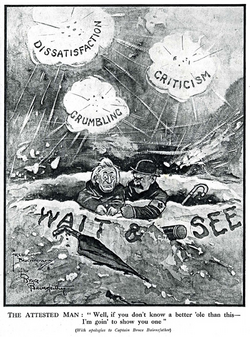
Then the war it is actually remembered for. Bruce Bairnsfather invented the character of Old Bill at Plugstreet Wood near Messines, in the first winter of trench fighting, and the drawings started appearing in The Bystander at the rate of one a week, on Tuesdays, for most of the duration. The magazine collected them under the title Fragments from France, published in London by The Bystander itself and in New York by G. P. Putnam's Sons, and kept the series going into a 1918 volume.
~ the dossier ~
| Born | 9 December 1903, published from Fleet Street |
|---|---|
| Peak | the First World War, one Bairnsfather cartoon a week |
| Killed | 30 October 1940, absorbed by The Tatler |
| Lifespan | 36 years and 10 months |
| Made by | George Holt Thomas, son of the founder of The Graphic |
| Killed by | its own stablemate, in the second year of the second war |
~ a better hole ~
The drawing everybody knows is two soldiers in a shell crater with the shelling coming in, one of them complaining. Old Bill sits there under a walrus mustache looking thoroughly unbothered and gives him the answer: well, if you knows of a better 'ole, go to it. Library exhibits put the best-known version around October 1915, with the first collected edition following close behind.
The joke works because Bill has done the comparison honestly and concluded that this hole is the one available. He is miserable and he is staying. Soldiers bought the collections and posted them home, which is the test a war joke actually has to pass. The line is still in English a century on, attached to a magazine almost nobody can name.
~ the man who left for aircraft ~
George Holt Thomas was the son of William Luson Thomas, who founded The Graphic and the Daily Graphic, so he came into publishing as the family trade and started The Bystander and Empire Illustrated inside it. From 1906 he was more interested in aircraft. He set up the Aircraft Manufacturing Company, known as Airco, at Hendon, brought Geoffrey de Havilland in during May 1914, and built military aircraft right through the war his old magazine was busy printing the trenches of. Airco came close to failing and the group was sold into BSA's Daimler Hire in February 1920.
~ 30 october 1940 ~
The newspaper archives that hold the complete run give the last issue as 30 October 1940. The title went into The Tatler, which came from the same publishing stable, and the combined masthead read The Tatler and Bystander until 1968. Britain was a year into the war and newsprint was under government control. No closure statement has come down from the publisher, though one owner running two society weeklies on a paper ration is a situation with a fairly obvious resolution.
The run is digitized now and sold by the month to anyone who wants it, the usual afterlife for a dead weekly with a complete archive. The vendors do not agree on how many issues there were: one lists 1,942 and another 1,849, a gap of ninety three numbers in a magazine whose first and last dates are both known to the day. The name itself drew twenty eight further years on somebody else's cover, and most absorbed titles get nothing of the sort.
~ leave a rose ~
an anonymous tribute. one rose per visitor per day.
@}-->-- ... roses left here
~ leave a wreath ~
a rose fades by morning. a wreath stays on this grave for good, with your name on it.
paid once through stripe. payments are handled by OÜ Lakeview, the small company that keeps rip.so running. the money pays for the hosting and the nightly digging. adopt it and the headstone reads "maintained in memory by" you. the groundskeeper plants new wreaths at the next tending, usually within a day.
» one email a week: new graves and the anniversaries of the dead. subscribe
other phenomena: CongressEdits, MOPy fish, TVGoHome, GarfieldEats
also died in the pre-1980s: Electric Telegraph Company, Sony CV-2000, PlayTape
~ leave a note ~
visitors before you have left these graveside notes. anonymous welcome.