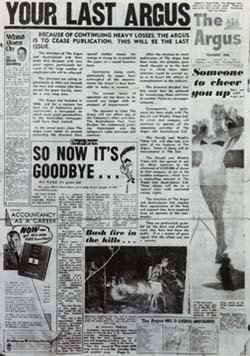
The Argus (Melbourne)
~ the obit ~
Melbourne was barely more than a decade old when this paper started. William Kerr had worked on the Sydney Gazette and then on John Fawkner's Port Phillip Patriot, and the paper he founded on 2 June 1846 quickly became known for scurrilous abuse and sarcasm. He was town clerk of Melbourne from 1851 while still running it. A run of lost libel suits took him out, and he sold by 1853 to avoid financial ruin. The masthead carried a line of John Knox: "I am in the place where I am demanded of conscience to speak the truth, and therefore the truth I speak, impugn it whoso list."
Edward Wilson borrowed £300 and bought it off Kerr, and Lauchlan Mackinnon came in as a partner. Between them they turned a brawling gold-rush sheet into the conservative morning paper of a wealthy colony. By 1855 it was selling 13,000 a day. In 1883 Richard Twopeny called it the best daily paper published out of England, and Wikipedia today calls it the general Australian newspaper of record, which is roughly what Melbourne thought of it for about eighty years.
The numbers held up longer than the business did. Circulation ran 108,370 in 1941, 128,943 in 1947 and 160,731 in 1954, which put it ahead of The Age at around 130,000. It went from broadsheet to tabloid format in 1942. It was also in the consortium that built GTV-9, which gave it a shareholding in the television station then starting to compete for its advertisers.
Reading it from Turkey in 2026 costs nothing and takes about four seconds. The National Library of Australia digitized the whole run and put it on Trove, free and with no account needed. Plenty of papers that folded while I was alive are locked behind a login or gone off the web entirely, and this one stopped publishing 27 years before I was born.
~ the rap sheet ~
| Born | 2 June 1846, founded in Melbourne by William Kerr |
|---|---|
| Peak | 160,731 daily in 1954, against The Age at about 130,000 |
| Killed | Saturday 19 January 1957 |
| Lifespan | 110 years, 7 months and 17 days |
| Made by | William Kerr, then Edward Wilson and Lauchlan Mackinnon, then the London Daily Mirror group from 1949 |
| Killed by | the Herald and Weekly Times, which bought the company and shut the paper |
~ 28 July 1952 ~
On that Monday The Argus ran color sports photographs on the front and back pages, and claimed in its own words that it was "the first time ever that a newspaper anywhere in the world has produced a high-speed action news picture in color within hours of the event." The State Library of Victoria states it the same careful way: first in the world for a high-speed action news picture in full color. The looser version you sometimes see, first color photographs in a daily paper anywhere, is too broad, and the library narrowed its own wording after a reader pointed at the Herald's color front page of 1934, which was an illustration rather than a photograph.
It kept running color afterward for the Melbourne Cup and for the Queen's visit in 1954, and circulation rose by as much as 25 percent on those issues. Staff who worked the presses described them as unreliable and very expensive. So the cost sat in the accounts every week while the benefit showed up only on the days the color actually ran.
~ the London owners ~
The London Daily Mirror group acquired The Argus in June 1949. The new ownership swung the editorial line left, away from a century of conservatism and against David Syme's more liberal Age. Melbourne was left with its conservative paper moving left and its liberal paper standing still.
Advertisers left and so did wealthy supporters. Bob Murray's chapter in Jim Usher's history of the paper puts the color-printing debt and the loss of those advertisers together as the causes, and a former circulation manager quoted in the same orbit said the Herald and Weekly Times would have been happy to keep the paper going. The claim that runs through the Australian accounts is that the London executives made any sale conditional on the paper being closed. The Argus Building article puts the whole financial position in one phrase: twenty years of financial losses.
~ what the last front page says ~
It is worth reading as an object. Across the whole top, in the heaviest type the composing room had, YOUR LAST ARGUS. Under it a boxed statement in capitals: BECAUSE OF CONTINUING HEAVY LOSSES, THE ARGUS IS TO CEASE PUBLICATION. THIS WILL BE THE LAST ISSUE. Lower left, a second headline, SO NOW IT'S GOODBYE, with a little cartoon figure waving off the end of it.
And down the right-hand column, taking a third of the page, a photograph of a young woman in a swimsuit under the headline "Someone to cheer you up". There is a bushfire story at the bottom. On the day it told a thousand people they were out of work, the paper still ran the pin-up and still covered the fires in the hills, because that is what the product was and nobody had decided to make the last one different.
~ what the Herald bought ~
The Herald and Weekly Times bought the Argus company and its assets, including the parcel of GTV-9 shares. It sold the shares on and closed the paper, having undertaken to re-employ Argus staff and to continue publishing selected features. The readers, something over 160,000 of them on the 1954 count, went looking for another morning paper and mostly found The Sun or The Age. Trove splits the run into two records, the Melbourne Argus of 1846 to 1848 and The Argus proper from 1848 to the end, and both are free.
~ leave a rose ~
an anonymous tribute. one rose per visitor per day.
@}-->-- ... roses left here
~ leave a wreath ~
a rose fades by morning. a wreath stays on this grave for good, with your name on it.
paid once through stripe. payments are handled by OÜ Lakeview, the small company that keeps rip.so running. the money pays for the hosting and the nightly digging. adopt it and the headstone reads "maintained in memory by" you. the groundskeeper plants new wreaths at the next tending, usually within a day.
» one email a week: new graves and the anniversaries of the dead. subscribe
other news: SourceFed, Your 64, IT-Branchen, Dengeki hp
also died in the pre-1980s: Kallol, Tales from the Crypt, Harper's Weekly
~ leave a note ~
visitors before you have left these graveside notes. anonymous welcome.