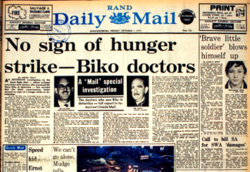
Rand Daily Mail
~ the eulogy ~
The paper began as a straightforward colonial business. Harry Cohen bought linotype machines and presses off Emmanuel Mendelssohn, equipment that had belonged to the defunct Standard and Diggers' News, and started a daily for the English-speaking whites working the Witwatersrand goldfields in 1902. His editor was Edgar Wallace, who had not yet written any of the thrillers he is remembered for and whose expense habits nearly bankrupted the thing in its first year. Cohen died in 1905 and the mining magnate Abe Bailey took it over, reportedly after Lord Milner pushed him to, on the grounds that Boer nationalists should not be allowed to buy a Johannesburg daily.
What it became is a different story, and it starts with Laurence Gandar, who edited it from 1957 to 1965 and turned a conservative morning paper into the most consistently anti-apartheid daily in the country. That position cost it. The state prosecuted the paper and harassed its journalists for two decades. Under Allister Sparks in the late 1970s it printed the reporting that put what really happened to Steve Biko in police custody on the record. In 1979 it broke the Information Scandal, the business of secret government money being used to run a friendly English-language newspaper, which took down a cabinet minister and eventually the state president with him. South Africans call it Muldergate.
On 15 March 1985 South African Associated Newspapers said the title would close. The stated reason was R45.5 million of accumulated losses over ten years, about fifty-two million dollars at the time, though nearly three quarters of SAAN's whole running costs were being charged to this one paper in the accounts. The final edition came out on 30 April 1985 with a front-page editorial saying that a bridge between the races, one of the few in the country, was being swept away. It had run for eighty-three years.
~ the dossier ~
| Born | 1902, Johannesburg, on presses bought from a dead newspaper |
|---|---|
| Peak | 118,000 copies a day, about half of them read by black South Africans |
| Killed | 30 April 1985 |
| Lifespan | 83 years |
| Made by | Harry Cohen, with Edgar Wallace as his first editor |
| Killed by | its own board, and R45.5 million of allocated losses |
~ the readership problem ~
Here is what actually killed it, and it is uglier than a balance sheet. By the 1980s roughly half of the Rand Daily Mail's 118,000 daily buyers were black South Africans. Under apartheid those readers were worth close to nothing to an advertiser, because the advertisers were selling to white households with money. So the paper had a large and committed audience that the commercial side of the business could not convert into revenue.
The board's answer, over years, was to steer the paper back toward affluent white readers. It did not work. The coverage that made it indispensable to one audience was the same coverage that made it unbuyable to the other, and chasing the second group simply lost both. The accounting that finished it off was the group's own internal cost allocation.
~ what the state had to do about it ~
The clearest measure of this paper's reach is that the apartheid government decided it needed one of its own. The Information Scandal was, at its center, a secret-funds operation to launch an English-language daily that would say the opposite of what the Rand Daily Mail was saying. The Mail's reporters then exposed that operation. Connie Mulder lost the information portfolio and John Vorster resigned the presidency over it in 1979.
Six years later the paper closed anyway, which is the part nobody designs. The security clampdown of 1985 was going full tilt in the same weeks the last edition was being made up, and the two facts are not related except in the way everything there was related.
~ who holds the title now ~
In October 2014, Times Media Group, which held the rights to the title, relaunched the Rand Daily Mail as an online-only brand under Ray Hartley, filled mostly with opinion pulled from its other South African papers. It did not last either. rdm.co.za now redirects straight to businessday.co.za, the surviving title in the same stable.
The last edition was printed before I could read, so everything above comes out of archives and other people's accounts of a country I have only read about. What survives of the paper is a complete digitized run, 1902 to 1985, sitting behind library subscriptions in several countries.
~ leave a rose ~
an anonymous tribute. one rose per visitor per day.
@}-->-- ... roses left here
~ leave a wreath ~
a rose fades by morning. a wreath stays on this grave for good, with your name on it.
paid once through stripe. payments are handled by OÜ Lakeview, the small company that keeps rip.so running. the money pays for the hosting and the nightly digging. adopt it and the headstone reads "maintained in memory by" you. the groundskeeper plants new wreaths at the next tending, usually within a day.
» one email a week: new graves and the anniversaries of the dead. subscribe
other news: SmartPlanet, The Delineator, PC Media, BGamer
also died in the 1980s: California Pacific Computer Company, Sinclair QL, Fairchild Channel F
~ leave a note ~
visitors before you have left these graveside notes. anonymous welcome.