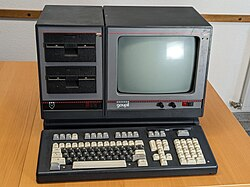
SMT Goupil
~ the eulogy ~
Goupil filed for insolvency in June 1991 and was put into liquidation on 11 July. There were 750 employees at that point and 700 million francs of debt the management had hidden from its own accounts, after twelve years spent being the domestic answer to who ought to build French computers.
Claude Perdrillat started it in 1979, having come out of the Direction générale des Télécommunications, the same state telecoms body that produced the Minitel. Goupil is the old word for a fox in French and a fox went on the machines. The first one, the G1, was a desktop with an acoustic coupler attached, which tells you what its founder thought a computer was for.
A machine built to be bought by French ministries in the mid-eighties had no path to Turkey and no interest in finding one, so what I can read at this distance is the business rather than the hardware. The real product here was a procurement relationship.
~ the dossier ~
| Born | 1979, Créteil, founded by Claude Perdrillat out of the French telecoms directorate |
|---|---|
| Peak | January 1990, claiming 18 percent of the French professional micro market |
| Killed | June 1991, the dépôt de bilan, with liquidation following on 11 July |
| Lifespan | 12 years |
| Made by | Société de micro-informatique et télécommunication, employee-owned after a 1986 buyout |
| Killed by | 700 million francs of hidden debt, over a customer base that was mostly public sector |
~ three processors on a switch ~
The G3 of 1983 is the machine worth describing. It accepted up to two of three possible processors: a Motorola 6809, a Zilog Z80, an Intel 8088. A switch on the machine chose between them. Depending on which board was live it ran FLEX 9, UniFLEX, MS-DOS, CP/M or UCSD Pascal.
That is not indecision, it is what the market actually looked like before the PC won. A French office in 1983 might need CP/M for one program and MS-DOS for another, and Goupil sold a box that did not ask the buyer to guess which one would last. The G4 of 1985 gave up on the question, went PC-compatible off an American design called the MAD-1, and everything after it chased IBM: the G40 server, the Club portable licensed from Kaypro, the G5, the G50, the G100 UNIX server designed with SFENA, the G6.
~ what the administration bought ~
The customer was the state. Ministries and public services took the machines through the eighties, and the G3-PC went into classrooms under the plan informatique pour tous, the 1985 program to put computers into French schools in bulk. By January 1990 the company was claiming 18 percent of the professional micro-computer market in France.
Public-sector business ran to something near 70 percent of revenue, which is an excellent position until budgets tighten. They tightened. Large contracts were being taken with discounts of up to 50 percent. The manufacturing sat with subcontractors, and suppliers waited for their money.
~ the accounts ~
In January 1990 the company was declaring a turnover of 1.2 billion francs. Its real revenue for 1990 came to 830 million, and even that figure had been dressed up. The debt was 700 million and hidden. Olivetti and Siemens each looked at a rescue and each walked away. The Commission des opérations de bourse, the French market regulator, passed the file to the justice system, which Les Échos reported on 25 July 1991.
The two men who had run the company were prosecuted on charges that read like an inventory of the ways a set of accounts can lie: fictitious dividends, unfaithful accounts, banqueroute, fictitious bookkeeping, spreading false information about a securities issuer. The employees had bought 51 percent of the holding company in the 1986 buyout, so a fair number of the 750 people who lost their jobs had also been shareholders in the thing that collapsed.
The name came back once. Late in the nineties an assembler bought it and sold PCs with the fox on the case. That did not work either.
~ leave a rose ~
an anonymous tribute. one rose per visitor per day.
@}-->-- ... roses left here
~ leave a wreath ~
a rose fades by morning. a wreath stays on this grave for good, with your name on it.
paid once through stripe. payments are handled by OÜ Lakeview, the small company that keeps rip.so running. the money pays for the hosting and the nightly digging. adopt it and the headstone reads "maintained in memory by" you. the groundskeeper plants new wreaths at the next tending, usually within a day.
» one email a week: new graves and the anniversaries of the dead. subscribe
other gadgets: Rio Karma, Microsoft ActiMates, Verizon Hub, Trident Microsystems
also died in the 1990s: IXI Limited, ARPANET, Spinnaker Software
~ leave a note ~
visitors before you have left these graveside notes. anonymous welcome.