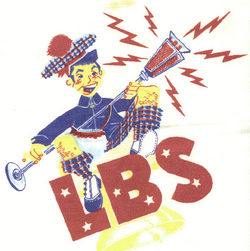
Liberty Broadcasting System
~ the goodbye ~
Gordon McLendon put KLIF on the air in the Oak Cliff part of Dallas on 1 September 1947 and planned to build its schedule around baseball the following spring. The major leagues would not sell him anything. To protect the gate receipts of minor league clubs, the owners had agreed that no big league game would be broadcast more than fifty miles from its home ballpark, which left tens of millions of people in the South and the West with no way to hear one at all. McLendon's answer was to take the play-by-play off a Western Union ticker and act out the rest from a studio eight hundred miles away.
The ticker gave him a line of shorthand per play. Everything a listener actually heard was built in Dallas. His engineers went to every major league park and recorded the crowds, the vendors, the organist playing the anthem. They found that a microphone in KLIF's tiled men's room made a convincing stadium public address system, and that a number two pencil swung against a bat was indistinguishable from a bat hitting a ball. In the control room four turntables held crowd noise graded from an expectant rumble up to a roar, and an engineer rode them like an instrument while McLendon, who called himself the Old Scotchman, described a game he was not watching.
Stations started asking to carry it. About fifty had signed up by the end of the 1948 season and 241 across 33 states by June 1950. By 1951 the number was 458, which made Liberty the second largest radio network in the country behind Mutual. Baseball paid for everything else: sixteen hours a day of schedule, mysteries and quiz shows sitting alongside news commentators the big networks had let go, among them William L. Shirer and Raymond Gram Swing.
Strip the showmanship out and what Liberty sold was a latency problem solved by performance. The game was real, the wire carried maybe twelve characters per play, and the entire value of the network sat in the gap between the two being inaudible to the person listening. It was audible if you went looking. Willie Morris, twelve years old in Yazoo City, Mississippi, was turning the dial one afternoon when he found a live broadcast of the same game the Old Scotchman was calling and realized Liberty was running several innings behind. He spent the rest of the afternoon telling the neighbors what was about to happen, and being right every time.
~ the chronicle ~
| Born | 1948, out of KLIF in Dallas, after the major leagues refused to sell him rights |
|---|---|
| Peak | 458 stations in 1951, second in size only to Mutual |
| Killed | 15 May 1952 |
| Lifespan | about four years |
| Made by | Gordon and B. R. McLendon, through Trinity Broadcasting Corporation of Dallas |
| Killed by | 13 of the 16 major league clubs refusing to renew, plus an NFL blackout rule |
~ the one that was real ~
Liberty's best-remembered broadcast was not a recreation. McLendon was at the microphone at the Polo Grounds on 3 October 1951 for the deciding game of the National League playoff between the Giants and the Dodgers, and when Bobby Thomson hit his ninth-inning home run into the left field stands, Russ Hodges's famous call was going out only to the Giants' own network. Most of the country heard McLendon's instead. Fifty years later HBO built a documentary around the moment and used his audio in it.
~ what baseball did about it ~
The Justice Department had actually helped him once. In 1949 federal lawyers started making antitrust noises about the fifty-mile rule and the owners dropped it rather than put their exemption at risk, which opened the whole country to Liberty's feed. Then the copying started. Mutual launched its own Game of the Day in 1950, and when the beer sponsor Falstaff moved over to it, a reported million dollars left Liberty's budget in one piece.
In 1951 the leagues had already repriced his rights from a nominal sum to $250,000 a year and barred broadcasts from any city holding a minor league franchise and from most of the Northeast and Midwest. After that season thirteen of the sixteen major league clubs declined to renew with him at all, and the National Football League added its own ban inside seventy-five miles of a league city. More than a hundred stations walked. McLendon sued organized baseball for twelve million dollars, which was the right move and far too slow to matter, since the payroll was weekly and the case was years out. Liberty went off the air on 15 May 1952 and into bankruptcy shortly after. The suit outlived the network it was meant to save and settled for a token sum, with what little came out of it going to lawyers and creditors. Senator Edwin Johnson of Colorado, who was also president of the Western League, summed it up without much sympathy: big as Liberty was, baseball broke it overnight.
~ the ship in the baltic ~
McLendon turned thirty-one three weeks after the network folded, and he had the rest of it in front of him. KLIF became the template for Top 40 radio, and he is credited with the first all-news station and the first station jingles. In 1960 he and the Texas oil heir Clint Murchison Jr. bought a 1921 German cargo schooner and fitted her out in Hamburg and Copenhagen with two ten-kilowatt transmitters that arrived from Dallas in six thousand parts. She was anchored off Stockholm as Radio Nord.
Radio Nord lasted from March 1961 to June 1962, killed by a Swedish law against selling advertising from a ship. The ship kept going. She was renamed Magda Maria, then Mi Amigo, and in 1964 she turned up off the Essex coast as Radio Atlanta and then as Radio Caroline South, where she stayed on and off until she sank in a gale in 1980. The man who invented the fake ballgame also supplied European offshore radio with its most famous hull.
~ leave a rose ~
an anonymous tribute. one rose per visitor per day.
@}-->-- ... roses left here
~ leave a wreath ~
a rose fades by morning. a wreath stays on this grave for good, with your name on it.
paid once through stripe. payments are handled by OÜ Lakeview, the small company that keeps rip.so running. the money pays for the hosting and the nightly digging. adopt it and the headstone reads "maintained in memory by" you. the groundskeeper plants new wreaths at the next tending, usually within a day.
» one email a week: new graves and the anniversaries of the dead. subscribe
other news: Personal Computer Games, News Chronicle, CNN Philippines, Infowars
also died in the pre-1980s: Electrologica, News Chronicle, Scribner's Magazine
~ leave a note ~
visitors before you have left these graveside notes. anonymous welcome.