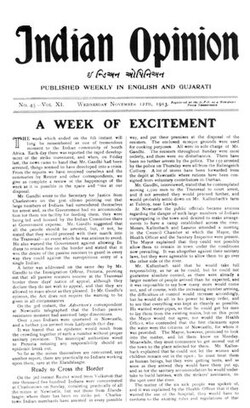
Indian Opinion
~ the last words ~
M. H. Nazar worked until three in the morning on 4 June 1903 in the center of Durban, then walked home to Sydenham because the last tram had gone. The first issue of Indian Opinion carried that day's date and actually reached the street on 6 June. He was already worried about the second number, due in five days.
Nazar was secretary of the Natal Indian Congress and the paper's first editor. Madanjit Viyavaharik owned the International Printing Press that produced it and handled the license and the advertisers. Behind both of them was a Johannesburg lawyer named Mohandas Gandhi, whose clients and allies in the Congress put up the support. The paper existed because the Boer War settlement had left the Indian community of South Africa under a system of warrantless search and compulsory registration papers that nobody in Europe was being told about.
It had 887 subscribers by its second year. Over the whole fifty-eight years the figure averaged around two thousand. For comparison, the Guardian, a South African left-wing weekly by then publishing as New Age, had a circulation of 20,000 in 1961 while Indian Opinion was dying. This was never a mass paper and never close to one, and Gandhi's own verdict on it was that satyagraha would have been impossible without it.
This is a long way outside anything I can speak to from memory, and the reason it is filed here is the ratio. Two thousand subscribers is a mailing list. It is smaller than a provincial club bulletin. It ran for fifty-eight years and left a documentary record of a civil rights struggle that the state had no interest in recording.
~ the record ~
| Born | first issue dated 4 June 1903, on the street two days later |
|---|---|
| Peak | 887 subscribers in year two, roughly 2,000 on average over 58 years |
| Killed | 4 August 1961 |
| Lifespan | 58 years |
| Made by | Mansukhlal Nazar and Madanjit Viyavaharik, with M. K. Gandhi behind it |
| Killed by | money, after the press outlived the movement that had needed it |
~ four languages and a shortage of type ~
At the start each issue was produced in English, Gujarati, Hindi and Tamil. It did not hold all four for long: the front page of number 45 of volume XI, dated 12 November 1913, says published in English and Gujarati, and that is what the paper stayed. Translation was the bottleneck, because it needed people fluent in two languages at once, and Nazar's letters complain that the translators were not especially clever and would not work during the day. Some of the translations he called simply shocking.
There was also not enough metal type. Virji Damodar Mehta, who went on to found his own press, asked Nazar to go easy on the Gujarati letter for "a", because the case was running short of them.
~ Phoenix ~
In 1904 Gandhi moved the press out of Durban to a settlement at Phoenix, nearby. The arrangement there was that everyone working on the paper held a share of the land and a share of any profit. They grew their own food and produced Indian Opinion together. It was a working experiment in the economics Gandhi was arguing for, with a newspaper as the output.
The editors who followed Nazar were Herbert Kitchin, Henry Polak, Albert West, Manilal Gandhi and then Manilal's wife Sushila. Manilal held the chair for thirty-six years. All but one of the paper's editors did time in prison. Alpha Ngcobo came to the press at twenty and was still there for the last issue, by which point he had given it forty-one years.
~ who else it wrote about ~
From 1906 the paper stopped being careful. It had opened in a deliberately moderate register, professing faith in common law and trying not to provoke Smuts's officials, and the satyagraha campaign against the Transvaal pass laws between 1906 and 1913 turned it into an instrument for telling readers which laws to break. It ran the conditions on the indenture estates and the suicide rate among indentured Indians, and Henry Polak took the campaign to India in person.
It also covered the treatment of Africans, which was not what its mandate required. Gandhi wrote in the issue of 22 October 1910 that Africans alone were the original inhabitants of the land, and that Indians lived there by African goodwill while the whites had taken the country by force. The paper gave space to the African women's campaign in the Orange Free State and backed John Langalibalele Dube against the Natives Land Act. Brian Gabriel, one of the earliest Indian photographers in Natal, shot the pictures.
~ the last number ~
In 1957 the English section was renamed Opinion, which is the sort of change a publication makes when it is trying to work out what it still is. Manilal had died in 1956 and Sushila carried it another five years on a subscriber base that had never grown. The last issue was dated 4 August 1961.
Phoenix Settlement was restored in 2000 and declared a National Heritage Site by the South African government in 2020. The run survives in better shape than the paper ever did: the Internet Archive holds volumes 2 through 12, covering 1904 to 1914, and volumes 28 through 59, covering 1930 to 1961, with a full year of issues in each scan.
~ leave a rose ~
an anonymous tribute. one rose per visitor per day.
@}-->-- ... roses left here
~ leave a wreath ~
a rose fades by morning. a wreath stays on this grave for good, with your name on it.
paid once through stripe. payments are handled by OÜ Lakeview, the small company that keeps rip.so running. the money pays for the hosting and the nightly digging. adopt it and the headstone reads "maintained in memory by" you. the groundskeeper plants new wreaths at the next tending, usually within a day.
» one email a week: new graves and the anniversaries of the dead. subscribe
other news: Gil Blas, Far Eastern Economic Review, More, Linux Format
also died in the pre-1980s: Gil Blas, PM, Architectural Forum
~ leave a note ~
visitors before you have left these graveside notes. anonymous welcome.