PM
~ the obit ~
Ralph Ingersoll had a theory about why newspapers were bad, and the theory was advertising. He had run The New Yorker as managing editor from 1925 to 1930, then went to Time Inc. and devised the formula of Fortune. By the end of the 1930s he had the standing to raise money on an argument, and the argument was that there should be at least one mass newspaper in the country supported solely by its readers. Everything that happened to PM over the next eight years is the bill for that sentence.
He wanted ten million dollars and got one and a half. Marshall Field III, the department store heir, came in as a silent partner and by October 1940 had bought out the others to become the only stockholder. The paper launched on 18 June 1940 after a preview issue four days earlier, a tabloid of thirty-two pages with roughly half of it given to pictures. It was bound with staples at first, and it used color on the front page years before anyone else in New York bothered. Some 11,000 people applied to work there. About 150 were hired.
The economics were stated openly and were never met. At five cents a copy, Time reckoned break-even at 200,000 to 250,000 circulation, and the figure PM itself used was 225,000 a day. Curiosity sold 372,000 copies of the first issue. By July 1940 it was under 200,000, and by 1941 it was at 89,500. The Columbia Journalism Review's retrospective has it climbing back to 150,000 in 1942 and just under 165,000 by its sixth birthday, which is still roughly a quarter below the number it needed. In April 1946 Time recorded 145,000, the smallest of Manhattan's nine dailies. The paper turned a profit exactly once, around $40,000 in 1945, and split it with the staff.
Refusing advertising was supposed to buy independence and it did. It also meant that every copy had to carry its own cost, which left the price high against competitors who were being subsidized by department store ads, and the price was the thing readers noticed. The CJR assessment lists it second among the causes of death, right after the observation that PM was not a complete newspaper.
~ the rap sheet ~
| Born | 18 June 1940 in New York, after a preview issue on 14 June |
|---|---|
| Peak | 372,000 copies on the first day, then an average around 165,000 |
| Killed | 22 June 1948, the last issue under the PM masthead |
| Lifespan | 8 years |
| Made by | Ralph Ingersoll, bankrolled by Marshall Field III |
| Killed by | a no-advertising model that never reached its own break-even number |
~ the front page for 16 April 1945 ~
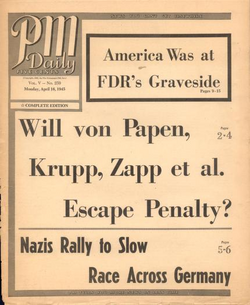
A scanned copy survives of the Monday after Roosevelt was buried, and it is instructive because there is not one photograph on it. The masthead reads PM Daily in a heavy slab, with FIVE CENTS printed underneath and the words COMPLETE EDITION in a box below that. The main headline runs across three lines: "Will von Papen, Krupp, Zapp et al. Escape Penalty?" A second deck reads "Nazis Rally to Slow Race Across Germany", and a boxed line at the top right points inside, to pages 9 through 15, under "America Was at FDR's Graveside".
Every one of those headlines sends you to a page number. The pictures were real and the paper was full of them, but they lived inside, where a reader had to pay the nickel to reach them. The front was an index.
~ who worked there ~
The staff list is the reason people still look this paper up. Theodor Geisel, not yet writing children's books under the Dr. Seuss name at the scale he later would, drew more than 400 editorial cartoons for PM between April 1941 and January 1943, sometimes five in a week, most of them attacking isolationism. Crockett Johnson's strip Barnaby started there in 1942, accepted by the comics editor Hannah Baker. I. F. Stone was the Washington correspondent and wrote the series that became Underground to Palestine. Arthur Fellig, who signed himself Weegee, shot for it. James Wechsler wrote editorials and Louis Kronenberger reviewed theater.
That is a remarkable collection of people for an eight-year run, and it is what a no-advertising paper could offer instead of money: the promise that nothing you wrote would be pulled for commercial reasons.
~ the fights inside ~
PM was liberal and pro-New Deal, and it spent its whole run being accused of Communist domination from outside and being torn up over the same question inside. Ingersoll himself admitted in a prospectus that poor screening had let in incompetents and Communists. The paper also fought openly with the Daily Worker, which complicates the charge considerably.
The Washington bureau came apart in 1946. Ingersoll ordered three staffers moved to Manhattan. Wechsler resigned rather than carry it out, and the three were fired anyway, one of them Milton Murray, president of the American Newspaper Guild. Time reported in June that five of the six Washington staff had resigned in a body. Wechsler went on to charge publicly that the Communist faction had intimidated the editors and other reporters. Ingersoll had been drafted during the war and had declined a deferment, and after his return he did not last long.
~ the ads, and then the Star ~
It took them in the end. PM accepted no advertising during its first six and a half years, which puts the change around the close of 1946, and the ads did not make it pay. Newsweek's account, written after the fact, says something sharper: advertisers were shunning Field's Chicago Sun-Times because of PM, so he decided to drop the New York paper. The experiment had become a liability to the business that was funding it.
By June 1946 Field had put in $4,318,000. Time ran the figure under the headline "100,000 Nickels Wanted", which was the shortfall written up as a want ad. In spring 1948 he sold control to Bartley Crum and Joseph Barnes, reportedly for $300,000, and lent the buyers half a million more. The last issue under the PM masthead came out on 22 June 1948.
The next morning the same presses printed the New York Star, which was PM with advertising and a different name on top. Newsweek's line on it was seven struggling months and 168 issues. It stopped on 28 January 1949, putting 408 people out of work.
Ingersoll never accepted the ordinary explanation. In a memo written in 1966 he blamed a sustained and well-organized plot among Field's business associates, run by Harry Cushing, designed to distract Field into founding the Chicago Sun instead. He also claimed the paper had actually been operating in the black before the end of the war. The circulation figures printed in Time while the paper was alive do not support him, and he was still saying it eighteen years later.
~ leave a rose ~
an anonymous tribute. one rose per visitor per day.
@}-->-- ... roses left here
~ leave a wreath ~
a rose fades by morning. a wreath stays on this grave for good, with your name on it.
paid once through stripe. payments are handled by OÜ Lakeview, the small company that keeps rip.so running. the money pays for the hosting and the nightly digging. adopt it and the headstone reads "maintained in memory by" you. the groundskeeper plants new wreaths at the next tending, usually within a day.
» one email a week: new graves and the anniversaries of the dead. subscribe
other news: PopEater, TSSZ News, Duowei News, L'Ordinateur individuel
also died in the pre-1980s: Gil Blas, Indian Opinion, Service Bureau Corporation
~ leave a note ~
visitors before you have left these graveside notes. anonymous welcome.