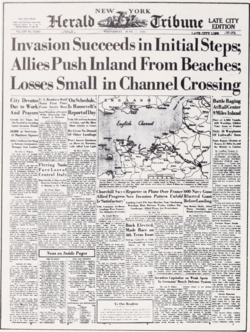
New York Herald Tribune
~ the obituary ~
Two old New York papers went into this one. James Gordon Bennett started the Herald in 1835 and his son ran it from Paris while it decayed, taking some thirty million dollars out of it over a lifetime before he died in 1918. Horace Greeley launched the New-York Tribune on 10 April 1841 as a penny paper with a moral mission, and under Whitelaw Reid it turned into a Republican organ with a wealthy readership and no particular urgency. Frank Munsey bought the Herald in 1920 and spent four years trying to buy the Tribune too. In early 1924 he approached Elisabeth Mills Reid with an offer; she told him she was not selling but would buy the Herald from him instead, and on 17 March 1924 he took five million dollars for the Herald and its Paris edition.
The merged paper's first edition came out on 19 March 1924. It was called the New York Herald New York Tribune until May 1926, when somebody mercifully shortened it. The merger cost six hundred jobs and kept only twenty-five Herald reporters, but within a year circulation was 275,000. The Tribune had been the first American paper to set its headlines in Bodoni, back in 1917, and it held a reputation for the best typography in the country for four decades after that. By 1929 it was over 300,000 copies and turning a profit of nearly $1.5 million, which the Depression took back inside two years.
It never found more money than that. The paper stayed in the black through the 1930s and 1940s without ever earning enough to reinvest, which meant that every year The New York Times pulled further ahead on sheer resources. The Reids sold to John Hay Whitney in 1958. Over the next eight years he put $39.5 million of his own fortune into it.
~ the case file ~
| Born | 19 March 1924, when the Reids merged the Herald into the Tribune |
|---|---|
| Peak | a $1.5 million profit in 1929, on 300,000 copies a day |
| Killed | 24 April 1966, formally closed on 15 August |
| Lifespan | 42 years, 1 month |
| Made by | Ogden Mills Reid, then John Hay Whitney from 1958 |
| Killed by | a strike against its own rescue merger |
~ the byline list ~
Twelve Pulitzer Prizes went to this newsroom, the first in 1930 for Leland Stowe's reporting on German war reparations. Homer Bigart won in 1945 for combat coverage and shared another in 1951 with Marguerite Higgins for Korea, the two of them loathing each other the entire time. Walter Lippmann wrote the column and Red Smith wrote sports. Walter Kerr reviewed Broadway for three decades, Judith Crist reviewed the films.
Under Whitney the paper started pushing at the form itself. Tom Wolfe was on staff in the early 1960s, and so were Jimmy Breslin and Dick Schaap, all of them working the reported-in-scene style that got labeled New Journalism a few years later. The Sunday magazine Book Week ran early essays by Susan Sontag. For a paper that was losing to the Times on budget, this was the only competition left worth entering, and the Herald Tribune won it. That is why it is still remembered as a writer's paper and not as a newspaper of record.
~ what happened on 25 april ~
A 114-day strike shut the New York papers from December 1962 until the spring of 1963, and the settlement the unions won in March of that year blocked most of the automation the publishers wanted. Three years later Whitney and his president Walter Thayer tried to assemble the city's first joint operating agreement: the Herald Tribune would keep the morning while the Journal-American and the World-Telegram and Sun merged into one afternoon paper. All three would share a Sunday edition. On paper it threw off four or five million dollars a year. It also deleted 1,764 of the 4,598 jobs at the three papers.
The Newspaper Guild wanted a new contract for the merged operation. The publishers refused. On 25 April 1966, the day the agreement took effect, the Guild struck, and the Herald Tribune never published again. Whitney announced on 15 August that the morning paper was finished and the name would be bolted onto the afternoon one. The World Journal Tribune appeared on 12 September 1966 and closed on 5 May 1967, eight months later.
~ paris ~
The European edition Munsey had thrown into the 1924 deal did not die with New York. After the closure the Times and The Washington Post went in with Whitney on it, and on 22 May 1967 it came out under a new name as the International Herald Tribune. It kept going for another forty-six years, until the Times took full control and renamed it the International New York Times in 2013.
Which means the only version of this paper I could ever have bought was the ghost of it. The IHT was the English-language daily on the big newsstands in Turkey through the 1990s and 2000s, thin and expensive, usually a day old. I had no idea the words Herald Tribune in the masthead belonged to a New York paper that had stopped printing eighteen years before I was born. By the time I did notice, the Times had taken the name off it.
~ leave a rose ~
an anonymous tribute. one rose per visitor per day.
@}-->-- ... roses left here
~ leave a wreath ~
a rose fades by morning. a wreath stays on this grave for good, with your name on it.
paid once through stripe. payments are handled by OÜ Lakeview, the small company that keeps rip.so running. the money pays for the hosting and the nightly digging. adopt it and the headstone reads "maintained in memory by" you. the groundskeeper plants new wreaths at the next tending, usually within a day.
» one email a week: new graves and the anniversaries of the dead. subscribe
other news: Park Avenue, The Minnesota Independent, Newsvine, Portfolio.com
also died in the pre-1980s: V-Cord, Everybody's Magazine, Société d'électronique et d'automatisme
~ leave a note ~
visitors before you have left these graveside notes. anonymous welcome.