Family Computing
~ the last words ~
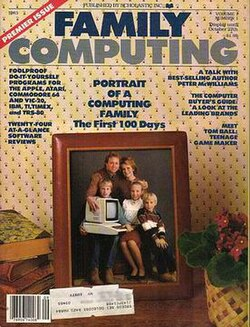
A magazine title is a market research document you can hold. In September 1983 Scholastic decided the market was the family, put the word on the cover, and guaranteed advertisers 200,000 copies. In October 1987 the same publisher decided the market was the home office and changed the title to Family & Home Office Computing, then dropped the first two words entirely. Nothing about that decision was sentimental. The households had stopped buying.
While it lasted it was the most domestic of the computer magazines. Claudia Cohl edited it for people who had one machine in the house and a genuine argument going about what it was for, and the content answered that argument directly: reviews of software a parent might justify, how-to pieces for people who had never used a command line, and type-in program listings printed for whatever was on the desk. Circulation hit 420,000 in August 1986, which is a large number for any magazine and an enormous one for a category four years old.
The type-in coverage is the part worth remembering. Family Computing kept printing listings for the Coleco Adam and the TI-99/4A long after everyone else had written those machines off, on the reasonable grounds that somebody had bought one and was stuck with it. If your household had made the wrong purchase, this was the magazine that still spoke to you.
The argument in those pages, the one about whether the machine in the living room is a tool or an expensive toy, arrived in Turkish homes a decade later with the exact same two sides and the same evidence on each. I was on the wrong end of it, being the person who needed the machine for reasons that sounded like homework and looked like games. What is strange about reading the magazine now is that its answer was so patient. It really did think a family could be talked into computing together, and then the home office killed that idea from the inside, because a machine that pays for itself does not have to be shared.
~ the record ~
| Born | September 1983, launched by Scholastic with a guaranteed 200,000 circulation |
|---|---|
| Peak | 420,000 copies in August 1986 |
| Killed | October 1987, when the title changed |
| Lifespan | four years under its own name |
| Made by | Scholastic, with Claudia Cohl as editor in chief |
| Killed by | the home computer turning into an office machine |
~ what was in it ~
The listings ran across Apple II, Commodore 64, Atari, IBM PC and Macintosh, with the differences between dialects handled in the margins, which meant a single page of the magazine had to be checked against five machines before it went to print. That was ordinary labor in 1984 and would be an unreasonable ask now. Everything else in the issue sat around that spine: what to buy, what it cost, how to make the thing you already owned do something.
Then the video game crash of 1983 kept working through the market, and by the late eighties the family computer as a category had thinned out into two clearer things. There were game consoles for the children and there were work machines for adults who had brought the job home. A magazine sitting exactly between them had nowhere left to stand.
~ what it became ~
Home Office Computing was the honest continuation, and it covered fax machines and office furniture next to the software, because that was what its readers were now buying. Scholastic sold the title to Freedom Technology Media Group in January 1998 and the final issue came out in April 2001, by which point the home office had stopped being a subculture worth a magazine and become the default arrangement for millions of people who did not think of it as a topic.
The archive is on the Internet Archive, cover to cover, ads included. The ads are the better history. You can watch the price of a printer fall, watch the modem speeds climb, and watch the word family quietly leave the pages a year or so before it left the masthead.
~ leave a rose ~
an anonymous tribute. one rose per visitor per day.
@}-->-- ... roses left here
~ leave a wreath ~
a rose fades by morning. a wreath stays on this grave for good, with your name on it.
from $1, paid once through stripe. it keeps the graveyard running: the hosting and the nightly digging. adopt it and the headstone reads "maintained in memory by" you. the groundskeeper plants new wreaths at the next tending, usually within a day.
» one email a week: new graves and the anniversaries of the dead. subscribe
other news: Zavit Acheret, Terça Livre, Nuntii Latini, WarCry Network
also died in the 1980s: NEC PC-6000 Series, Sega SG-1000, ETA Systems
~ leave a note ~
visitors before you have left these graveside notes. anonymous welcome.