Efke
~ the obituary ~
The machine that coated Efke film was German and was already old when it arrived. ADOX had been a brand of Fotowerke Dr. C. Schleussner of Frankfurt, the first company in the world to manufacture photographic materials, and its 35mm black and white line dated from 1952. The Schleussner family sold the photographic business to DuPont in 1962. In the 1970s DuPont licensed out the film technology while keeping the trademark for itself, and in 1972 it sold the coating plant, dip-and-dunk tanks and all, to Fotokemika in Samobor, in what was then Yugoslavia.
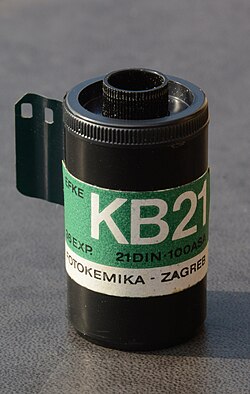
What came off that line was a 1950s formula running on its original hardware, in a factory outside Zagreb, for four decades after the people who designed it had left the business. KB was the 35mm line and R the rollfilm. Sheet film went out as PL, and the speeds ran from 25 to 100 ISO. A cassette from the earlier years reads KB21, with 21 DIN and 100 ASA printed beside it and FOTOKEMIKA - ZAGREB around the bottom.
Photographers who used it were specific about why. The silver content was high and the exposure latitude was wide. The slowest of them, KB 25, was laid down as a single emulsion layer rather than the stack a modern film uses, which also made it thin and soft, so it scratched during processing if you were careless. It was cheap, the quality varied batch to batch, and everyone buying it understood the trade.
~ the case file ~
| Born | 1972, when DuPont's ADOX coating plant arrived in Samobor |
|---|---|
| Peak | the only 127 film made anywhere between 1995 and 2006 |
| Killed | August 2012 |
| Lifespan | about forty years |
| Made by | Fotokemika Zagreb d.d., of Samobor, Croatia |
| Killed by | silver prices against a coating machine not worth repairing |
~ the only 127 left ~
Kodak dropped 127 rollfilm in 1995. From that year until 2006, when a Canadian manufacturer picked it up, Efke was the only company on the planet still coating it, which meant that every Baby Rolleiflex and every Yashica 44 in working order anywhere depended on one production line in Samobor.
The other orphan product was Efke IR820, an infrared film with usable sensitivity past 750 nanometers and out to 820. Nothing else on the market reached that far once Kodak's HIE was gone, and nothing has replaced it since.
~ the machine ~
The long decline was structural. Through the 1990s and 2000s the company went through privatization, with equipment and real estate sold off to western buyers while staff went in waves, so by the end there was a small operation running old plant. The color lines had gone one at a time before that. The efkechrome reversal film ran from 1982 to 1999 and the spektar negative films lasted until about 2009.
The end was announced through the distributor rather than the factory. On 28 August 2012 Mirko Boeddecker of Fotoimpex in Berlin passed on the news, and his account is the clearest statement of cause anyone has. Efke was stopping voluntarily because it could no longer make money selling film and paper, and market prices had been too low for silver-rich products for about five years. Fixing the machine made no economic sense once you worked out what came after the repair. The production was not being moved anywhere, and the stock in the pipe would last about two months.
~ what went back to germany ~
Fotoimpex had been founded in 1992 to import film and paper out of the former eastern bloc, and it had been selling some Efke stock in Germany under the ADOX name, which quietly reunited the brand with the emulsions that had always been its own. After Samobor closed, ADOX rebuilt KB100 as ADOX CHS II on modern plant, so the formula outlived the factory by going home.
Fotokemika itself ran on briefly as a distributor of other manufacturers' medical film and then stopped. In late 2020 the photographer Silvester Kolbas put an exhibition about it into the Nikola Tesla Technical Museum in Zagreb, built out of equipment and products left behind in the abandoned buildings, hung alongside pictures taken on expired Efke. The domain fotokemika.com is a sales listing now, with a form for offers and a note that anything under a thousand dollars is not usually considered.
~ leave a rose ~
an anonymous tribute. one rose per visitor per day.
@}-->-- ... roses left here
~ leave a wreath ~
a rose fades by morning. a wreath stays on this grave for good, with your name on it.
paid once through stripe. payments are handled by OÜ Lakeview, the small company that keeps rip.so running. the money pays for the hosting and the nightly digging. adopt it and the headstone reads "maintained in memory by" you. the groundskeeper plants new wreaths at the next tending, usually within a day.
» one email a week: new graves and the anniversaries of the dead. subscribe
other media formats: DVD-Audio, Sabamobil, CD Video, Quadruplex Videotape
also died in 2010-2014: Dragon Ball Online, Squidoo, 앨리샤 (Alicia)
~ leave a note ~
visitors before you have left these graveside notes. anonymous welcome.