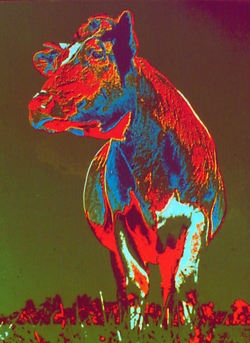
Agfacontour Professional
~ the eulogy ~
Agfacontour was fourteen years older than I am, and it belonged to a room I have never worked in. It is a sheet film, sold to laboratories rather than to people photographing weddings, and the only reason it is buried here at all is that it was a format with a specific job, and that job was taken away from it by software. The job was equidensitometry, which is the business of finding the lines of equal brightness in an image and making them visible.
Agfa-Gevaert introduced it in 1970. Before that, anyone wanting those lines had to work for them: the popular route was the Sabattier effect, and the accurate route meant making three to five separate exposures of a negative onto ultra high-contrast lith film and printing those again until the middle tones were gone. Then you paired a positive from one set against a negative from another, held in register, and a single equidensity emerged. Both methods were hard to reproduce twice running, and the second was simply a great deal of labor.
The Agfacontour answer was to put the complexity in the emulsion instead of the workflow. The film carried two emulsions with different spectral sensitivities, and after a single pass through the dedicated Agfacontour developer it produced the equidensities directly. A yellow or magenta filter during exposure controlled how wide the resulting band was, and changing the exposure moved which density the band landed on. The cost was sensitivity: it was a slow film and the exposures were long. In exchange the results came back repeatable, which is what the workgroup had been asked for.
~ the dossier ~
| Born | 1970, from an Agfa-Gevaert workgroup set up to make equidensitometry repeatable |
|---|---|
| Peak | a 1975 NASA technical note evaluating it for film from the Apollo 16 spectrograph |
| Killed | 2002, the year sources record it as no longer produced |
| Lifespan | about thirty-two years |
| Made by | Agfa-Gevaert |
| Killed by | image processing software that drew the same lines without a darkroom |
~ what equidensity means ~
An equidensity is a contour line through brightness. Take a photograph of anything with a smooth gradient in it, a shadow falling across a wall or a glowing object, and the eye reads it as continuous. An equidensity picks one exact density value out of that gradient and renders everywhere it occurs as a visible boundary, the way a topographic map picks the 400-meter line out of a hillside. Do it several times at different values and you get a map of the light rather than a picture of the subject.
That turns out to be useful anywhere a photograph is a measuring instrument. Agfa's own workgroup specified what the film had to support: a black and white extract across a controllable range of densities, and the ability to break an image into distinct density bands you could then colorize or screen. A further requirement was measuring distances between similar densities across a gradient, the case Agfa's specification called isodensities.
~ the apollo film ~
NASA published a technical note on the film in 1975 evaluating it as an analysis tool, with the stated expectation that it would serve on the film brought back from the Apollo 16 far-ultraviolet camera and spectrograph. That is about as good a credential as a sheet film gets: the pictures taken on the Moon in April 1972 came home as densities on emulsion, and somebody had to turn those densities into readable values.
It had a parallel life in engineering, where photoelastic stress analysis produces fringe patterns in loaded transparent models, and reading a fringe order accurately is the whole measurement. A paper from the period describes Agfacontour as simplifying that evaluation. Both uses have the same shape: a scientist with a photograph that contains a number, needing the number out.
The end is recorded thinly, and the grave should say so. No discontinuation notice from Agfa has surfaced. What exists is an as-of statement that the film was no longer in production by 2002, plus a place in the register of products discontinued that year, so the year stands and nothing finer than the year does. Anyone wanting equidensities now opens an image editor and applies a threshold, which takes a second and costs nothing, and that is what happened to Agfacontour.
~ leave a rose ~
an anonymous tribute. one rose per visitor per day.
@}-->-- ... roses left here
~ leave a wreath ~
a rose fades by morning. a wreath stays on this grave for good, with your name on it.
paid once through stripe. payments are handled by OÜ Lakeview, the small company that keeps rip.so running. the money pays for the hosting and the nightly digging. adopt it and the headstone reads "maintained in memory by" you. the groundskeeper plants new wreaths at the next tending, usually within a day.
» one email a week: new graves and the anniversaries of the dead. subscribe
other media formats: VHS-C, PlaysForSure, MegaSWF, AgfaPhoto
also died in the 2000s: Transamerica Japan, WiseNut, WebSideStory
~ leave a note ~
visitors before you have left these graveside notes. anonymous welcome.