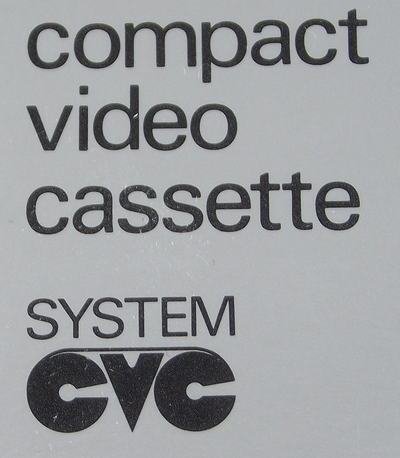
Compact Video Cassette
~ the last words ~
In 1980 the open question in consumer video was not picture quality. It was whether the thing could leave the living room at all. Compact Video Cassette answered that first, and it still lost, because the camera that Funai and Technicolor bolted to the front of it could not see anything in an ordinary room with the lights on.
Funai Electric introduced the format in 1980 and the machine everybody actually met was the Technicolor 212, developed jointly by the two companies: a portable recorder and a handheld camera sold as one product. The tape was 6.5mm, a quarter of an inch, against the half inch that VHS and Betamax were both using. The clever part was the shell. Almost every video cassette of the period wrapped its reels in flanges, plastic discs above and below the tape pack to keep it from spilling. CVC threw those away and ran on bare hubs, the way an audio compact cassette does, and that one decision is most of the reason it fit in a hand.
You got thirty minutes on the first tapes, the V30. V45 and V60 followed. It shipped for all three broadcast systems, with the European cassettes labelled VExx, and like every analogue format of the era a PAL recording would not play back on an NTSC deck. Picture in color with the sound in mono, and the whole thing pitched squarely at the people still shooting 8mm film at birthdays, which was a real and large market that nobody had taken yet.
~ the record ~
| Born | 1980, introduced by funai electric with the technicolor 212 |
|---|---|
| Peak | sold under technicolor and grundig badges, in both ntsc and pal territories |
| Killed | 1983, when funai switched its own production to vhs |
| Lifespan | about three and a half years on the market |
| Made by | funai electric, with technicolor |
| Killed by | a camera that could not see indoors |
~ the one component ~
Two faults killed it and only one of them was interesting. The dull one was dropouts, brief losses on playback that a quarter-inch tape running that fast was always going to be prone to. The interesting one was sensitivity. The camera needed more light than a house contains. Point it at a garden in summer and you got a picture. Point it at a birthday in a living room with the lamps on, which is the actual use case somebody buys a camcorder for, and you got a dim mess.
That is a component failure rather than a format failure, and it is the reason CVC reads as a near miss rather than a bad idea. Everything above the sensor was correct. The mechanism was correct, the cassette was correct, the two-piece portable design was correct. Sony shipped Video8 in 1985 with the same basic proposition and won with it, not because the concept was better but because by 1985 the pickup tubes and then the CCDs had improved enough that you could film inside a house. Funai did not wait to find out. It started producing VHS machines in 1983 and let the format go.
~ the inheritance ~
The home video I actually grew up around in Turkey was VHS, and it arrived as a rental shop rather than as a camera. Recording your own life onto tape came much later and came as VHS-C and Video8, the two formats that finished the job CVC started. By then the interesting question had already been settled and nobody had to explain what a portable video recorder was for.
The tapes themselves are now a specialist digitization job. A handful of transfer labs still list CVC on their price sheets alongside the other orphan formats, which means somewhere there are family recordings from 1981 and 1982 sitting in boxes on tape that almost no working machine can read. Whatever is on them was shot outdoors.
~ leave a rose ~
an anonymous tribute. one rose per visitor per day.
@}-->-- ... roses left here
~ leave a wreath ~
a rose fades by morning. a wreath stays on this grave for good, with your name on it.
from $1, paid once through stripe. it keeps the graveyard running: the hosting and the nightly digging. adopt it and the headstone reads "maintained in memory by" you. the groundskeeper plants new wreaths at the next tending, usually within a day.
» one email a week: new graves and the anniversaries of the dead. subscribe
other media formats: MovieCD, DIVX (Digital Video Express), Video CD, Open eBook
also died in the 1980s: Lucasfilm's Habitat, Timex Sinclair, Datasoft
~ leave a note ~
visitors before you have left these graveside notes. anonymous welcome.