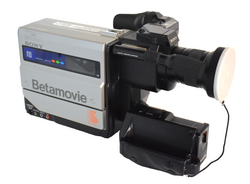
Betamovie
~ the obituary ~
The Betamovie could not show you anything it had recorded. There was no screen, which was normal for 1983, but there was also no playback head and no play button, which was not. You shot your daughter's birthday, carried the cassette back to the living room, pushed it into the Betamax deck under the television, and only then found out whether the exposure had been right. Sony sold the first consumer camcorder as half a machine and charged $1,500 for it.
The BMC-110 reached American shops in May 1983, with the BMC-100P doing the same in PAL countries. Before it, shooting video at home meant two objects joined by a cable: a camera in one hand and a portable video recorder hanging off a shoulder strap. Sony's own SL-3000 deck weighed around nine kilos without a battery and the HVC-2000P camera added three more. Betamovie put both jobs in one body at 2.5 kg, and that is the entire reason it mattered.
Getting there took real engineering. A Betamax cassette is not small and the head drum that reads it is not either, so Sony shrank the drum to roughly 45 mm and spun it at 2500 rpm instead of the standard 1500. The tape then had to wrap 300 degrees around it rather than the usual half turn. The recording that came out was a normal Betamax tape that any Betamax deck could play. The compromise landed on the camera side, and the compromise was playback.
This one was never going to reach me and the reason is the order of purchase. A Betamovie was the second thing you bought, not the first, because without a Betamax deck already sitting under your television the tape you shot was unreadable. In Turkey in 1983 a home video recorder was a rare object, and when video did arrive here properly it came in as VHS through the neighborhood rental shop. A camcorder that required you to have already picked the losing format had no path into this house or most others.
~ the case file ~
| Born | may 1983, as the BMC-100P and BMC-110 |
|---|---|
| Peak | 1985, three models in the range at once |
| Killed | 1987, after the BMC-1000 |
| Lifespan | four years and five models |
| Made by | sony |
| Killed by | video8, and a rival that could show you the shot |
~ the half that was missing ~
Sony kept the line going for four years and five models, and the prices barely moved. The BMC-110K opened at $1,500 in 1983 with an optical viewfinder and nothing else. The BMC-220K in 1985 added autofocus and went up to $1,700, while the BMC-550K the same year came in at $1,495 and worked down to 25 lux. The BMC-660K in 1986 was the first with a CCD sensor and SuperBeta recording, and the BMC-1000K closed the range in 1987 at $1,695 with SuperBeta High Band and 15 lux.
Every one of them still recorded only. Four years of successive models picking up autofocus and better low-light performance, and not one of them ever gained the ability to play a tape back. Sony's position was that the deck in your living room did that job already. What that missed is what the camera is for at the moment you are using it, which is knowing whether the thing you just filmed is on the tape.
~ what jvc did with it ~
JVC shipped the GR-C1 a year and change later, in 1984, built around the smaller VHS-C cassette. It weighed about the same as Sony's and it played back what it had shot. You could watch what you had shot through the viewfinder standing where you had shot it. Its other distinction is that it is the camera Marty McFly carries in Back to the Future, which meant an enormous number of people saw exactly one camcorder in 1985 and it was not Sony's.
Sony's own answer to the problem was to abandon the tape rather than fix the camera. Video8 arrived in 1985 with a cassette small enough that a camcorder could hold a full transport, and the Handycam line that grew out of it ran for the next fifteen years. The Betamovie is what you get when a company is first to a category and solves the hard problem on the way, then discovers that the part it left out is the part people notice.
~ leave a rose ~
an anonymous tribute. one rose per visitor per day.
@}-->-- ... roses left here
~ leave a wreath ~
a rose fades by morning. a wreath stays on this grave for good, with your name on it.
from $1, paid once through stripe. it keeps the graveyard running: the hosting and the nightly digging. adopt it and the headstone reads "maintained in memory by" you. the groundskeeper plants new wreaths at the next tending, usually within a day.
» one email a week: new graves and the anniversaries of the dead. subscribe
other gadgets: Motorola Razr V3, Sony EyeToy, Zeos International, Scion
also died in the 1980s: Traf-O-Data, Imagine Software, System Development Corporation
~ leave a note ~
visitors before you have left these graveside notes. anonymous welcome.