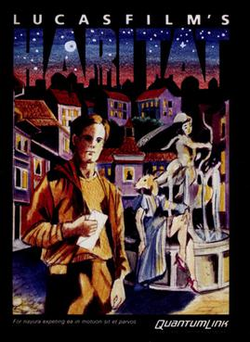
Lucasfilm's Habitat
~ the last words ~
Habitat sits in the part of internet history I can read about but have no way to remember. The beta opened in 1986, when I was two years old in Turkey, and the whole thing was finished by 1988. Everything I know about it comes from a paper its own authors published afterward, which is unusual on its own, because most dead products never get a postmortem written by the people who built them.
Chip Morningstar and Randy Farmer built it at Lucasfilm Games with Aric Wilmunder and Janet Hunter, and it ran on the Commodore 64 over Quantum Link, the American consumer service that later renamed itself America Online. You got a body. It was a jointed cartoon figure you could dress and walk from room to room, and it spoke in a balloon over its head. Nothing before this had put a stranger's body in the same frame as yours and let the two of you work out what to do about it.
The numbers underneath are the part that still surprises people. The world held around twenty thousand discrete regions and the system was designed for twenty thousand avatars, with headroom to grow to fifty thousand, while the pilot itself ran with roughly five hundred testers. Everyone connected at three hundred baud, and packet delays ran anywhere from a tenth of a second to five full seconds, which meant almost nothing could be sent over the wire. All the artwork lived on the floppy in the drive and the host sent short codes telling the machine which pictures to assemble. The world was already on your desk. The network only told you where you were standing in it.
By the time I had a modem of my own, in 1998, Habitat had been dead for ten years and the things it discovered were being rediscovered from scratch by everybody building anything with more than one person in it. That is the honest position I write this from. I was not there and neither was almost anybody, because the entire population would not have filled a small cinema.
~ the record ~
| Born | 1986, in beta on Quantum Link |
|---|---|
| Peak | around 500 beta testers in a world built for 20,000 |
| Killed | 1988 |
| Lifespan | two years |
| Made by | Chip Morningstar and Randy Farmer at Lucasfilm Games |
| Killed by | a pilot that cost more to run than it brought back |
~ the day the money broke ~
Habitat had an economy with vending machines that sold objects and pawn machines that bought them back. Somebody noticed that a doll sold for 75 tokens and pawned for 100. A crystal ball sold for 18,000 and pawned for 30,000. Two players spent a night shuttling between the two machines and came out with hundreds of thousands of tokens, which roughly quintupled the money supply of the entire world before morning.
What the operators did about it is the interesting half. They did not roll it back. They fixed the prices and let the new money stand, and the players who had found it spent it on a scavenger hunt for everyone else. A bug in a price table had produced the first documented case of an online world discovering that its economy was a real economy, with real arbitrage in it, run by people who were paying attention harder than the designers were.
~ the vote ~
Guns worked in Habitat, and players killed each other with them. When the operators asked the population what to do, the answer split almost exactly down the middle. Half said killing was a crime that had no business being there. Half said it was the best thing in the world. Neither answer had a majority to hide behind, so the compromise was geographic: weapons stopped working inside town and kept working out in the wilderness.
Then the community elected a sheriff, without being asked to, because a rule needs someone to sit behind it. Every online world since has run this exact argument, usually while believing it invented the question. Habitat had it settled and legislated in 1987 on a machine with 64 kilobytes of memory.
~ what replaced it ~
The pilot closed in 1988 and Lucasfilm recovered its costs by shipping a reduced version called Club Caribe on the same service, which held something like fifteen thousand participants over the next couple of years. Fujitsu licensed the technology and launched Fujitsu Habitat in Japan in 1990. The same lineage came back to the American market as WorldsAway on CompuServe in 1995 and survived, under other owners and other names, until VZones went dark in August 2014.
The source code was released decades later through the Museum of Art and Digital Entertainment, and a group of volunteers rebuilt a working server so you can dial into 1986 with an emulator. That makes Habitat one of the few products on this site whose actual running state can be recovered. The paper is the better artifact anyway. It is the one thing here that people still send each other for reasons that have nothing to do with nostalgia.
~ leave a rose ~
an anonymous tribute. one rose per visitor per day.
@}-->-- ... roses left here
~ leave a wreath ~
a rose fades by morning. a wreath stays on this grave for good, with your name on it.
from $1, paid once through stripe. it keeps the graveyard running: the hosting and the nightly digging. adopt it and the headstone reads "maintained in memory by" you. the groundskeeper plants new wreaths at the next tending, usually within a day.
» one email a week: new graves and the anniversaries of the dead. subscribe
other community: buildspace, Pandlr, bobiler.org, Rigveda Wiki
also died in the 1980s: Compact Video Cassette, Timex Sinclair, Datasoft
~ leave a note ~
visitors before you have left these graveside notes. anonymous welcome.