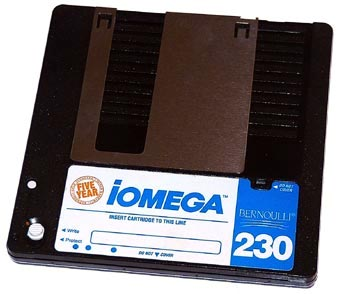
Bernoulli Box
~ the goodbye ~
I met Iomega at the end of the story. In the late 90s a Zip disk was the thing you took to the print shop, and by then it was already losing to the CD burner. That was my whole relationship with the company: one blue cartridge, a parallel port, and the click of death arriving a couple of years later. I had no idea that Iomega's first product had been a genuinely beautiful piece of engineering, or that the Zip drive was the compromise that killed it.
Iomega was founded on 1 April 1980 in Roy, Utah, by three people out of IBM. Two years later it shipped the Alpha-10: ten megabytes on an 8-inch removable cartridge, at a moment when a personal computer with a hard disk at all was a serious machine. The pitch was that you could carry the disk out of the building.
What made it work was fluid dynamics. A rigid platter has to hold its head at a fixed distance and any shock closes that gap, which is what a head crash is. Bernoulli did it the other way round. The medium was flexible, and when the drive spun it up the airflow between the spinning disk and a fixed plate pulled the disk toward the head rather than away from it. Cut the power and the disk simply drops back. There is no crash available, because the thing holding the disk in position is the air itself.
~ the chronicle ~
| Born | 1982, the alpha-10, ten megabytes on an 8-inch cartridge |
|---|---|
| Peak | 1986, over 70,000 drives and a million cartridges sold at $80 each |
| Killed | 1994, discontinued |
| Lifespan | twelve years |
| Made by | iomega, founded 1 april 1980 in roy, utah |
| Killed by | the zip drive, from the same company |
~ who bought it ~
This was expensive hardware for people whose work was worth more than the hardware. A dual-drive unit in 1987 listed at $2,595 and a single at $1,795, at a time when the whole computer might cost less. What justified it was pre-press and design work, medical imaging, engineering drawings, anything where the file was large by the standards of the day and losing it meant losing a week.
By 1986 Iomega had sold over 70,000 drives and more than a million cartridges at $80 apiece, which is the real business: the drive is the razor. PC Magazine described it as having the advantages of a floppy and of a hard disk at once, and a BYTE reviewer reported nine months of use without a single problem, which for removable storage in 1986 was worth saying out loud.
~ the shrinking ~
The Bernoulli Box II arrived in September 1987 and moved the format from 8-inch to 5.25-inch, starting again at 20 megabytes and climbing to 44 and then 90. A MultiDisk drive followed that would read 35, 65 and 105 megabyte cartridges and write 150. The last of them, in 1993, held 230.
That is a twenty-three-fold capacity increase across eleven years while the cartridge got physically smaller, which is a perfectly respectable engineering record. It was also, by 1993, no longer the point. Hard disks had fallen off a cliff in price, and the reason to own a removable cartridge system had quietly changed from I need more storage to I need to hand this to somebody.
~ killed by the next desk over ~
Iomega discontinued the Bernoulli line in 1994 and shipped the Zip 100 in March 1995. The Zip disk used none of the Bernoulli mechanism. It was a straightforward flexible disk with a head that contacted the surface, which is why it eventually developed a fault that chewed through the media and gave the company its worst years. It held less than the last Bernoulli cartridges. It cost around ten dollars instead of eighty and the drive was under two hundred, and it sold in numbers the Bernoulli Box never approached.
So the elegant design lost to the cheap one, from inside the same building. That is the ordinary outcome and it is worth saying plainly, because the Bernoulli Box is remembered now as a curiosity when the correct description is that it solved head crashes in 1982 and the industry declined to pay for the solution.
Iomega itself was bought by EMC in 2008 and folded into Lenovo's joint venture after that, and the name stopped being used around 2013. The last Bernoulli cartridges are thirty-three years old and the ones that have been powered up recently mostly still read, which is more than the Zip disks in the same drawer can say.
~ leave a rose ~
an anonymous tribute. one rose per visitor per day.
@}-->-- ... roses left here
~ leave a wreath ~
a rose fades by morning. a wreath stays on this grave for good, with your name on it.
from $1, paid once through stripe. it keeps the graveyard running: the hosting and the nightly digging. adopt it and the headstone reads "maintained in memory by" you. the groundskeeper plants new wreaths at the next tending, usually within a day.
» one email a week: new graves and the anniversaries of the dead. subscribe
other media formats: Sorenson Video, IVC videotape, Embedded OpenType, U-matic
also died in the 1990s: Cyberdreams, PrairieTek, Color Dreams
~ leave a note ~
visitors before you have left these graveside notes. anonymous welcome.