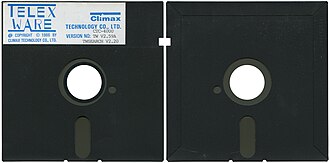
5.25" Floppy Disk
~ the goodbye ~
The 5.25 inch floppy was the dominant format for personal computer storage from roughly 1980 to 1990. It is the one that was actually floppy. The plastic case was thin and bent if you put any pressure on it. You held it carefully, by the edges, the way a serious adult held an LP record.
I was born in 1984. By the time i was old enough to actually use a computer, around 1992 or 1993, the 5.25 was already on the way out. We had 3.5 disks at school. The 5.25 i mostly remember from labs, or from my dad's friend at his office, or from the back room of the computer shop where they kept old hardware. So this one is a little before my time. But anyone who was using computers in the 1980s remembers them clearly.
~ the chronicle ~
| Born | 1976 |
|---|---|
| Standard size | 360 KB or 1.2 MB (depending on density) |
| Made by | Shugart Associates originally |
| Replaced by | the 3.5 inch floppy |
| Practically dead by | 1995 |
| Was actually floppy | yes, this one really did bend |
~ how it actually worked ~
The disk inside was the same idea as on the 3.5: a circle of magnetic mylar. The case was different. The 5.25 case was made of vinyl, was not rigid, and had a permanent oval cutout exposing part of the disk inside. There was no metal slider to protect the magnetic surface. The disk was literally exposed to your fingers if you tried hard.
Capacity depended on density. Single sided single density was 360 kb on most pcs. High density 5.25 disks held 1.2 mb. Compared to the 1.44 mb of a 3.5 high density floppy that came later, the 5.25 was actually a bit smaller, and physically larger, which is why nobody missed it once the 3.5 was the default.
You used the disk by sliding it into a horizontal drive that took up about half of a desktop pc's front panel. You pushed it in, you closed the lever on the drive, and you waited. The drive made a louder noise than the 3.5. It was less of a whirr and more of a grind.
~ what we used them for ~
In the 1980s, almost everything. Operating systems came on 5.25 disks. WordPerfect came on a stack of them. PC games shipped on 5.25 sets. The original sim city came on a 5.25 disk. Most early MS-DOS software was distributed this way, often with two or three disks per program and an instruction sheet about which disk to insert at which step.
For people in the early home computing era, 5.25 disks were also the way you traded software with your friends. There was a whole subculture of disk swapping. You copied things you should not have copied. You wrote on the label with a soft pen because a hard pen could damage the magnetic surface underneath. There were rumors about magnets and microwaves. We took the rumors seriously.
~ how it died ~
The 3.5 inch floppy showed up in 1981. By 1986 to 1987 most new pcs had both drive types. The 3.5 was smaller, more durable, held more data, and had a metal slider that protected the disk surface. There was no real reason to keep using 5.25.
By 1992 most new computers shipped with only a 3.5 drive. The 5.25 lived on for a few more years on older machines and in industrial settings. By 1995 you had to go out of your way to find a working 5.25 drive. By 2000 they were museum pieces.
The 5.25 had a quiet death. It was just out-engineered by its own smaller cousin. Nobody mourned it the way people now mourn the 3.5. Maybe because the 3.5 lived long enough to become the save icon, and the 5.25 did not.
~ leave a rose ~
an anonymous tribute. one rose per visitor per day.
@}-->-- ... roses left here
~ leave a wreath ~
a rose fades by morning. a wreath stays on this grave for good, with your name on it.
paid once through stripe. payments are handled by OÜ Lakeview, the small company that keeps rip.so running. the money pays for the hosting and the nightly digging. adopt it and the headstone reads "maintained in memory by" you. the groundskeeper plants new wreaths at the next tending, usually within a day.
» one email a week: new graves and the anniversaries of the dead. subscribe
~ epitaphs from visitors ~
"Used to have a whole collection of games on these disks. What a trip down memory lane, thanks."
left by Feeling Old At The Moment, 2026-05-20
"Used these disks to play the game Sneakers and Oregon Trail on appleII in elementary and middle school"
left by Sneaker Player, 2026-05-19
other media formats: AgfaPhoto, SmartMedia, VHS-C, MegaSWF
also died in the 1990s: Technōs Japan, Distinctive Software, Periphonics Corporation
~ leave a note ~
visitors before you have left these graveside notes. anonymous welcome.