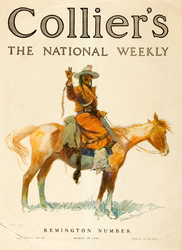
Collier's Weekly
~ the eulogy ~
Collier's stopped printing in the first week of 1957, twenty-seven years before I existed, so everything here comes out of the record rather than out of memory. The record on this one is unusually good. Peter Fenelon Collier left Ireland for the United States at seventeen, intending to enter the priesthood, and ended up selling books door to door for a Catholic publisher instead. He fell out with his employer over how subscription selling ought to work, went out on his own in 1875, and built P. F. Collier and Son into the largest subscription house in America, moving thirty million books in the decade after 1900.
The magazine began as a way to feed that machine. The issue dated 28 April 1888 launched Collier's Once a Week at seven cents, promising fiction and fact and news and wit, and by 1892 it was past 250,000 copies. Its title then changed about as often as its ambitions did: Once a Week on its own from 1889, Collier's Weekly: An Illustrated Journal from 1895, and Collier's: The National Weekly from 1905 onward, which is the name it kept for the last half-century of its life.
Peter Collier dropped dead of apoplexy in the Riding Club in 1909, by which point his son Robert had been a full partner for eleven years and the magazine was deep in the work it is now best known for. Crowell Publishing bought the company in 1919 and the printing moved to Springfield, Ohio in 1924. It ran weekly until 1953, went fortnightly to save money, and never recovered from the decision.
~ the dossier ~
| Born | 28 April 1888, as Collier's Once a Week, priced at seven cents |
|---|---|
| Peak | 2,846,052 copies an issue in 1946 |
| Killed | 4 January 1957, Princess Grace of Monaco on the last cover |
| Lifespan | 68 years, 8 months |
| Made by | P. F. Collier and Son, then Crowell-Collier from 1939 |
| Killed by | television advertising, and $15 million of losses after 1953 |
~ the great american fraud ~
Norman Hapgood took the editor's chair in the early 1900s and turned the magazine into one of the instruments of American muckraking, publishing Samuel Hopkins Adams, Ray Stannard Baker, C. P. Connolly and Ida Tarbell. On 7 October 1905 Adams began an eleven-part series called "The Great American Fraud", documenting that the patent-medicine industry was lying about what its products did and that several of them were actively dangerous. The first Pure Food and Drug Act followed in 1906. The American Medical Association reprinted the whole series as a book and sold half a million copies of it at fifty cents each.
Taking on that industry was not free, because patent medicines were a major source of magazine advertising at the time, and the magazine's proprietor went after one of them in court himself. Robert Collier won a fifty-thousand-dollar verdict against the Postum Cereal Company over the claim that Grape-Nuts was a food for brain and nerves. An appeals court handed Postum a new trial in 1912. Separately, in the spring of 1905, an article by Upton Sinclair asking whether Chicago meat was clean helped push the Senate toward the Meat Inspection Act the following year.
~ fu manchu, twelve parts at a time ~
The other half of the product was fiction, and the list of people who published there is close to absurd: Willa Cather, F. Scott Fitzgerald, Ring Lardner, Sinclair Lewis, Zane Grey, Erle Stanley Gardner, Roald Dahl, Ray Bradbury, Kurt Vonnegut, J. D. Salinger, Louis L'Amour, Walter Tevis, Jack Finney. Henry James's The Turn of the Screw ran across twelve parts between 27 January and 16 April 1898. Collier's also popularized a format of its own, the short-short story, written deliberately to fit on a single page.
Its most commercially valuable fiction was Sax Rohmer's Fu Manchu, serialized from 1913 to 1949. The first three Fu Manchu novels were not written as novels at all: they are compilations of twenty-nine short stories Rohmer wrote for this magazine. The Mask of Fu Manchu arrived as a twelve-part serial between 7 May and 23 July 1932.
~ man will conquer space soon ~
On 22 March 1952 Collier's ran the first installment of a series under the headline "Man Will Conquer Space Soon", edited by Cornelius Ryan and running across eight issues until 30 April 1954. Wernher von Braun laid out his plans for crossing what the magazine called the last frontier. Willy Ley wrote the space station and the moon ship, Fred Lawrence Whipple took the astronomy and the Mars question, Heinz Haber handled whether a human body could survive up there, and Oscar Schachter was given the legal problem of who owns the universe. The paintings were Chesley Bonestell's, with Fred Freeman and Rolf Klep working beside him.
One effect of the series was actually measured at the time. The share of Americans who believed a crewed trip to the moon could happen within fifty years moved from 15 percent to 38 percent by 1955. Disney turned the series into three episodes of its anthology show, the first going out on ABC on 9 March 1955 with von Braun among the narrators alongside Ward Kimball, and roughly forty million people watched it. NASA did not exist while any of this was happening. It was founded in 1958, four years after the last installment ran.
~ the name, sold twice ~
What killed it was the arithmetic of 1956. Circulation was higher than it had ever been, 4,165,000 copies, lifted in part by inheriting subscribers from a sister title Crowell-Collier had already closed that summer. The advertising had gone to television regardless. The magazine lost over fifteen million dollars after the 1953 switch to fortnightly publication and was 7.5 million down for 1956 alone.
In the middle of December the board met for six hours and voted to stop both of its remaining magazines, and chairman Paul Smith announced it at half past ten the next morning. Four hundred and forty office staff went immediately and around 2,300 printing workers followed. Cowles, which published Look, paid a million dollars for the Collier's title and the subscription business attached to it. The last copies were stamped 4 January 1957 and carried Princess Grace of Monaco on the front.
No magazine appeared under the name for decades afterward, though Collier's Encyclopedia kept the family name on shelves until 1998. Somebody tried to bring the weekly back in 2012 and failed. Then in 2025 a New Jersey company called LNN USA bought the title, and in July 2026 it began publishing a magazine called Collier's out of Hammonton.
Its footer line reads "Independent, investigative journalism in the American tradition since 1888", and its About page describes its owners as new stewards of a storied brand. Those owners are Craig Richards, a career journalist, and Robert Capoferri, whose other company lays asphalt. The site dates itself to 1888 in three separate places and does not mention Peter Fenelon Collier anywhere on it. That is why this page is filed under the name the magazine actually died with. What ended that December was a weekly with four million readers and a printing plant in Ohio, and what exists now is a trademark somebody paid for.
~ leave a rose ~
an anonymous tribute. one rose per visitor per day.
@}-->-- ... roses left here
~ leave a wreath ~
a rose fades by morning. a wreath stays on this grave for good, with your name on it.
paid once through stripe. payments are handled by OÜ Lakeview, the small company that keeps rip.so running. the money pays for the hosting and the nightly digging. adopt it and the headstone reads "maintained in memory by" you. the groundskeeper plants new wreaths at the next tending, usually within a day.
» one email a week: new graves and the anniversaries of the dead. subscribe
other news: Amiga World, Official Dreamcast Magazine (UK), The Siberian Times, Big K
also died in the pre-1980s: Lacerba, Daily Herald (UK), Immediate Records
~ leave a note ~
visitors before you have left these graveside notes. anonymous welcome.