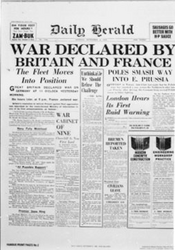
Daily Herald (UK)
~ the goodbye ~
The name comes off a picket line. In December 1910 the London Society of Compositors went out over a 48-hour week and started a daily strike bulletin called The World, which was renamed the Daily Herald on 25 January 1911 and published until the dispute ended that April. At its best it sold 25,000 copies a day. Once the strike was settled, Ben Tillett of the dockers and a group of radical trade unionists decided the unions needed a permanent daily of their own, independent of both the Labour Party and the TUC, each of which was quietly planning one anyway.
Issue one of the permanent paper is dated 15 April 1912, edited by William H. Seed, with cartoons by the Australian artist Will Dyson setting its tone. Its politics were broadly syndicalist: unconditional backing for anybody on strike, and an argument that the future belonged to workers organizing themselves rather than to either party. In that same first week it covered the loss of the Titanic by counting the dead among the crew and the third class, which told a reader within days exactly what kind of paper this was going to be. The company was in liquidation by June 1913, and George Lansbury rebuilt it under a new one called the Limit Printing and Publishing Company, a name taken from Lloyd George's answer when somebody asked him about the Herald.
It went weekly through the First World War, when the split on the left over whether to support the fighting cut its constituency badly, and spent those years campaigning against conscription and defending conscientious objectors. Its most famous story ran in November 1917 under the headline "How they starve at the Ritz", an account of what the rich were eating while the country went short. It was reprinted in leaflets and some historians credit it with pushing the government into compulsory rationing. Lansbury handed the paper over to the TUC and the Labour Party in 1922.
In 1930 the TUC sold 51 percent of it to Odhams Press, run by Lord Southwood, which mainly wanted something to keep its presses busy between Sundays. The promotion campaign that followed worked better than anyone expected: by 1933 the Daily Herald had certified net sales of two million and was the best-selling daily newspaper on earth, which set off a circulation war with the Express that ran for years.
The decline after that was slow and never once reversed. The International Publishing Corporation took over Odhams around 1961 and bought out the TUC's remaining stake in 1964, commissioned a study from the market researcher Mark Abrams to find out what was wrong, and then acted on what it said. The last Daily Herald is dated 14 September 1964. The following morning the same presses, the same building and a good deal of the same staff produced the first issue of The Sun under Sydney Jacobson.
~ the chronicle ~
| Born | 15 April 1912, out of a printers' strike bulletin |
|---|---|
| Peak | certified net sales of 2 million in 1933, the best-selling daily in the world |
| Killed | 14 September 1964 |
| Lifespan | 52 years |
| Made by | radical trade unionists, then the TUC, then Odhams Press and IPC |
| Killed by | an advertising market that would not pay for working class readers |
~ the strike sheet ~
From 1923 until its final year the Herald handed out an award of its own invention, the Order of Industrial Heroism, which everybody called the Workers' VC. It went to ordinary people who had done something dangerous at work and were otherwise never going to be decorated for anything by anyone. A newspaper that strikes medals for its own readers has a fairly clear idea of who it is for, and this one kept striking them for forty-one years.
~ readers advertisers did not want ~
The arithmetic that finished it sits in two pairs of percentages. In 1955 the Daily Herald held 10.8 percent of total national newspaper circulation and 10.8 percent of newspaper advertising revenue, which is what a working newspaper looks like from the accounts department. By 1964 the circulation share had slipped to 8.1 percent while the advertising share had fallen off a cliff to 3.5 percent. It was still being read by well over a million people every single morning. Those people were old and poor, and the advertising market of the early 1960s had quietly concluded they were not worth reaching.
A survey in 1958 found that the Herald had the highest level of reader appreciation of any newspaper in Britain. Its readers liked it more than anybody else's readers liked theirs, and that bought the paper nothing at all, because what was actually being sold in Fleet Street was not newspapers but access to people with money. Roy Greenslade has argued that the Herald was mostly losing readers to the Daily Mirror, its own stablemate inside the same company, rather than to any broad change in British life, which would make 1964 a decision taken in one boardroom rather than a verdict delivered by the country.
None of this is mine to claim. The Herald was finished off by an advertising department a long way ahead of anything I could have dialed into, in a newspaper trade that was already old on the day it happened. What survives the gap is the mechanism. A product can carry an audience that genuinely loves it and still be closed because the wrong people love it, and that shape sits under half of what is buried on this site. The Daily Herald ran it in 1964, on paper, with a market research report attached.
~ the paper that replaced it ~
The Sun of 1964 was not Rupert Murdoch's paper. It was IPC's attempt to keep something of the Herald's politics while reaching the younger and better-off readers the Abrams study had pointed at, and it failed on its own terms. By 1969 the new Sun had fewer readers than the Herald had on the day it closed, at which point IPC sold it to Murdoch's News Limited and the format, then eventually the politics, went somewhere else entirely.
What outlived all of it is the photography. The Daily Herald's picture archive, including the work of James Jarché, went to the National Science and Media Museum in Bradford, and in 2022 nearly 50,000 of those images were digitized and published through Google Arts and Culture. The paper the advertising industry wrote off as too poor to sell to ended up in a museum, and the photographs are free to look at from anywhere.
~ leave a rose ~
an anonymous tribute. one rose per visitor per day.
@}-->-- ... roses left here
~ leave a wreath ~
a rose fades by morning. a wreath stays on this grave for good, with your name on it.
paid once through stripe. payments are handled by OÜ Lakeview, the small company that keeps rip.so running. the money pays for the hosting and the nightly digging. adopt it and the headstone reads "maintained in memory by" you. the groundskeeper plants new wreaths at the next tending, usually within a day.
» one email a week: new graves and the anniversaries of the dead. subscribe
other news: GameFan, Seattle PostGlobe, Facebook News, Computing Today
also died in the pre-1980s: Collier's Weekly, Lacerba, Deram Records
~ leave a note ~
visitors before you have left these graveside notes. anonymous welcome.