Deram Records
~ the eulogy ~
In the mid-1960s Decca's engineers were working on better stereo. Early stereo pop was mixed to three fixed positions with nothing in between them, because the four-track machines everyone used would not comfortably do anything else. Decca's answer was to run two four-track recorders together and layer stereo pairs rather than overdub mono tracks, which let an engineer place an instrument anywhere across the field instead of at one of three points. They called it Decca Panoramic Sound, shortened it to Deramic, and in 1966 built a whole record label around the abbreviation.
The launch was not rock. To demonstrate the technique Deram put out six orchestral easy-listening albums in October 1967, every one of them with the word Night in the title, from Strings in the Night to Brass in the Night, by arrangers including Peter Knight and Tony Osborne. A month later it released Days of Future Passed by the Moody Blues, and the label's identity quietly changed under it from a stereo demonstration into a home for progressive and psychedelic records, competing with Island and Vertigo.
Then the premise evaporated. Professional eight-track recorders reached British studios in early 1968, starting with Advision and Trident, and they did everything the paired four-tracks did with less effort. By 1969 Decca had one of its own. Deramic Sound was dropped, about two years after a label had been named for it. Deram carried on for another decade as an ordinary imprint with an unusual name, which nobody outside the building would have known was an unusual name at all.
~ the dossier ~
| Born | 1966, London, as the outlet for 'Deramic Sound' |
|---|---|
| Peak | Days of Future Passed, November 1967 |
| Killed | 1979, then kept on as a reissue stamp |
| Lifespan | 13 years |
| Made by | Decca Records |
| Killed by | Roger Ames picking Decca and London instead |
~ the hits it did not make ~
Deram's best-known early singles were not really Deram's. Procol Harum's "A Whiter Shade of Pale" and a pair of Move singles came through a deal with an outside company, Straight Ahead Productions, whose acts were produced elsewhere and merely released on the label. Straight Ahead later took them to EMI and the Regal Zonophone imprint, and the biggest records in Deram's catalog walked out the door with them.
What it did sign ran in two directions at once, which was the standing problem. Pop sat next to progressive on the same imprint. Cat Stevens found his early success here before leaving for Island, and David Bowie's first album came out on it, in the years before either of them meant anything commercially. On the other side were serious British jazz players like John Surman and Mike Westbrook, cataloged under DML for mono and SML for stereo. Decca pointed the label at Harvest and never got close.
~ what the name does now ~
Sir Edward Lewis sold Decca to PolyGram in 1980 and Roger Ames took charge of what he had bought. Ames decided the group needed Decca for classical and London for pop, and that was the whole list. Deram had already been used in the early eighties for odd one-offs by Bananarama and Splodgenessabounds, which is a sentence that tells you the imprint had stopped meaning anything specific. After that it became a reissue stamp for Decca and London back catalog and was eventually sold on to Universal along with Decca itself.
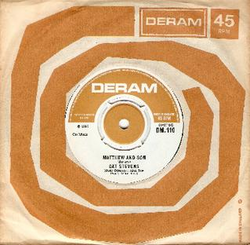
So the name is technically in use, printed on reissues of records it originally released, which is how most dead labels persist. The 1960s pressings themselves are the honest survivor. The Cat Stevens single "Matthew and Son" went out in a brown Deram bag with the catalog number DM 110 on it, and those objects outlasted both the technique and the label that was named after it.
~ leave a rose ~
an anonymous tribute. one rose per visitor per day.
@}-->-- ... roses left here
~ leave a wreath ~
a rose fades by morning. a wreath stays on this grave for good, with your name on it.
paid once through stripe. payments are handled by OÜ Lakeview, the small company that keeps rip.so running. the money pays for the hosting and the nightly digging. adopt it and the headstone reads "maintained in memory by" you. the groundskeeper plants new wreaths at the next tending, usually within a day.
» one email a week: new graves and the anniversaries of the dead. subscribe
other media music: Charlton Comics, Maverick Records, Winamp, Immediate Records
also died in the pre-1980s: Immediate Records, Lacerba, Electric Telegraph Company
~ leave a note ~
visitors before you have left these graveside notes. anonymous welcome.