VPL Research
~ the goodbye ~
VPL stood for Virtual Programming Languages, which tells you the company started as a software idea and turned into a hardware company because there was nothing to run the software on. Jaron Lanier set it up in 1984, and by the end of the decade it was the only place on earth where you could write a purchase order for a working virtual reality system and have one delivered.
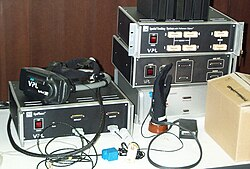
The catalog was small and famous. The DataGlove was a lycra glove with fiber optic loops along the fingers that measured how much each one bent, and it sold for around $10,000. The EyePhone was the head-mounted display, a heavy pair of goggles with a small screen for each eye, and a complete system with the computers behind it ran upward of a quarter of a million dollars. The DataSuit did the same job as the glove for the whole body. Reality Built for Two, usually just RB2, was the setup that let two people share one simulation and see each other in it, which was the demonstration that made journalists write the articles.
The hardware was not good. The EyePhone managed five or six frames per second against the thirty that television had trained everyone to expect, so the world lagged behind your head, and the thing was heavy enough that a long session was a physical experience in the wrong way. Everyone who tried it knew the machinery was inadequate and wrote it up as a revelation anyway, because the idea underneath was legible even through the failure.
I was six years old and in Ankara, so this arrived as a photograph. For most of the world outside a few American labs, VR in 1990 was one image reprinted everywhere: a person in goggles with a wired glove raised in front of them, caption underneath explaining the future. I saw that picture years before I saw a computer that could render anything in three dimensions. The first VR I could put on my own head was a phone in a plastic holder, twenty-five years later, and it was not obviously better than the photograph.
~ the chronicle ~
| Born | 1984, founded by Jaron Lanier; VPL stood for Virtual Programming Languages |
|---|---|
| Peak | the DataGlove at $10,000 and the EyePhone rig at upwards of $250,000 |
| Killed | bankruptcy in 1990; Thomson-CSF foreclosed on the patents in 1992 |
| Lifespan | six years selling, another two being dismantled |
| Made by | Jaron Lanier, with early funding from Marvin Minsky among others |
| Killed by | hardware that cost a quarter million dollars and ran at six frames a second |
~ what it actually sold ~
The customer list was research labs, NASA, car manufacturers doing design review and a handful of universities. There was no consumer product and no plausible path to one at those prices. Mattel licensed the glove concept and shipped the Power Glove for the NES at about $90 in 1989, which was a toy that barely worked and which is the only version of this technology that anyone under forty actually held in their hands during the period.
Lanier is also the reason the phrase exists in the form we use it. He did not invent the words but he pushed "virtual reality" into general circulation as the name for the whole field, and he did it while running the only company selling any. Naming the category and going bankrupt in it inside six years is a specific kind of bad luck.
~ the postmortem ~
The money ran out in 1990 and the company filed for bankruptcy. What made the ending ugly rather than just sad is what Lanier had done to keep it alive beforehand: he had put the company's whole intellectual property portfolio up as collateral against a set of small bridge loans from Thomson-CSF, the French defense contractor. By july 1992 VPL owed Thomson $1.6 million it did not have. Thomson took the patents and pushed Lanier out of his own company.
In february 1998 Sun Microsystems bought the portfolio from Thomson and from Greenleaf Medical. Sun had a workstation graphics business and an interest in whatever came next, and what came next did not come for another fifteen years. The patents aged out quietly.
~ the long tail ~
Every argument the industry had about VR between 2012 and 2020 was an argument VPL had already lost once. Frame rate against latency, weight against optics, whether two people in a shared space is the point or a demo, whether anyone outside a lab will pay for this. Palmer Luckey's contribution was not conceptual, it was that phone manufacturing had made small high-resolution displays and motion sensors nearly free, so the thing VPL sold for $250,000 could be assembled for a few hundred dollars.
Lanier spent the following thirty years writing books arguing against most of what the technology industry did with his ideas, which is an unusual second act for a founder. The company itself left almost nothing you can point at. The gloves are in museums, the patents expired unexercised, and the demonstration it built has been rebuilt from scratch three separate times by people who were not born when it first worked.
~ leave a rose ~
an anonymous tribute. one rose per visitor per day.
@}-->-- ... roses left here
~ leave a wreath ~
a rose fades by morning. a wreath stays on this grave for good, with your name on it.
from $1, paid once through stripe. it keeps the graveyard running: the hosting and the nightly digging. adopt it and the headstone reads "maintained in memory by" you. the groundskeeper plants new wreaths at the next tending, usually within a day.
» one email a week: new graves and the anniversaries of the dead. subscribe
other gadgets: Plastc Card, Sony eVilla, Dell Streak, Poqet PC
also died in the 1990s: Aldus Corporation, Dr Solomon's Anti-Virus Toolkit, The Hornet Archive
~ leave a note ~
visitors before you have left these graveside notes. anonymous welcome.