Poqet PC
~ the goodbye ~
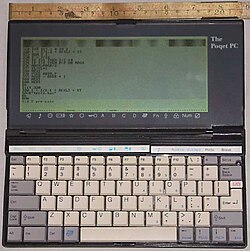
Ian Cullimore left his job in 1988 to start a company around one idea, which was a full IBM PC that fit in a coat pocket. The Poqet PC shipped in october 1989 at two thousand dollars. Inside was an 80C88 running at 7 MHz with up to 640KB of memory and MS-DOS 3.3 in ROM, and the screen did MDA or CGA graphics rather than the truncated character grid every other pocket machine settled for. It ran ordinary DOS software off the shelf, which nothing else that size could claim.
The famous part is the power. Two AA batteries. Wikipedia puts the figure at fifty to a hundred hours of use and the contemporary write-ups talk about weeks, and both are true depending on what you were doing, because the machine's whole design was about not running. The processor was static CMOS, which means the clock can be stopped without losing state, so the Poqet halted the CPU between your keystrokes and dropped voltage wherever it could get away with it. A machine that spends most of its life switched off while still being on is a design nobody was doing in 1989.
The two slots on the side are the other legacy. Cullimore wanted memory cards for storage and pushed the industry to agree on a connector, and the standardization effort that came out of that became PCMCIA. Every laptop for the next fifteen years had that slot in the side of it, holding a modem or a network card, and it came from a palmtop most people never saw.
I was five when this shipped, and at two thousand 1989 dollars it was never going to be an object in my life or anyone's around me. What I do now is argue about milliwatts. Put a vision model on something that has to fly and the whole design turns into a negotiation between what the processor wants and what the battery can give, and the tricks are the same ones this machine used: slow the clock down, then stop it entirely when nothing is happening. A palmtop from 1989 got weeks out of two AA cells doing that. Nothing on my desk in 2026 comes near it, because we took the improvement and spent it somewhere else.
~ the chronicle ~
| Born | october 1989 at $2,000 |
|---|---|
| Peak | the first IBM PC compatible palmtop that ran MS-DOS at CGA resolutions |
| Killed | 1994, production ended under Fujitsu |
| Lifespan | five years |
| Made by | Poqet Computer Corporation, started in 1988 by Ian Cullimore |
| Killed by | a price nobody could defend against cheaper palmtops |
~ what it actually was ~
Roughly a pound of computer with a keyboard you could touch type on if your hands were the right size. No hard disk, because there was nothing to spin: your files lived on the memory cards or in the RAM disk, and the machine held that RAM alive on the same two AA cells. Software came on cards too, and Poqet sold a bundle of applications the way you would sell cartridges.
It got a successor, the Poqet PC Plus, with an NEC V30 at 16 MHz behind a backlit screen. By then the argument was already lost, because the backlight and the faster processor ate exactly the power advantage that had made the original remarkable.
~ what became of it ~
Atari released the Portfolio the same year at four hundred dollars. It was a worse machine in almost every respect, DOS-compatible rather than a real PC and stuck behind a smaller screen, and none of that mattered, because it cost a fifth as much and it was in shops. Poqet was selling a corporate expense line, not a product a person buys.
Fujitsu bought Poqet Computer Corporation in 1992, kept the brand alive for a couple of years and ended production in 1994, after which the engineering went into Fujitsu's own notebook line. Working units now sell to collectors for several hundred pounds, which is a strange fate for a machine whose only real crime was costing too much in a category that turned out to be entirely about price.
~ leave a rose ~
an anonymous tribute. one rose per visitor per day.
@}-->-- ... roses left here
~ leave a wreath ~
a rose fades by morning. a wreath stays on this grave for good, with your name on it.
from $1, paid once through stripe. it keeps the graveyard running: the hosting and the nightly digging. adopt it and the headstone reads "maintained in memory by" you. the groundskeeper plants new wreaths at the next tending, usually within a day.
» one email a week: new graves and the anniversaries of the dead. subscribe
other gadgets: Nintendo Virtual Boy, Dell Streak, Sony eVilla, VPL Research
also died in the 1990s: Wildcat! BBS, Nintendo Virtual Boy, Dunkindonuts.org
~ leave a note ~
visitors before you have left these graveside notes. anonymous welcome.