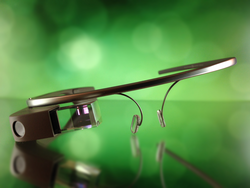
Google Glass
» see google.com/glass as it lived, on the wayback machine
~ the goodbye ~
Google announced Glass at Google I/O on June 27 2012 with one of the showiest demo stunts in keynote history. Skydivers wearing Glass jumped out of a blimp over San Francisco and landed on the roof of Moscone Center. The live POV video came through to the stage where Sergey Brin was standing, and the crowd lost its mind. The pitch was that Glass would put a small heads-up display over your right eye and surface notifications without you ever pulling out a phone. Voice commands triggered photo and video capture. It looked like the most science-fictional thing Google had ever shipped.
Distribution to selected developers and early adopters began on April 16 2013. The price was $1500. You had to apply through a #ifihadglass contest on Twitter and Google Plus to be invited to buy one. The invited group called themselves Explorers. By spring 2014 Glass had its own SXSW season and a Vogue fashion editorial shot on a runway model wearing it. There was also a steady drumbeat of bar-and-restaurant incidents involving the people who were wearing them. The word glasshole had been coined and entered general use by the middle of 2014. Google itself published an etiquette guide telling Explorers not to be glassholes, which functioned as an admission that the etiquette problem was real.
On January 15 2015 Google announced it was halting the Explorer program. The framing was that Glass was graduating out of Google X and into a standalone product team under Tony Fadell, with a planned consumer redesign down the road. The redesign never materialized. What did follow was Google Glass Enterprise Edition, a model aimed at factory floor and surgical-suite use cases where having both hands free actually solved a problem. The Enterprise Edition shipped quietly in 2017 and was updated in 2019. Google ended sales of it on March 15 2023, with support ending the following September. The cultural product, the consumer-Glass moment, was already over by January 2015.
i never wore one. they never reached turkey at retail. the closest i got was photos and reviews on engadget and the verge in 2013-2014. by the time the explorer program was being shut down i had moved into edge-vision work professionally and started looking at glass with engineer eyes. the optics were a real achievement, the battery life and thermal envelope were not. the product was three or four hardware generations away from being something a normal person could wear all day.
~ the chronicle ~
| Born | April 16 2013, Explorer Edition shipping at $1500 |
|---|---|
| Peak | spring 2014, when Glass got its own SXSW season and a Vogue editorial |
| Killed | January 15 2015, Explorer program ended for a consumer redesign that never came |
| Lifespan | 21 months as a consumer product, plus eight more years as enterprise hardware |
| Made by | Google X, with project lead Babak Parviz and later Astro Teller |
| Killed by | The glasshole backlash and a product that did not solve any actual problem |
~ the glasshole backlash ~
The social problem with Glass was the camera. The display and the voice control were tolerable. The fact that anyone wearing Glass could be recording you at any moment, with a single voice command and no obvious indicator, was not. Bars in San Francisco and Seattle put up "no Glass" signs through 2013-2014. There were several documented incidents of Glass wearers being assaulted by strangers who objected to being filmed. The word glasshole was coined to describe the subset of Explorers who refused to take Glass off in social settings where it was unwelcome.
Google's etiquette guide, published in February 2014, addressed all of this directly. Do not be creepy. Take it off in conversation when someone seems uncomfortable. The guide read like the legal team and the PR team had reached the same conclusion at the same time. The product had a structural privacy problem that no firmware update could fix.
~ the enterprise pivot ~
Once it was clear consumer Glass was dead, Google moved the technology into industrial use. The Enterprise Edition launched quietly in 2017 with companies like Boeing and DHL running pilots. The hands-free heads-up display was actually useful when you were inside a warehouse picking orders or on an assembly line referring to a torque diagram. Surgical applications followed, with Glass overlay used for vital signs during operations. Enterprise Edition 2 launched in 2019 with a faster processor and better battery.
The enterprise version sold steadily for almost a decade and then quietly stopped. Google announced the end of sales on March 15 2023 with support ending September 15 of that year. The reason was probably some combination of newer purpose-built competitors like Vuzix and the broader Google X cost-cutting that hit a lot of moonshot products in the 2022-2023 stretch. Either way, all variants of Google Glass were officially discontinued in 2023.
~ what glass actually predicted ~
Glass was wrong about what year it was. It was right about almost everything else. By 2024 Apple had shipped Vision Pro and Meta had iterated through several generations of Ray-Ban Meta camera glasses. The smart-glasses category was no longer a joke. Ray-Ban Meta shipped the always-available wearable camera that Glass had pitched, with the social-acceptance problem mostly solved by hiding the technology inside ordinary-looking sunglasses. This is the same idea Glass had tried in 2013 with worse hardware and obvious geek aesthetics that made the camera impossible to ignore.
The lesson the 2024 wearables drew from Glass was not that the category was bad but that it had to look normal first and capable second. Glass got the order wrong and paid for it. By 2026 the Glass Explorer Edition is a collectible item that occasionally surfaces on eBay for more than its original $1500, mostly bought by people who were not old enough to be glassholed at on Mission Street in 2014.
~ leave a rose ~
an anonymous tribute. one rose per visitor per day.
@}-->-- ... roses left here
~ leave a wreath ~
a rose fades by morning. a wreath stays on this grave for good, with your name on it.
from $1, paid once through stripe. it keeps the graveyard running: the hosting and the nightly digging. adopt it and the headstone reads "maintained in memory by" you. the groundskeeper plants new wreaths at the next tending, usually within a day.
» one email a week: new graves and the anniversaries of the dead. subscribe
other gadgets: Nokia Memories, Supertek Computers, Handy (Tink Labs), Hello Sense
~ leave a note ~
visitors before you have left these graveside notes. anonymous welcome.