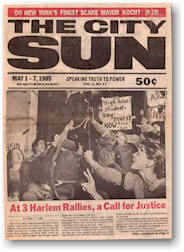
The City Sun
~ the goodbye ~
The City Sun published its first issue on 6 June 1984 out of Brooklyn, with a cover story called "Death of a Generation" by Errol Louis. The masthead carried the line "Speaking Truth to Power," and for twelve years that was the editorial program, taken literally. Andrew W. Cooper was the publisher and editor-in-chief. Utrice C. Leid, who helped found the paper with him, was the managing editor. It was a weekly, it covered African American life and politics in New York City, and the New York Times would later describe it as an aggressive competitor to the more staid Amsterdam News.
Cooper was 56 when he started it and had already done the thing he will be remembered longest for. He spent twenty years as an executive at the F. and M. Schaefer Brewing Company, from 1951 to 1971, and in the mid-1960s he became lead plaintiff in a federal suit challenging how Brooklyn's congressional districts were drawn. Bedford-Stuyvesant had been split across five districts, each one represented by a white member of Congress, which meant a large Black neighborhood was a minority everywhere and a majority nowhere. The case is remembered as Cooper v. Power. Combined with other litigation it produced New York's new twelfth congressional district, and in 1968 that district elected Shirley Chisholm, the first Black woman to serve in the United States Congress. Cooper founded the Trans-Urban News Service in 1977. The National Association of Black Journalists named him Journalist of the Year in 1987.
The paper's actual work was local and unrelenting. It covered the Eleanor Bumpurs killing in the autumn of 1984, Howard Beach in 1986, Tawana Brawley. In 1989 it printed the name of the Central Park jogger, a decision almost no other outlet made. The staff list reads like a roster of people who went on to run things: Armond White as arts editor, Errol Louis, Fern Gillespie, Tony Paige on sports, Clinton Cox in Albany, Isaiah Poole in Washington, Milton Allimadi, Peter Noel. Circulation ran around 18,500 in 1987, which is small, and the paper was never anything but broke. It emerged from Chapter 11 bankruptcy protection in December 1990.
By 1996 the State Department of Taxation and Finance had warrants out against Sun Publishing for roughly $380,000 in back taxes. On 21 October 1996, city marshals evicted the paper from its offices at 44 Court Street for unpaid rent and changed the locks on the third-floor newsroom. The staff were working on the next edition when it happened. When the Times checked in on 9 November, the paper had not published in three weeks and never published again.
~ the chronicle ~
| Born | 6 June 1984, lead story 'Death of a Generation' by Errol Louis |
|---|---|
| Peak | About 18,500 circulation in 1987 |
| Killed | October 1996 |
| Lifespan | 12 years |
| Made by | Andrew W. Cooper, with Utrice C. Leid as managing editor |
| Killed by | $380,000 in unpaid state taxes, then an eviction |
~ why it was always broke ~
Two explanations circulate and they are not in conflict. The money was never there: a Black weekly in Brooklyn in the 1980s had a readership advertisers did not value and a cost base identical to anyone else's. Staff routinely went unpaid, which former employees said plainly to the Times after the end, along with the harder judgment that Cooper had run the weekly into the ground.
The other explanation is about control. Milton Allimadi, a former reporter who now edits the Black Star News, said Cooper passed up investors because he did not want to lose control of the paper. Both of those things can be true of a man who sued over a congressional district map and won. Utrice Leid left in November 1992, and the people who were there say the paper never recovered the force it had with her in the newsroom.
~ what happened after ~
Cooper told the Times in November 1996 that he planned to dissolve the company and start over with a new one, and that he hoped to be publishing again by the middle of 1997. A buyout attempt that year failed. By 2002 the Times was calling The City Sun a defunct weekly, in the obituary it ran for Cooper, who died in Brooklyn on 28 January 2002 at the age of 74.
Wayne Dawkins wrote the book on him, City Son: Andrew W. Cooper's Impact on Modern-Day Brooklyn, published by the University Press of Mississippi in 2012. St. Francis College runs the Andrew W. Cooper Young Journalists in Training Program. The domain citysun.com now redirects to a tanning salon chain's regional page, which returns a 404.
~ twelve years that are hard to read ~
Here is the part that gets me about this one, and it is not about geography. I was twelve years old in Turkey when this paper shut, and a Brooklyn weekly was never going to reach me. But I got online in 1998 on dial-up, and my whole relationship with the foreign press started there, which means it started about eighteen months after The City Sun stopped printing.
So those twelve years sit just on the wrong side of the line. The New York State newspaper union list shows the New York Historical Society holding the 6 June 1984 issue. Searching for a digitization project turns up nothing. There is no archive site, no PDF run, no scanned set the way there is for the big city dailies that died with institutions behind them. Six hundred-odd issues of serious reporting on Howard Beach and Brawley and Bedford-Stuyvesant exist on paper and microfilm in a handful of buildings, and that is the whole of it. A newspaper that died in 1996 died one generation too early to be searchable, and that is a different kind of death from running out of money.
~ leave a rose ~
an anonymous tribute. one rose per visitor per day.
@}-->-- ... roses left here
~ leave a wreath ~
a rose fades by morning. a wreath stays on this grave for good, with your name on it.
paid once through stripe. payments are handled by OÜ Lakeview, the small company that keeps rip.so running. the money pays for the hosting and the nightly digging. adopt it and the headstone reads "maintained in memory by" you. the groundskeeper plants new wreaths at the next tending, usually within a day.
» one email a week: new graves and the anniversaries of the dead. subscribe
other news: Svět počítačů, PC Joker, Motion Picture Herald, Webwereld
also died in the 1990s: Borland Sidekick, Renegade Software, Teletype Corporation
~ leave a note ~
visitors before you have left these graveside notes. anonymous welcome.