Chicago Daily News
~ the eulogy ~
Melville E. Stone put out the first Chicago Daily News on 23 December 1875, with Percy Meggy and William Dougherty, and priced it at one cent, which made it the first penny paper in the city. Victor Lawson bought into it the following year and ran the business side. Stone left in 1888 and Lawson held the paper outright from then until his death in August 1925, which makes forty-nine years of one man in the building, thirty-seven of them with nobody above him.
The early circulation curve is the clean part of the story. Yearly averages went 22,037 in 1877, then 54,801 in 1880, then 132,957 in 1890, and 275,514 by 1898. After Lawson died a group led by Walter A. Strong bought the paper for $13.7 million, which was reported as the highest price ever paid for a newspaper to that date. Field Enterprises took it over in 1959 and moved it into the Sun-Times building at 401 North Wabash, so the two papers shared a plant and a company while competing on the street.
By the 1950s it was selling somewhere around 600,000 copies a day and it had won, depending on who is counting, thirteen or fifteen Pulitzer Prizes. From there circulation fell to roughly 327,000, for reasons that never once touched the paper's quality. Carl Sandburg had worked there. So had Ben Hecht, and later Mike Royko.
~ the dossier ~
| Born | 23 December 1875, founded by Melville E. Stone as Chicago's first penny paper |
|---|---|
| Peak | around 600,000 daily in the 1950s |
| Killed | Saturday 4 March 1978 |
| Lifespan | 102 years |
| Made by | Melville E. Stone, then Victor Lawson for half a century, then Field Enterprises |
| Killed by | the end of the American afternoon paper |
~ a daily paper for busy people ~
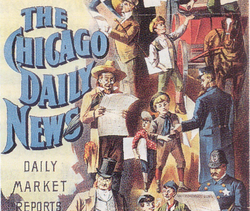
There is an advertising poster from 1901 that explains the product better than any history does. Across the top, in two colors of heavy display type: A DAILY PAPER FOR ONE CENT A DAY. Below that a crowd of Chicagoans reading it all at once, a policeman in uniform near a woman in a red dress, and in the middle a boy holding up a sheet that reads OVER 200,000 A DAY.
The small print is where the argument lives. The paper sells for one cent a day, the poster says, mailed for $3.00 a year, "this is $3.00 per year less than the price of any other Chicago morning paper." Then the pitch itself: it "is NOT a blanket-sheet. It is a condensed paper. You can read it and still have time left for an honest day's work. It is a DAILY PAPER FOR BUSY PEOPLE."
A newspaper in 1901 is selling you brevity, and it is selling brevity to a reader whose time and money are both already spoken for. The afternoon daily was always a product sized to whatever was left of a working day.
~ 123 correspondents ~
In 1898 Lawson opened one of the first foreign bureaus run by an American newspaper, and the Chicago Daily News Foreign Service grew from there into something no city paper had any business owning. At its height the paper had 123 cable correspondents abroad. Five Pulitzers went to members of the Foreign Service alone, including the 1929 prize for correspondence, and the paper's foreign report was regarded as first class from the 1930s through the 1950s.
Nothing in the news business now works like that. When I started reading news online from Turkey at the end of the 1990s, foreign coverage meant the wires: the same Reuters or AP paragraph on every site, nobody's own reporting anywhere in it. A newspaper serving one American city paying 123 people to live abroad and file home belongs to an economy that has since been dismantled. Readers did not stop wanting foreign news. The classified page stopped paying for it.
~ so long, Chicago ~
Marshall Field V made the decision. He read the staff a typewritten closure notice roughly four weeks out, and the paper kept publishing through every one of those weeks with everybody in the building already knowing. The last edition came out on Saturday 4 March 1978 under the banner SO LONG, CHICAGO. Three hundred jobs went with it.
The reasons given at the time are the same ones every American afternoon daily got: the readers had moved to the suburbs where the trucks could not reach them before dinner, and television had taken the evening. Much of the staff crossed the hall to the Sun-Times, Royko among them, so the newsroom partly survived its own paper. The masthead did not.
~ leave a rose ~
an anonymous tribute. one rose per visitor per day.
@}-->-- ... roses left here
~ leave a wreath ~
a rose fades by morning. a wreath stays on this grave for good, with your name on it.
paid once through stripe. payments are handled by OÜ Lakeview, the small company that keeps rip.so running. the money pays for the hosting and the nightly digging. adopt it and the headstone reads "maintained in memory by" you. the groundskeeper plants new wreaths at the next tending, usually within a day.
» one email a week: new graves and the anniversaries of the dead. subscribe
other news: Digitiser, .net magazine, The Industry Standard, GamesMaster
also died in the pre-1980s: Blast, Harper's Weekly, The Argus (Melbourne)
~ leave a note ~
visitors before you have left these graveside notes. anonymous welcome.