Borland Sidekick
» see borland.com as it lived, on the wayback machine
~ the obit ~
sidekick's peak years overlap with my early childhood, which puts it in the part of pc history i can read about but cannot personally remember. by the time i was a cs student in ankara in the early 2000s, the turbo pascal ide on the lab machines still had borland's name on it. sidekick the product was already a decade past its moment. our instructors talked about it the way older engineers talk about wordstar, more as a reference point than a tool anyone still used.
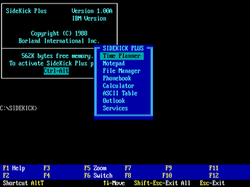
borland shipped sidekick in 1984 as one of the first commercially successful terminate-and-stay-resident programs on dos. you pressed ctrl-alt and a small panel appeared over whatever you were doing, a calculator, a notepad, a four-function calendar, an ascii table, an address book, a phone dialer that drove your modem. it was the same trick the mac would later do with desk accessories, only running inside the constrained memory of an ibm pc.
the product sold around a million copies in its first three years. by september 1985 borland had already moved four hundred thousand units. for a tool that mostly sat in the background waiting for a hotkey, that was a serious number. it gave borland the cash and the name recognition to launch turbo pascal at scale and to chase the database tier later. sidekick stayed in the catalog through the mid-nineties and got a sidekick 95 release that arrived alongside windows 95.
the windows version did not really matter the same way. windows already had a calculator and notepad, and the os let you keep multiple programs running on screen, which was the entire reason the tsr trick existed. starfish software ended up holding the rights, nokia bought starfish in 1998 for the contact-sync stack, and sidekick 99 was the last build to ship under the name. nokia let it fade rather than killing it on a specific date.
~ the rap sheet ~
| Born | 1984, $49.95 on a single floppy |
|---|---|
| Peak | 1985-1988 popup PIM standard on DOS |
| Killed | Sidekick 99 final release under Nokia |
| Lifespan | ~15 years across DOS, Windows, Mac |
| Made by | Borland, written by Bruce Webster and Niels Jensen |
| Killed by | Windows multitasking; the PIM category absorbed into the OS |
~ what a tsr was ~
i did not write tsrs, but the concept came up often enough in dos-era assembly courses that it stuck. a terminate-and-stay-resident program loaded into memory, returned control to the operating system, and then hooked an interrupt vector so it could wake itself back up when a key combination or timer event came in. it is the trick every memory-resident antivirus, mouse driver, and clipboard extender used through the late eighties.
sidekick was the application that made non-programmers understand why this was useful. it gave you a desk accessory model on a system that did not have desk accessories. that conceptual move, popup utilities over your real document, is the entire ancestry of modern shortcut launchers and command palettes.
~ what killed it ~
multitasking killed sidekick, not a competitor. once windows 3.x landed and people could keep calc and notepad open in their own windows, the entire reason for a tsr popup pim went away. the sidekick 95 and sidekick 98 releases tried to compete with outlook on contact and calendar features and were not really there. the original product had been about the dos constraint, and the constraint was gone.
borland the company sold off the personal productivity line to starfish software in the mid-nineties, more or less, to focus on developer tools where it was still credible. nokia acquired starfish in 1998 mostly for the truesync engine that synced phones with desktops. sidekick 99 was the last build, sold to a shrinking audience, and quietly retired afterwards.
~ what survived ~
sidekick is one of those products whose ideas got absorbed so completely that the original is invisible. every operating system since windows 95 ships with a calculator and notepad accessible from a shortcut. quickbar utilities like spotlight on mac or powertoys run on windows still occupy the popup-over-your-work slot sidekick defined. people who built launchbar or alfred were directly aware of what they were rebuilding.
the trademark portfolio ended up at t-mobile after nokia's brand sales, which is how the unrelated danger sidekick phone got to use the name a few years later. that one has its own grave on this site. the two sidekicks have nothing in common except an old borland lawyer letting the mark migrate.
~ leave a rose ~
an anonymous tribute. one rose per visitor per day.
@}-->-- ... roses left here
~ leave a wreath ~
a rose fades by morning. a wreath stays on this grave for good, with your name on it.
from $1, paid once through stripe. it keeps the graveyard running: the hosting and the nightly digging. adopt it and the headstone reads "maintained in memory by" you. the groundskeeper plants new wreaths at the next tending, usually within a day.
» one email a week: new graves and the anniversaries of the dead. subscribe
other software: Socratic, Yahoo Aviate, Bump, Google Trips
also died in the 1990s: Teletype Corporation, TURNET, Minuet
~ leave a note ~
visitors before you have left these graveside notes. anonymous welcome.