WordStar
~ the last words ~
wordstar sat in the part of computing history i can read about but cannot personally remember. by the time i learned what a word processor was, in a turkish school computer lab around 1996, the program on the screen was microsoft word. wordstar's peak years were 1979 to 1985, before i was old enough to read in any language. the first time i heard the name was years later, in a magazine piece about george r. r. martin's writing setup.
micropro international shipped wordstar in june 1979 for cp/m. rob barnaby wrote the original code, and the program's defining trick was the wordstar diamond, four ctrl-keys mapped to cursor movement so your hands never left the home row. on a 1980 keyboard with no arrow keys the diamond was a real productivity feature. on a 1990 keyboard with arrow keys it became muscle memory worth keeping anyway.
by 1984 micropro was the world's largest software company by revenue, with wordstar holding around twenty-three percent of the word processor market. the same year the company shipped wordstar 2000, a redesigned version that broke the muscle memory of its existing users and turned into an immediate disaster. wordperfect saw the opening and took the dos market through the second half of the 80s. word closed it out on windows once that platform had won. the final dos release shipped in december 1992. micropro renamed itself to chase other products and eventually folded the brand.
~ the record ~
| Born | June 1979 (CP/M release by MicroPro) |
|---|---|
| Peak | 23% of the word processor market in 1984; MicroPro briefly the world's largest software company |
| Killed | December 1992 (final DOS release, WordStar 7.0; no further updates) |
| Lifespan | 13 years of active development |
| Made by | MicroPro International, Rob Barnaby |
| Killed by | WordPerfect on DOS, then Microsoft Word on Windows |
~ what it was ~
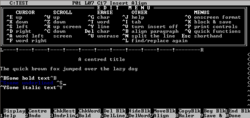
a wordstar document on screen looked nothing like a printed page. you typed into a text-mode terminal with no immediate font or italics rendering, and dot commands at the start of a line like.pn for page number controlled the layout. the screen was strictly a coding view of your manuscript. authors who learned this way describe it as the absence of distraction more than the presence of any feature.
the program ran on whatever you had. the cp/m versions installed onto 8-bit machines with 64k of ram, and the dos port ran on the original ibm pc. by the late 80s wordstar was on every business hardware tier from the kaypro luggable up. it was less a modern-feeling application than a piece of writing infrastructure that ran more or less anywhere a keyboard was plugged in.
~ the long tail ~
a small group of writers never left. george r. r. martin is the famous one, still typing his game of thrones manuscripts into wordstar 4.0 on a dos box he keeps off the internet. anne rice used it for years, and robert j. sawyer was reportedly still on version 7.0 going into the 2020s. the common pattern is genre-novelist working alone, valuing keystroke fluency above any modern feature.
the program is functionally abandonware now. micropro shut down in the 90s and the rights changed hands a couple of times before settling in a corner of corel's catalog. you can still find a copy and run it under dosbox if you want to see what writing looked like before the mouse won. most of the people who would do that are doing it for research, not for daily use.
~ what got buried with it ~
the diamond is gone, and so is the dot-command layout system, replaced by wysiwyg formatting that shows you the page directly. what is left is the principle that a writing tool should keep the writer's hands on the keyboard. vim users still recognize the lineage, even if they would never use a wordstar binary.
the deeper loss is the model where one piece of software defined what writing on a computer was. wordstar held that role for about six years, the way visicalc held it for spreadsheets. nothing has held that monopoly since. word is dominant but not exclusive, and the writing world is split across a dozen tools that share no common interface. the era of one writing program for everybody ended when wordstar lost it.
~ leave a rose ~
an anonymous tribute. one rose per visitor per day.
@}-->-- ... roses left here
~ leave a wreath ~
a rose fades by morning. a wreath stays on this grave for good, with your name on it.
from $1, paid once through stripe. it keeps the graveyard running: the hosting and the nightly digging. adopt it and the headstone reads "maintained in memory by" you. the groundskeeper plants new wreaths at the next tending, usually within a day.
» one email a week: new graves and the anniversaries of the dead. subscribe
other software: Perian, Excelsior JET, Microsoft Entourage, Quickoffice
also died in the 1990s: Sequent Computer Systems, Hercules Computer Technology, Commodore International
~ leave a note ~
visitors before you have left these graveside notes. anonymous welcome.