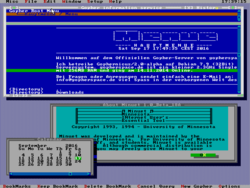
Minuet
~ the goodbye ~
Minuet stands for Minnesota Internet Users Essential Tool, which is the kind of name a university computing department gives something. It was an integrated internet package for MS-DOS, written by the microcomputer support people at the University of Minnesota because the software that existed was not good enough for the students in front of them. In 1994 the realistic options on a DOS machine were NCSA Telnet and NCSA FTP, both of them hard to configure and both of them teletype-shaped.
So they built the alternative, under constraints that read today like a list of jokes. It had to run on any PC with at least 384 kilobytes of memory, including an original 4.77 megahertz IBM PC. It had to have a graphical interface with a mouse. It could not require Windows. It had to need little or no configuration, and it had to multitask. They wrote it in Turbo Pascal on top of Turbo Vision, which gave them a fast character-mode interface and a window manager for almost nothing, and they wrote their own small multitasking kernel so an FTP transfer could run in one window while you typed an email in another.
I was ten years old in 1994 and four years away from a modem at home. The first time I connected to anything it was 1998, over a 14.4k line into a Turkish ISP, and the machine already had Windows with a dialer and a browser in it. Everything this program solved had been solved before I had the problem, which is why the DOS internet era reaches me only as file listings in archives.
~ the chronicle ~
| Born | 1994, at the University of Minnesota's microcomputer support department |
|---|---|
| Peak | around 1996, in use at colleges and institutions |
| Killed | 1996, as Windows 95 spread through the labs |
| Lifespan | about two years |
| Made by | the University of Minnesota, the campus that also produced Gopher |
| Killed by | Windows 95 bundling a TCP stack and a browser for free |
~ what was in it ~
Mail came over POP, with attachments encoded in BinHex or uuencode, since MIME was not yet the thing everyone agreed on. News looked like mail folders, and rather than pull down the full newsgroups list, which already ran to thousands of lines, Minuet asked a server to search for groups that matched what you wanted, turning a multi-minute startup into a few seconds. There was a Gopher client, which makes sense for software from the campus where Gopher was invented. The FTP client showed remote servers as a tree you could click through, at a time when most clients expected you to type cd and ls until you found the directory. The about box on the last beta carries a copyright line reading 1993, 1994 for the Regents of the University of Minnesota, so the work started a year earlier than the date usually given for it.
The web part arrived last and was honest about its limits. In version 1.0 Beta 18A the suite gained a browser speaking HTTP/1.0 against a pre-HTML 2.0 world, with no forms and no tables. What it did have, if you switched to graphics mode, was inline GIF and JPEG rendering, so images appeared in the page instead of launching a viewer. For a DOS browser in the mid nineties that was ahead of the field.
~ the dialer they had to write ~
Most people reaching the internet from a PC in 1994 did it over a modem, which meant SLIP, and the SLIP drivers then available were bad. They were difficult to configure, awkward to test, missing obvious features like dialing the phone, and they ignored the buffering the serial chips could do. The Minuet team wrote their own driver and their own dial-up program rather than ship on top of someone else's.
This is the detail that explains the whole project. A university support department looked at the commercial and free stacks available to it, decided every layer was inadequate, and wrote the layers. The result fit in a few hundred kilobytes and ran on hardware a department could already afford.
~ what killed it ~
Windows 95. The suite's usage peaked around 1996 and then fell away as Microsoft put a TCP/IP stack into the operating system and gave away a mail reader and a browser on top of it. Nobody needed a DOS program that dialed its own modem to read mail, and no university needed to maintain one.
There was no announcement and there is no shutdown date, because a free program from a campus support group does not get a press release. What the record holds is the trail: FOLDOC's entry, last touched in April 1995, points at beta 16 sitting on boombox.micro.umn.edu, the FTP host the university used for distribution. The last release was 1.0 Beta 18A. By the time the archive crawled that directory in the late nineties there was nothing in it but an admin folder.
~ leave a rose ~
an anonymous tribute. one rose per visitor per day.
@}-->-- ... roses left here
~ leave a wreath ~
a rose fades by morning. a wreath stays on this grave for good, with your name on it.
from $1, paid once through stripe. it keeps the graveyard running: the hosting and the nightly digging. adopt it and the headstone reads "maintained in memory by" you. the groundskeeper plants new wreaths at the next tending, usually within a day.
» one email a week: new graves and the anniversaries of the dead. subscribe
other browsers: Torch Browser, NetCaptor, Opera Turbo, Adblock Edge
also died in the 1990s: TURNET, Multiflow Computer, Borland Sidekick
~ leave a note ~
visitors before you have left these graveside notes. anonymous welcome.