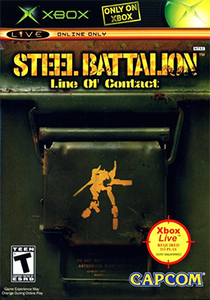
Steel Battalion: Line of Contact
~ the eulogy ~
Steel Battalion came out in 2002 and was already an absurd object: a Capcom mech simulator for the original Xbox that shipped in a box the size of a small suitcase, because the controller came with it. Line of Contact, released on 26 February 2004 in Japan and North America and on 26 March in Europe, was the sequel, and the sequel had no single-player mode at all. It was built by Capcom Production Studio 4 with Nude Maker, and the only way to play it was against other people over Xbox Live.
The requirements stacked up in a way nothing else on the console asked for. You needed an Xbox, the disc, a broadband connection, an Xbox Live subscription, and the controller, which had forty-four input points across two joysticks, a throttle, a radio channel dial, five switches, an eject button and three foot pedals. The box art carried a black banner reading LIVE ONLINE ONLY above the logo and a second note saying Xbox Live was required to play and sold separately. Nothing about the packaging was misleading.
Reviewers mostly liked it and the aggregate landed around seventy out of a hundred. Edge gave it eight out of ten and GameSpot 7.3, while Famitsu's four reviewers in Japan came to thirty out of forty. In Germany the servers crashed badly enough at launch that GamePro's German edition declined to score it. Matches were supposed to run ten players, five a side, and outside Japan the connection requirements meant most of them ran three on three.
~ the dossier ~
| Born | 26 February 2004 in Japan and North America, 26 March 2004 in Europe |
|---|---|
| Peak | ten players per match in Japan, mostly three against three everywhere else |
| Killed | 30 September 2005, campaign mode; free mission lasted until Xbox Live 1.0 closed on 15 April 2010 |
| Lifespan | 17 months of campaign |
| Made by | Capcom Production Studio 4 with Nude Maker |
| Killed by | a user base too small to justify the servers |
~ the controller ~
The controller is the reason anybody still remembers the series, and the eject button is the reason the controller is remembered. In the first game, taking fatal damage prompted you to eject, and if you did not hit the button in time your pilot died and the game deleted your save. Not the mission, and not back to a checkpoint: every unlocked machine and every hour of progress went with it. The button sat under a safety cover on the panel, and lifting that cover in time was the whole defense.
Starting a machine meant throwing switches in order before you could move. The design logic was that if a cockpit is going to be the whole premise, the cockpit should be inconvenient in the way a cockpit is. Capcom then took the same position a second time and built the sequel so that the only way to use any of it was to find strangers online, which narrowed the audience to people who owned the hardware and could also hold a broadband session.
~ seventeen months ~
Capcom announced in early September 2005 that the campaign was ending at the end of the month. A company representative put it plainly: current user base conditions were at a level where continuing the campaign mode service was no longer feasible. The shutdown ran between 10am and noon Pacific on Friday 30 September 2005, seventeen months after launch, and Capcom said Xbox Live support for free mission mode would continue. A patch followed with a code that unlocked every machine for use there, which was the only compensation available to somebody who had bought a game whose main mode had been switched off.
This one sat a long way from me and the distance is measurable rather than cultural. In 2004 I was at university in Turkey, and home broadband that could hold an Xbox Live session was still two years away for me; TTNet's connection arrived around 2006. The gaming I had access to was in internet cafes, which ran Counter-Strike on PCs and had no console in the building. A game that requires a console, a subscription service with limited reach, a broadband line and a dedicated peripheral has set four conditions on who is allowed to buy it, and in 2004 I failed three of them.
~ what still runs ~
Free mission mode outlived the campaign by four and a half years and then died with the whole platform: Microsoft shut down the original Xbox Live on 15 April 2010, which ended online play for every game on the console at once. After that the disc did LAN only, and a small number of people kept playing through XLink Kai tunnels, which is a lot of effort for a game that needs a suitcase of hardware per player.
Then in the 2020s a project called Insignia rebuilt Xbox Live 1.0 from scratch as a third-party service, and by late 2023 it supported around 150 titles. Steel Battalion: Line of Contact is one of them. Capcom's campaign is still gone and is not coming back, but the matches that remain can be played again by people who have kept a controller the size of a desk in working order for twenty years.
~ leave a rose ~
an anonymous tribute. one rose per visitor per day.
@}-->-- ... roses left here
~ leave a wreath ~
a rose fades by morning. a wreath stays on this grave for good, with your name on it.
from $1, paid once through stripe. it keeps the graveyard running: the hosting and the nightly digging. adopt it and the headstone reads "maintained in memory by" you. the groundskeeper plants new wreaths at the next tending, usually within a day.
» one email a week: new graves and the anniversaries of the dead. subscribe
other gaming: Online Pass, Gas Powered Games, Landmark, Personal Software Services
also died in the 2000s: SmartMedia, SeeqPod, Procomm Plus
~ leave a note ~
visitors before you have left these graveside notes. anonymous welcome.