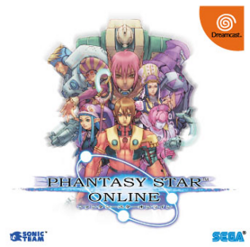
Phantasy Star Online
~ the goodbye ~
Phantasy Star Online was region locked at the phone line. The Dreamcast had a modem in the back and the modem dialed into a network Sega ran country by country, and the countries were a specific list that mine was not on. Whatever a Dreamcast was doing in Turkey in 2001, it was playing the half of this game that came on the disc.
Sonic Team shipped it in Japan on 21 December 2000, with Yuji Naka producing and Takao Miyoshi directing. North America got it on 30 January 2001 and Europe two weeks later. It moved 75,000 copies on its first day in the United States, which for a console game whose main argument was the internet was not a small statement about where consoles were going.
The design was modest on paper. Four players, real time combat, randomly assembled dungeons, loot at the end. What made it land was the lobby: a room where people stood around before a run and sized each other up before picking who they were going in with. Console games had been letting two people share a couch for twenty years. This was the first one where the other three were somewhere else entirely.
~ the chronicle ~
| Born | 21 December 2000, on Dreamcast in Japan |
|---|---|
| Peak | 235,000 registered players by April 2001, 26,000 on at once |
| Killed | 27 December 2010, the last Japanese Blue Burst server |
| Lifespan | ten years across four platforms |
| Made by | Sonic Team for Sega |
| Killed by | Sega, closing one platform at a time over seven years |
~ the breakout ~
By April 2001 there were 235,000 registered players worldwide with a peak of 26,000 on at the same time, numbers that a PC MMO of the period would have found respectable and a console had never produced at all. The Dreamcast was already dying commercially when this shipped, which gives the whole thing a strange quality: the best argument for the machine arrived after the machine had lost.
So it moved. A GameCube version in 2002, an Xbox version in 2003, then Blue Burst on Windows in 2004 in Japan and 2005 in the States. The console ports charged for a Hunter's License, around nine dollars a month, which made a Nintendo console into something you paid a subscription to use. That was not a normal thing to ask in 2002 and people paid it.
~ word select ~
The feature nobody talks about enough is the chat. Typing on a Dreamcast controller was miserable, and Sega's answer was a menu of preset phrases you assembled through a hierarchy, so you could say you needed healing or that you were going to the shop without touching a keyboard.
The clever part is that the phrases were stored as codes rather than as text. When your message arrived on someone else's screen it was rendered in whatever language their copy was running. A player in Osaka and a player in Ohio could coordinate a boss fight through the same menu and each read it in their own language, in 2001, over a dial-up modem plugged into a console. Every translation feature that has shipped in a game since is doing a more expensive version of that trick with worse results.
~ the long tail ~
Sega switched it off in pieces. North American Dreamcast servers went first on 30 September 2003. The remaining Dreamcast servers and the North American GameCube ones went together on 30 March 2007. Blue Burst in the West ended on 31 March 2008 and the North American Xbox servers three weeks after that. The Japanese Blue Burst service outlived all of it and closed on 27 December 2010.
It is one of the few dead online games where the answer is not simply that it is gone. Fan-run servers have been carrying every version of it for years, including the Dreamcast one, which means people are still dialing consoles into dungeons that Sega abandoned. The commercial descendant is Phantasy Star Online 2, and the design descendant is Monster Hunter, which took the four player hunt with loot at the end and built a much larger house on it.
~ leave a rose ~
an anonymous tribute. one rose per visitor per day.
@}-->-- ... roses left here
~ leave a wreath ~
a rose fades by morning. a wreath stays on this grave for good, with your name on it.
from $1, paid once through stripe. it keeps the graveyard running: the hosting and the nightly digging. adopt it and the headstone reads "maintained in memory by" you. the groundskeeper plants new wreaths at the next tending, usually within a day.
» one email a week: new graves and the anniversaries of the dead. subscribe
other gaming: 3DO Interactive Multiplayer, Sony Online Entertainment, TurboGrafx-16, WildStar
also died in 2010-2014: OpenSolaris, Mixi, Tenbit.pl
~ leave a note ~
visitors before you have left these graveside notes. anonymous welcome.