MILNET
~ the eulogy ~
MILNET sits in the part of internet history I can read about and never once touched. It had no public. By the time I got a modem in 1998 the name had already been retired, and even at its height there was no version of my life that came with an address on it. What it left in my internet was a hole I had no way of seeing.
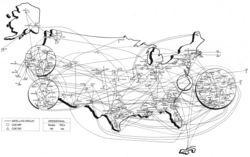
The Defense Communications Agency killed a program called AUTODIN II in 1982 and adopted Defense Data Network as the name for whatever would replace it. The split came the following year. ARPANET at that point ran on 113 interface message processors, and the majority of them, usually counted at 68, went to the military side. Sources have disagreed about the exact number since the day it happened. The Washington Post ran the story on 4 October 1983 under a headline about the Pentagon splitting a big computer network.
Nothing was severed in the way that phrase suggests. BBN had built both halves out of the same equipment and kept operating both, and gateways relayed mail across the boundary, so a researcher at a university could still write to somebody on a base. What changed was that the two networks now had separate reasons to exist and separate people deciding who was allowed on.
~ the dossier ~
| Born | 1983, as the military half of a split ARPANET |
|---|---|
| Peak | roughly 68 of ARPANET's 113 nodes at the moment of the split |
| Killed | 1995, renamed into NIPRNET as the Defense Data Network wound up |
| Lifespan | twelve years |
| Made by | the Defense Communications Agency, built and operated by BBN |
| Killed by | a rename |
~ the argument for cutting the wire ~
By 1983 ARPANET had spent fourteen years as a research network and had the habits of one. Accounts were handed out informally and hosts trusted each other by default. The security model amounted to everyone on it knowing somebody who knew you. That is a workable arrangement for a few dozen computer science departments. It is not one for a network with military installations hanging off it, and the Defense Communications Agency had been saying so for years before it got its way.
The fix was structural rather than technical. Nobody invented a firewall in 1983. They pulled the wire out and put a mail gateway back in, which is the same idea implemented in geography.
~ what it became ~
MILNET was one of four parallel networks under the Defense Data Network, each running at its own classification level. Unclassified traffic sat on MILNET. Above it were the DSNET networks, carrying secret material and then material that had its own vocabulary for how secret it was.
None of them died. In the 1990s MILNET was renamed NIPRNET, and the classified networks became SIPRNET and JWICS, which are the names still in service. The Defense Data Network as a program ran from 1983 to 1995 and then stopped being a program. The wires did not stop.
~ the name that outlived it ~
The visible remainder is.mil. Most of the original top-level domains describe what kind of thing you claim to be. This one describes which side of a 1983 decision your computer ended up on, and it is still enforced that way. You cannot buy one.
The other remainder is the shape. The internet's default assumption is that any host can reach any host, and the first large exception was made by the organization funding the whole experiment. The corporate intranet and the national firewall are later versions of the same move. MILNET just did it first, and did it with a wire cutter.
~ leave a rose ~
an anonymous tribute. one rose per visitor per day.
@}-->-- ... roses left here
~ leave a wreath ~
a rose fades by morning. a wreath stays on this grave for good, with your name on it.
from $1, paid once through stripe. it keeps the graveyard running: the hosting and the nightly digging. adopt it and the headstone reads "maintained in memory by" you. the groundskeeper plants new wreaths at the next tending, usually within a day.
» one email a week: new graves and the anniversaries of the dead. subscribe
other connectivity: Alltel, BOLT! Super 4G, Ciudad Internet, Nortel Networks
also died in the 1990s: Quarterdeck QEMM, Absolute Entertainment, Mercury Center
~ leave a note ~
visitors before you have left these graveside notes. anonymous welcome.