CSNET
~ the eulogy ~
My first internet was a modem dialing a number and then waiting to see what came back. CSNET was built on that same motion in 1981, seventeen years earlier and for a whole department at a time, because dialing a telephone was the only way in for people the real network would not admit.
The real network was ARPANET, and a connection to it required a Department of Defense research contract. Most computer science departments in the United States had no such thing. Lawrence Landweber at the University of Wisconsin wrote a proposal on behalf of a group of them, and in 1981 the National Science Foundation put up five million dollars for an initial three years to build the network for everyone left outside.
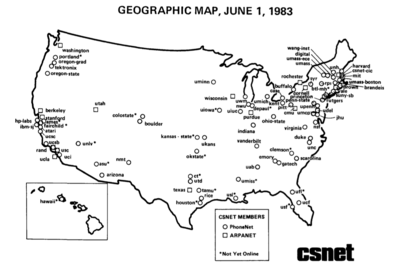
Three sites came up that first year. There were 24 by 1982 and 84 by 1984. It ended up with more than 180 institutions, around 60 percent of them universities. The international links reached as far as Japan and Australia. In 1986 JUNET in Tokyo got out of Japan for the first time by dialing into CSNET over a packet-switched circuit, which means a network built for the excluded ended up carrying another country's first hop abroad.
~ the dossier ~
| Born | 1981, on a five million dollar National Science Foundation grant |
|---|---|
| Peak | more than 180 institutions, about 60 percent of them universities |
| Killed | October 1991 |
| Lifespan | ten years |
| Made by | Lawrence Landweber at Wisconsin, for a consortium of computer science departments |
| Killed by | NSFNET, which admitted everyone it had been built to work around |
~ phonenet ~
The cheapest tier was called Phonenet and it was mail over ordinary telephone lines. Your machine dialed a relay host on a schedule, handed over what it was holding, took whatever was waiting and hung up. No permanent link and no packet switching at your end. If a department could afford a modem and a phone bill it was on the network, with a delivery time measured in hours rather than seconds.
Above that sat TCP/IP tunneled over X.25 for sites that could pay for a public data network, and a name service so mail could be addressed to a person instead of a route. The gateway into ARPANET is what made any of it worth having. A department with no defense contract could now write to one that had.
~ how it ended ~
By the end of the 1980s the exclusion CSNET existed to work around was gone. NSFNET and the regional networks under it would take anyone in higher education at speeds Phonenet could not pretend to match. In 1989 CSNET merged with BITNET into the Corporation for Research and Educational Networking, which is the sort of name an organization takes when both of its halves are finished.
The network shut down in October 1991. The Internet Society gave it the Jonathan B. Postel Service Award in 2009, eighteen years after it stopped existing, which is about the right delay for anyone to work out what a piece of infrastructure was actually for.
~ leave a rose ~
an anonymous tribute. one rose per visitor per day.
@}-->-- ... roses left here
~ leave a wreath ~
a rose fades by morning. a wreath stays on this grave for good, with your name on it.
from $1, paid once through stripe. it keeps the graveyard running: the hosting and the nightly digging. adopt it and the headstone reads "maintained in memory by" you. the groundskeeper plants new wreaths at the next tending, usually within a day.
» one email a week: new graves and the anniversaries of the dead. subscribe
other connectivity: Erols Internet, MIDnet, Greenpoint, Freei
also died in the 1990s: Brøderbund, ClariNet, Erols Internet
~ leave a note ~
visitors before you have left these graveside notes. anonymous welcome.