BITNET Relay
~ the obituary ~
Relay is the only chat program i know of that had to argue for its own right to exist on efficiency grounds. BITNET in 1985 was universities and government agencies strung together with leased telephone lines, and an entire campus could be hanging off one line or off a 4800 baud dial-up. Spending that on conversation was not a neutral act. Other chat experiments on the same network, one of them called Galaxy Network, were asked to shut themselves down for exactly this reason.
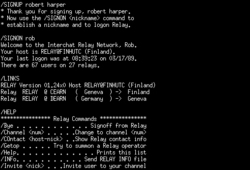
Jeff Kell wrote it at the University of Tennessee at Chattanooga in 1985, in REXX, and it ran under a special user ID called RELAY on a handful of BITNET hosts. You sent a message to that ID and got back a multi-user chat system organized into channels. The name came from a relay race, because a message traveled hop by hop between servers until it arrived rather than going straight to its destination.
Inside the United States a message landed in a few seconds. Internationally it varied, and if the link between two nodes was down BITNET did what BITNET always did, which was hold the message and forward it when the link came back up. That could be minutes. It could also be hours, which makes Relay one of the few chat systems where a line might reach you well after the conversation it belonged to had ended.
BITNET reached Turkey before the internet did, and it did not reach anybody's house. Ege University led the academic network here and the line to Italy went live in December 1986, with Middle East Technical and Boğaziçi among the universities that joined over the following year, roughly seven years ahead of the first real internet connection out of Ankara in April 1993. So Relay was running on Turkish university machines while i was two years old. It was a network you got onto by belonging to an institution, and by the time i had a modem in 1998 those institutions had long since handed everything over to TCP/IP.
~ the case file ~
| Born | 1985, written in rexx at the university of tennessee at chattanooga |
|---|---|
| Peak | the late 1980s, after virginia tech rewrote it in pascal |
| Killed | 1996, when cren ended support for bitnet |
| Lifespan | eleven years, plus one punctuation mark that outlived it |
| Made by | jeff kell |
| Killed by | tcp/ip |
~ proving it was not waste ~
The reason Relay survived the resource argument is in its architecture. A naive chat server sends one copy of every message to every participant, so ten people on one channel at ten different sites means ten separate transfers across the expensive links. Relay ran as a mesh of peer servers that passed a single copy along a route and fanned it out at the far end. The bandwidth saving was the political argument, and the political argument is why administrators left it alone.
It got faster twice. Valdis Kletnieks at Virginia Tech rewrote it in Pascal in the late 1980s and cut the CPU time hard enough that more sites could afford to host a server. Smart Relay in the early 1990s improved how messages were delivered. Both changes were about the same thing, which was keeping the program under the threshold where somebody senior would start asking what it cost to run.
~ the slash ~
Type a slash into Slack or into IRC and you are using a convention that came out of this program. A message sent to the RELAY user ID was either something to say or something to do, and the code needed a cheap way to tell the two apart, so anything starting with a forward slash was a command and everything else was speech. That is one person solving a parsing problem in 1985. It is now in every chat product on earth, including plenty whose engineers have never heard the word BITNET.
~ what jarkko took ~
Jarkko Oikarinen wrote IRC at the University of Oulu in 1988 and has said plainly that BITNET Relay is where the idea came from. He originally wanted to link the two systems together. That never happened, and IRC ended up as the thing that replaced Relay rather than the thing that extended it, which is the ordinary fate of software written on a network that is about to be superseded.
The inheritance is easy to trace. Channels, and a server-to-server mesh instead of one central host. IRC did both over TCP/IP, where the bandwidth question that had shaped every design decision in Relay was no longer the first thing anybody asked, and it kept the slash as well.
~ how a network comes apart ~
BITNET merged with CSNET in 1991 and the combined organization, CREN, built BITNET II to run over TCP/IP, which was already an admission about which network had won. CREN ended support for BITNET in 1996 and that is the date on this grave, though it is not a shutdown in any clean sense. Individual sites stayed free to keep their lines up as long as they were willing to pay for them.
So it thinned instead of stopping. Nodes dropped away, and each departure cut some surviving part of the network off from some other part, until what was left was fragments that could not reach each other. By 2007 nothing was operating. There is no last message and no closing announcement, because a store-and-forward network does not end so much as run out of places to forward to.
Jeff Kell died on 25 November 2015. The notices that reached technical audiences described him as the man who wrote the thing IRC came from, which he was, and which he had already written up himself in 1987 in a paper called Relay: Past, Present, and Future.
~ leave a rose ~
an anonymous tribute. one rose per visitor per day.
@}-->-- ... roses left here
~ leave a wreath ~
a rose fades by morning. a wreath stays on this grave for good, with your name on it.
from $1, paid once through stripe. it keeps the graveyard running: the hosting and the nightly digging. adopt it and the headstone reads "maintained in memory by" you. the groundskeeper plants new wreaths at the next tending, usually within a day.
» one email a week: new graves and the anniversaries of the dead. subscribe
other protocols: Context.IO, Microsoft Notification Protocol, OpenSocial, SDCH
also died in the 1990s: Sega CDX, Apple Bandai Pippin, Gravis UltraSound
~ leave a note ~
visitors before you have left these graveside notes. anonymous welcome.