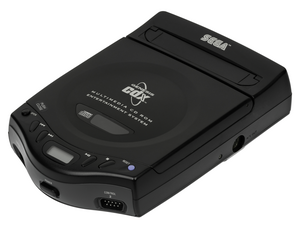
Sega CDX
~ the eulogy ~
sega cdx was a north american console at us four hundred dollars in 1994. that was about half the monthly minimum wage in turkey at the time. the cdx never reached me at any layer. when i first got online in 1998 i was on a 14.4k modem in ankara reading text-mode irc and downloading shareware off bbs lists, not buying us-import consoles. the cdx had been discontinued for two years by then.
the device itself was a combined genesis and sega cd unit in a single small case slightly larger than a discman. you could plug a controller in and play cartridge games. you could load a sega cd disc and play sonic cd or night trap. honestly, you could pop in a regular audio cd and use it as a portable cd player with an lcd track display. it weighed about two pounds. the headphone jack worked. the bundled software was sonic cd, the sega classics arcade collection, and ecco the dolphin on cd.
the catch was the price. a regular genesis and sega cd set bought separately in 1994 cost roughly three hundred dollars combined. the cdx asked for a hundred dollars more for the portability angle and the all-in-one case. the sega cd attach rate was already weak by 1994 because the library was thin and the full motion video games on it were widely regarded as bad. the cdx asked the buyer to commit harder to that same library at a premium.
~ the dossier ~
| Born | April 1994 in North America at $399.95 |
|---|---|
| Peak | Late 1994 holiday season as the all-in-one Genesis hardware |
| Killed | 1996 with the Sega CD lineup |
| Lifespan | About 2 years |
| Made by | Sega of America |
| Killed by | The Saturn launch and the Sega CD failing as a category |
~ the origin ~
in europe and japan the same hardware was sold as the multi-mega. brazil got it through tec toy with a localized release. the multi-mega did somewhat better in european markets where the sega cd carried a different cultural weight than it did in north america, though sales were still in the low tens of thousands rather than anything mass-market.
the portability framing made some sense on paper. you could carry it to a friend's house and only plug it into a television. the discman framing was also a real selling point in 1994 before mp3 players. but the people who already had a discman did not need a more expensive one with a cartridge slot. and the people who wanted a sega cd were the small slice of genesis owners who had already been willing to spend the original three hundred.
~ the unraveling ~
the sega cd as a category never recovered after late 1993. the launch lineup was uneven. the cd-rom-as-storage-medium pitch did not translate into much better games because most of the disc capacity went to full motion video clips that aged badly inside a year. by 1995 sega's attention was on the saturn, which would launch in north america at e3 in may 1995. resources moved off the genesis-and-cd ecosystem.
the cdx never got a price cut large enough to fix the premium-pricing problem. by mid-1995 it was being closed out at clearance prices in some retailers. the formal discontinuation came in 1996, alongside the rest of the sega cd hardware. honestly, the inventory clearance dragged into 1997 in some stores.
~ what it became ~
i was not there for any of this and i learned the cdx existed years later through retro-handheld and sega-history youtube channels. the device is now a collector item with a small premium for working units because the optical drive was fragile and the laser had a known drift problem after a few years of use. a cared-for cdx today sells for somewhere between three hundred and six hundred dollars on enthusiast secondary markets, which is approximately the launch price.
the cdx sits in a small category of console-handheld hybrids that sega kept trying. in those days. the nomad came two years later with the same logic for cartridges (or whatever it ended up being called). neither one outsold the standalone hardware they were combining. that pattern repeated until sega exited the hardware business after the dreamcast.
~ leave a rose ~
an anonymous tribute. one rose per visitor per day.
@}-->-- ... roses left here
~ leave a wreath ~
a rose fades by morning. a wreath stays on this grave for good, with your name on it.
paid once through stripe. payments are handled by OÜ Lakeview, the small company that keeps rip.so running. the money pays for the hosting and the nightly digging. adopt it and the headstone reads "maintained in memory by" you. the groundskeeper plants new wreaths at the next tending, usually within a day.
» one email a week: new graves and the anniversaries of the dead. subscribe
other gaming: Apple Bandai Pippin, Princess Connect!, Atari Games, Lionhead Studios
also died in the 1990s: Apple Bandai Pippin, Gravis UltraSound, BITNET Relay
~ leave a note ~
visitors before you have left these graveside notes. anonymous welcome.