Kilobaud Microcomputing
~ the goodbye ~
Kilobaud was written for people who were building the computer, not operating it. Don Lancaster wrote up a cheap video display for the Heathkit H-8, which was itself a computer you assembled from a box of parts, and in May 1982 somebody wrote up the ZX-81 kit the same way. Where BYTE was for readers interested in computers, Kilobaud was for readers interested in soldering them, which is a narrower room and in 1977 it was a room that was filling up fast.
The timing was close to perfect. January 1977 is the month it launched into, and that year brought the TRS-80 and the Apple II, with the Commodore PET ahead of both. Wayne Green had been to see the manufacturers and the first issue carried his account of the trip, including one of the earliest mentions of Apple Computer in a magazine anybody outside the hobby read. The second issue ran five pages on the Apple I by Sheila Clarke. Green got Steve Jobs and Steve Wozniak the wrong way round on who designed the machine, which is the kind of mistake you can only make that early.
Its best idea was the one that finished it. So much TRS-80 material was coming in that Green split it off into 80 Microcomputing in January 1980, and that magazine passed its parent in pages and subscribers. The future belonged to titles about one machine. Kilobaud had invented that pattern and then stood in the path of it, and by the early 1980s the readers who wanted to build their own 8-bit machine from parts had mostly either stopped or become professionals.
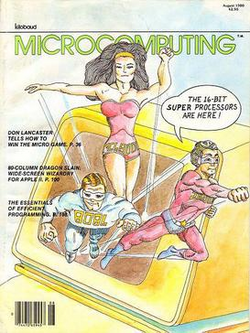
I was not born when the first issue went out and I was an infant when the last one did. The copy I have looked at is the August 1980 cover, which has a painted woman in a cape riding a 16-bit processor like a surfboard, and the word kilobaud up in the corner at roughly a tenth the size of MICROCOMPUTING.
~ the chronicle ~
| Born | January 1977, fourteen months after Wayne Green lost BYTE |
|---|---|
| Peak | One of the three computer magazines of the 1970s, alongside BYTE and Creative Computing |
| Killed | November 1984 |
| Lifespan | Ninety-five monthly issues under three versions of the title |
| Made by | Wayne Green out of Peterborough, New Hampshire, sold to CW Communications in late 1983 |
| Killed by | The kit-building market drying up, and magazines written for one machine each |
~ the byte divorce ~
In November 1975 Green came into his own office and found that his ex-wife and the BYTE staff had moved out of it and taken the January issue with them. The January 1976 issue went out with Virginia Green listed as publisher. He wanted to name the replacement KiloByte to needle them, and the BYTE people registered KILOBYTE as a cartoon strip inside their own magazine to stop him. His line about it in 73 was that he would rather spend the money on a better magazine than on lawsuits. The resulting title measured a thousand symbols per second, which is not a thing a magazine can be, and he said as much.
~ the name that kept shrinking ~
It began as plain Kilobaud in January 1977. By the January 1979 issue the cover said Kilobaud Microcomputing. Then the first word got smaller every year until it disappeared, and accounts of when disagree: Matthew Reed puts the vanishing at 1982, and Call-A.P.P.L.E. has it clinging on at a tenth size until the December 1983 issue, with January 1984 the first one headed only Microcomputing.
The ending is dated better than the renaming. Wikipedia's infobox says 1983 and the magazine itself says otherwise: the January 1984 issue is number 85, which puts the final one, November 1984, at ninety-five. Both Reed and the Computer History Museum's holdings stop there.
~ what wayne green sold ~
In late 1983 Green sold Wayne Green Inc. to CW Communications, which became IDG, for a figure InfoWorld put at sixty million dollars. Microcomputing went with it, along with four other titles. His Publisher's Remarks column kept running in Microcomputing after the sale, which it did not in 80 Micro or Hot CoCo.
He bought 73 back from them in 1986 and published it until 2003. He died on 13 September 2013, aged 91. The magazine he started to settle a score with his ex-wife ran ninety-five issues. The one he lost to her ran in print until July 1998.
~ leave a rose ~
an anonymous tribute. one rose per visitor per day.
@}-->-- ... roses left here
~ leave a wreath ~
a rose fades by morning. a wreath stays on this grave for good, with your name on it.
paid once through stripe. payments are handled by OÜ Lakeview, the small company that keeps rip.so running. the money pays for the hosting and the nightly digging. adopt it and the headstone reads "maintained in memory by" you. the groundskeeper plants new wreaths at the next tending, usually within a day.
» one email a week: new graves and the anniversaries of the dead. subscribe
other news: Slashfood, True/Slant, Business 2.0, JWN (全国新聞ニュース網)
also died in the 1980s: Calma, Mattel Aquarius, Xonox
~ leave a note ~
visitors before you have left these graveside notes. anonymous welcome.