Interface Age
~ the obit ~
I was born in 1984. Interface Age printed its last issue that September, which puts the entire run of it outside anything I could have an opinion about. What there is instead is a scanned run of it on the Internet Archive, about a hundred items, the earliest dated December 1975.
It began as SCCS Interface, the newsletter of the Southern California Computer Society, in a period when a computer club newsletter was where you learned what computing was doing, because nothing else carried it. Robert S. Jones offered to turn it into a real magazine: he would carry the costs of publishing and marketing, the society would supply a substantial share of the editorial, and they would split what came back. The society did not supply the editorial. Jones ended up commissioning all of it through his own writers, then ended the arrangement entirely and kept the magazine, which continued its volume numbering straight through the break and appeared under the name Interface Age from Volume 1, issue 9.
The tagline on the cover was "published for the home computerist", a word that did not survive. Like every magazine of that moment it ran type-in BASIC listings, pages of source code you keyed in by hand and debugged by comparing your typos against the printed page. That was the normal way software reached a home computer in 1977. It makes the magazines of this era primary documents rather than commentary on them.
~ the rap sheet ~
| Born | August 1976, after a newsletter run that began in December 1975 |
|---|---|
| Peak | May 1977, the issue with the first Floppy ROM bound inside it |
| Killed | September 1984 |
| Lifespan | 8 years under its own name |
| Made by | Robert S. Jones |
| Killed by | No cause on record. The last issue is dated September 1984 |
~ the record in the middle of the magazine ~
The May 1977 issue did something nobody else was doing. Bound into it was a flexi disc, the floppy vinyl sound sheet that record labels used to give away, playing at 33 and a third. On it were about six minutes of audio encoded in the Kansas City standard, the agreed scheme for writing bytes as tones onto a cassette. You put the sheet on a turntable, ran the output into your machine the way you would run a tape, and what came off it was a BASIC interpreter for the 6800, credited to Robert Uiterwyk.
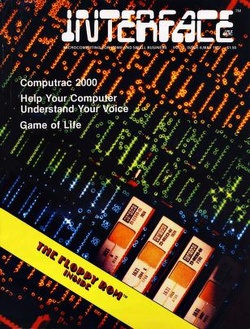
The magazine called it a Floppy ROM, and the cover of that issue shouts it from a yellow banner across the bottom corner, above a photograph of circuit boards and under cover lines about making your computer understand your voice. Nothing about the idea was unsound. A flexi disc cost almost nothing to press and bind, and a magazine that could ship working software to every subscriber at once had solved a real distribution problem years before anyone could reasonably mail a floppy.
It never became the standard. A few other magazines used the trick into the early 1980s. Then cover-mounted cassettes, and later disks, did the job properly. But for a few years the fastest way to get a BASIC interpreter into an American living room was to play a record at it.
~ the society that stopped filing copy ~
You still see that founding arrangement, in other industries and under other names. A volunteer organization with all the expertise agrees to supply content to a commercial partner with all the money, and then discovers that writing to a monthly deadline is a job rather than a hobby. Jones did not get his free editorial and had to build a real masthead instead.
By 1984 the market Interface Age was created to serve had changed out from under it. The audience was no longer a few thousand people who had soldered their own machines and wanted a BASIC interpreter on any medium you could hand them; it was millions of people with a Commodore or an Apple who wanted to know which software to buy. The magazines that made that turn lasted into the next decade. No source gives a reason for this one closing, only the date on the last issue.
~ leave a rose ~
an anonymous tribute. one rose per visitor per day.
@}-->-- ... roses left here
~ leave a wreath ~
a rose fades by morning. a wreath stays on this grave for good, with your name on it.
paid once through stripe. payments are handled by OÜ Lakeview, the small company that keeps rip.so running. the money pays for the hosting and the nightly digging. adopt it and the headstone reads "maintained in memory by" you. the groundskeeper plants new wreaths at the next tending, usually within a day.
» one email a week: new graves and the anniversaries of the dead. subscribe
other news: PLAY Magazine, Beacon Reader, Breaking News, News360
also died in the 1980s: Vectrex, NABU Network, TI-99/4A
~ leave a note ~
visitors before you have left these graveside notes. anonymous welcome.