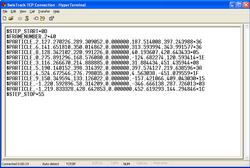
HyperTerminal
~ the goodbye ~
HyperTerminal was in the start menu of every Windows machine i used between 1998 and 2005, two folders deep under Accessories, and i had nothing to dial with it. The program was built for one motion: you gave it a phone number and a computer somewhere answered you in text.
Hilgraeve wrote it. The company started in 1980 in Monroe, Michigan, and took its name from the first three letters of the founders' surnames. Its first product was HyperACCESS, a terminal program for Heath 8-bit machines, ported to the IBM PC in 1985. IBM bundled a reduced version called HyperAccess Lite with OS/2 Warp in 1994, and Microsoft did the same thing a year later with a version renamed HyperTerminal.
What Microsoft shipped was deliberately small. It emulated a few terminal types and moved files with zmodem and the older protocols underneath it. It also carried one option that turned out to matter more than the rest: a direct connection that skipped the modem entirely and spoke straight at a serial port.
By the time i got online, on a modem in Turkey in 1998, the number you dialed belonged to an ISP and Dial-Up Networking handled the call without ever showing you a terminal window. HyperTerminal was a door into a world that had shut a year or two before i arrived. i knew exactly where it lived in the menu and never had a number that would answer it.
~ the chronicle ~
| Born | 24 August 1995, bundled with Windows 95 under license from Hilgraeve |
|---|---|
| Peak | shipped on every consumer Windows release from 95 to XP, filed under Accessories then Communications |
| Killed | 30 January 2007, Windows Vista reached consumers without it |
| Lifespan | eleven years inside Windows |
| Made by | Hilgraeve of Monroe, Michigan, licensed to Microsoft |
| Killed by | Vista's housecleaning, and a world with nothing left to dial |
~ the second life ~
The direct-connect option is why the program outlived its reason for existing. Every managed switch and industrial controller of that era had a console port on the front, and the way you reached it was a serial cable and a terminal emulator set to 9600 baud. HyperTerminal was already installed. For about a decade it was the default first tool of anyone whose job involved configuring hardware that had no screen.
The other survival was diagnostic. Point it at the modem instead of at a phone number and you could type AT commands directly, which is how you found out whether the hardware was alive before blaming the phone line.
~ how it ended ~
Vista went to business customers on 30 November 2006 and to everyone else on 30 January 2007, and the Communications folder was gone. Microsoft shipped nothing in its place. The support answer for years afterward was to buy the paid edition from Hilgraeve or install somebody else's software, which in practice meant PuTTY for people who wanted it free and Tera Term for people who wanted the serial handling.
~ the long tail ~
Hilgraeve is still there and still sells HyperTerminal Private Edition, so what died in 2007 was the Windows accessory rather than the product. That distinction matters less than it sounds. Nobody paid for a terminal emulator because it was good. It was in front of them, and the moment it stopped being in front of them almost everyone switched to whatever was free.
The modem it was written for is gone and the serial port it fell back on is not. Console cables are still sold, still the answer when a device will not come up on the network.
~ leave a rose ~
an anonymous tribute. one rose per visitor per day.
@}-->-- ... roses left here
~ leave a wreath ~
a rose fades by morning. a wreath stays on this grave for good, with your name on it.
from $1, paid once through stripe. it keeps the graveyard running: the hosting and the nightly digging. adopt it and the headstone reads "maintained in memory by" you. the groundskeeper plants new wreaths at the next tending, usually within a day.
» one email a week: new graves and the anniversaries of the dead. subscribe
other software: Aviary, Adobe FormsCentral, Project Looking Glass, Traf-O-Data
also died in the 2000s: MobShop / Accompany, Project Looking Glass, MapBlast
~ leave a note ~
visitors before you have left these graveside notes. anonymous welcome.